
Close Menu
    Facebook X (Twitter) Instagram
    SciTechDaily
    • Biology
    • Chemistry
    • Earth
    • Health
    • Physics
    • Science
    • Space
    • Technology
    Facebook X (Twitter) Pinterest YouTube RSS
    SciTechDaily
    Home»Space»Hubble Data Reveals a New Neptune Moon
    Space

    Hubble Data Reveals a New Neptune Moon

    By Hubble Space TelescopeJuly 16, 2013No Comments4 Mins Read
    Facebook Twitter Pinterest Telegram LinkedIn WhatsApp Email Reddit
    Share
    Facebook Twitter LinkedIn Pinterest Telegram Email Reddit
    Hubble Discovers a New Moon
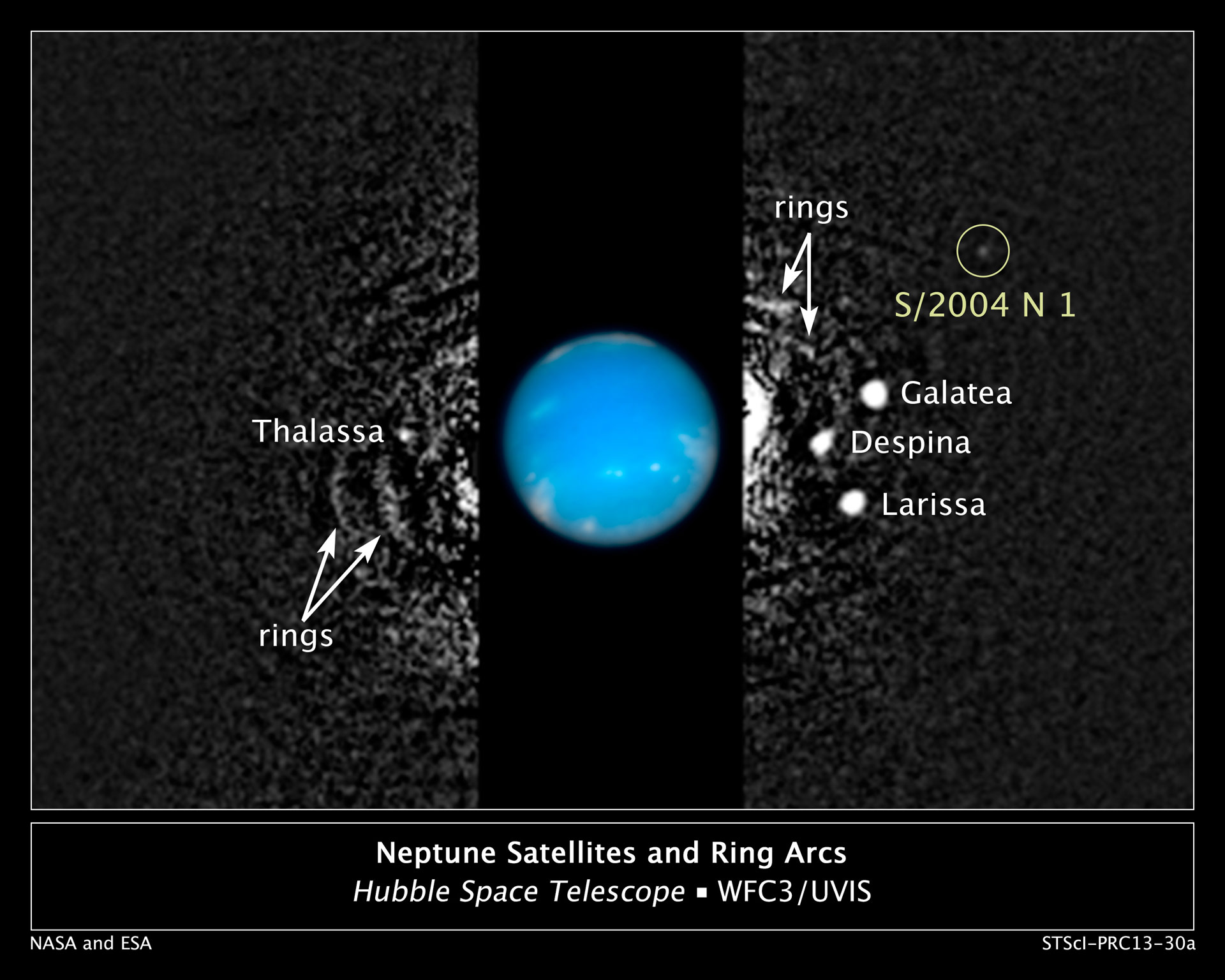
    This composite Hubble Space Telescope picture shows the location of a newly discovered moon, designated S/2004 N 1, orbiting the giant planet Neptune, nearly 3 billion miles from Earth. The moon is so small (no more than 12 miles across) and dim, it was missed by NASA’s Voyager 2 spacecraft cameras when the probe flew by Neptune in 1989. Several other moons that were discovered by Voyager appear in this 2009 image, along with a circumplanetary structure known as ring arcs.
    Mark Showalter of the SETI Institute discovered S/2004 N 1 in July 2013. He analyzed over 150 archival Neptune photographs taken by Hubble from 2004 to 2009. The same white dot appeared over and over again. He then plotted a circular orbit for the moon, which completes one revolution around Neptune every 23 hours.
    The black-and-white image was taken in 2009 with Hubble’s Wide Field Camera 3 in visible light. Hubble took the color inset of Neptune on August 19, 2009. Credit: NASA, ESA, and M. Showalter (SETI Institute)

    While analyzing Neptune photos taken by the Hubble Space Telescope, an astronomer discovered a new moon orbiting Neptune. Designated S/2004 N 1, the new moon is located between the orbits of the moons Larissa and Proteus and completes one revolution around Neptune every 23 hours.

    NASA’s Hubble Space Telescope has discovered a new moon orbiting the distant blue-green planet Neptune. This brings the number of known satellites circling the giant planet to 14.

    The body is estimated to be no more than 12 miles (19 kilometers) across, making it the smallest known moon in the Neptunian system. It’s so small that it escaped detection by NASA’s Voyager 2 spacecraft, which flew by Neptune in 1989 and surveyed the planet’s system of moons and rings.

    Mark Showalter of the SETI Institute in Mountain View, California, discovered the moon on July 1, while studying the faint ring-arcs of Neptune. “The moons and arcs orbit very quickly, so we had to devise a way to follow their motion in order to bring out the details of the system,” he said. “It’s the same reason a sports photographer tracks a running athlete — the athlete stays in focus, but the background blurs.”

    On a whim, Showalter extended his analysis outward to regions well beyond the ring system, and noticed an extra white dot about 65,400 miles from Neptune, located between the orbits of the moons Larissa and Proteus.

    Showalter next analyzed over 150 archival Neptune photographs taken by Hubble from 2004 to 2009. The same white dot appeared over and over again. He then plotted a circular orbit for the moon, which completes one revolution around Neptune every 23 hours.

    Orbit of Neptunes Newly Discovered Moon
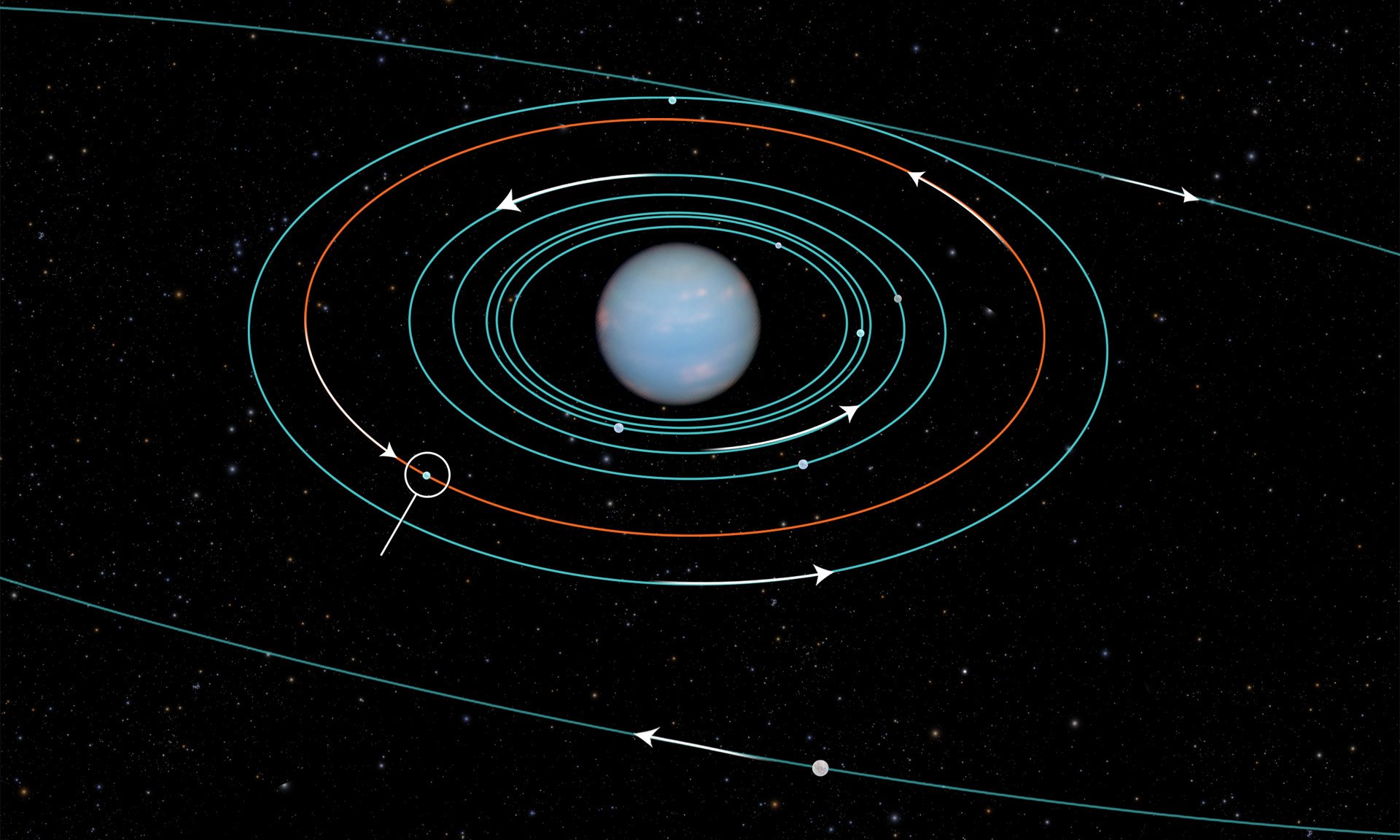
    This diagram shows the orbits of several moons located close to the planet Neptune. All of them were discovered in 1989 by NASA’s Voyager 2 spacecraft, with the exception of S/2004 N 1, which was discovered in archival Hubble Space Telescope images taken from 2004 to 2009. The moons all follow prograde orbits and are nestled among Neptune’s rings (not shown).
    The outer moon Triton was discovered in 1846 — the same year the planet itself was discovered. Triton’s orbit is retrograde, suggesting it is a captured Kuiper Belt object and therefore a distant cousin of Pluto. The inner moons may have formed after Triton’s capture several billion years ago. Credit: NASA, ESA, and A. Feild (STScI)

    The moon, designated S/2004 N 1, is so small and dim that it is roughly one hundred million times fainter than the faintest star that can be seen with the naked eye.

    Neptune’s largest moon, Triton, which is nearly the size of Earth’s moon, maybe a captured icy dwarf planet from the Kuiper Belt at the outer rim of our solar system. This capture would have gravitationally torn up any original satellite system Neptune possessed. Many of the moons now seen orbiting the planet probably formed after Triton settled into its unusual retrograde orbit about Neptune.

    Never miss a breakthrough: Join the SciTechDaily newsletter.
    Follow us on Google and Google News.

    Astronomy Hubble Space Telescope Moon NASA Neptune Planetary Science Popular
    Share. Facebook Twitter Pinterest LinkedIn Email Reddit

    Related Articles

    A Tale of Four Worlds: Hubble’s Ten-Year Hunt for Secrets in the Outer Solar System

    Hubble Telescope Close-up of the Red Planet

    Hubble Reveals a Dry Atmosphere Around Super-Earth 55 Cancri e

    Hubble at 25 Series: How Hubble Has Helped Pave the Way for Interplanetary Missions

    NASA Spacecraft Confirms Existence of Neon in Lunar Atmosphere

    NASA’s GRAIL Mission Solves a Lunar Mystery Almost as Old as the Moon Itself

    Hubble Detects Water Vapor Over Jupiter’s Moon Europa

    Hubble Finds Signatures of Water on Distant Exoplanets

    New Study Revives Doubted Exoplanet Fomalhaut b

    Leave A Reply Cancel Reply

    • Facebook
    • Twitter
    • Pinterest
    • YouTube

    Don't Miss a Discovery

    Subscribe for the Latest in Science & Tech!

    Trending News

    First-of-Its-Kind Discovery: Homer’s Iliad Found Embedded in a 1,600-Year-Old Egyptian Mummy

    Beyond Inflammation: Scientists Uncover New Cause of Persistent Rheumatoid Arthritis

    A Simple Molecule Could Unlock Safer, Easier Weight Loss

    Scientists Just Built a Quantum Battery That Charges Almost Instantly

    Researchers Unveil Groundbreaking Sustainable Solution to Vitamin B12 Deficiency

    Millions of People Have Osteopenia Without Realizing It – Here’s What You Need To Know

    Researchers Discover Boosting a Single Protein Helps the Brain Fight Alzheimer’s

    World-First Study Reveals Human Hearts Can Regenerate After a Heart Attack

    Follow SciTechDaily
    • Facebook
    • Twitter
    • YouTube
    • Pinterest
    • Newsletter
    • RSS
    SciTech News
    • Biology News
    • Chemistry News
    • Earth News
    • Health News
    • Physics News
    • Science News
    • Space News
    • Technology News
    Recent Posts
    • NASA Powers Down Voyager 1 Instrument As It Fights To Survive Deep Space
    • Physicists Propose Strange Experiment Where Time Goes Quantum
    • Scientists Flip Immune System “Switch,” Uncover Surprising Path To Stop Gut Inflammation
    • Magnesium Magic: New Drug Melts Fat Even on a High-Fat, High-Sugar Diet
    • Weight-Loss Drugs Like Ozempic May Come With an Unexpected Cost
    Copyright © 1998 - 2026 SciTechDaily. All Rights Reserved.
    • Science News
    • About
    • Contact
    • Editorial Board
    • Privacy Policy
    • Terms of Use

    Type above and press Enter to search. Press Esc to cancel.