
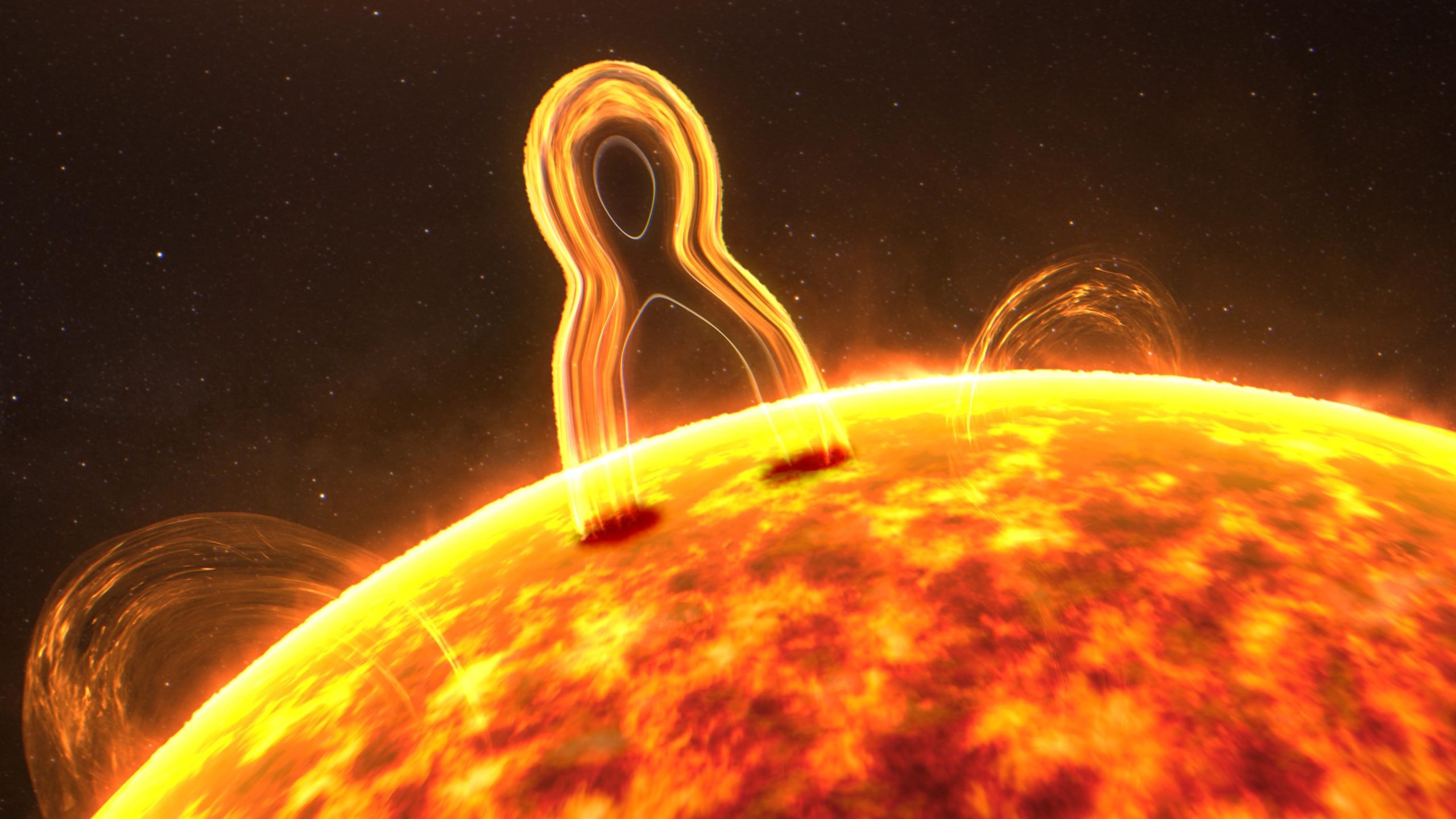
Researchers identify the physics that enables rapid magnetic explosions in space.
When magnetic field lines of opposite directions merge, they create explosions that can release tremendous amounts of energy. The merging of opposing field lines on the sun creates solar flares and coronal mass ejections, which are massive blasts of energy that can travel to Earth in less than a day.
While the general mechanics of magnetic reconnection are well understood, researchers have struggled for over a half-century to explain the precise physics behind the rapid energy release that occurs.
A new Dartmouth research study published yesterday (April 28, 2022) in the journal Communications Physics provides the first theoretical description of how a phenomenon known as the “Hall effect” determines the efficiency of magnetic reconnection.
“The rate at which magnetic field lines reconnect is of extreme importance for processes in space that can impact Earth,” said Yi-Hsin Liu, an assistant professor of physics and astronomy at Dartmouth. “After decades of effort, we now have a full theory to address this long-standing problem.”
Magnetic Reconnection in Natural Plasmas
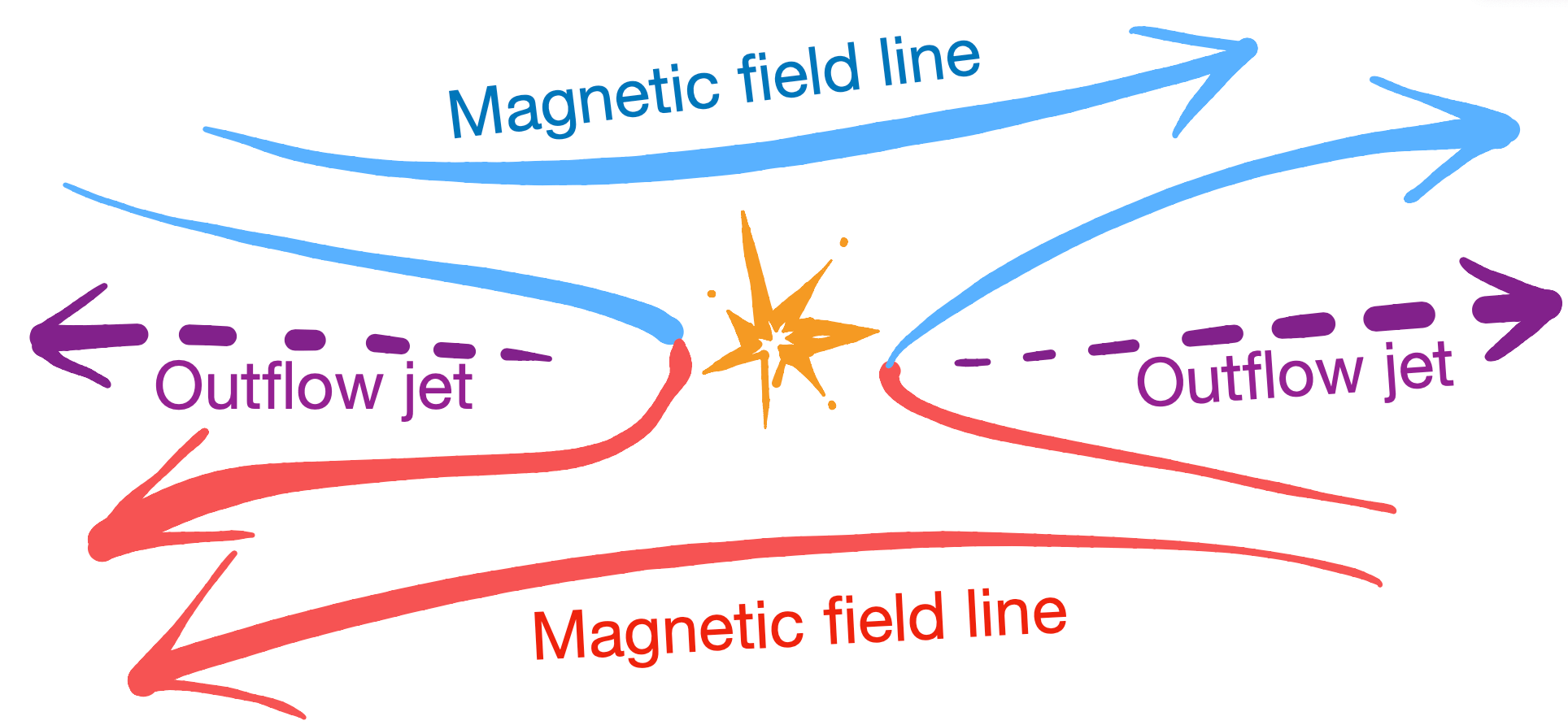
Magnetic reconnection exists throughout nature in plasmas, the fourth state of matter that fills most of the visible universe. Reconnection takes place when magnetic field lines of opposite directions are drawn to each other, break apart, rejoin, and then violently snap away.
In the case of magnetic reconnection, the snapping of magnetic lines forces out magnetized plasma at high velocities. The energy is created and displaced to plasmas through a tension force like that which ejects objects from slingshots.

The Role of the Hall Effect in Fast Reconnection
The Dartmouth research focused on the reconnection rate problem, the key component of magnetic reconnection that describes the speed of the action in which magnetic lines converge and pull apart.
Previous research found that the Hall Effect— the interaction between electric currents and the magnetic fields that surround them—creates the conditions for fast magnetic reconnection. But until now researchers were unable to explain the details of how exactly the Hall effect enhances the reconnection rate.
The Dartmouth theoretical study demonstrates that the Hall effect suppresses the conversion of energy from the magnetic field to plasma particles. This limits the amount of pressure at the point where they merge, forcing the magnetic field lines to curve and pinch, resulting in open outflow geometry needed to speed up the reconnection process.

“This theory addresses the important puzzle of why and how the Hall effect makes reconnection so fast,” said Liu, who serves as deputy lead of the theory and modeling team for NASA’s Magnetospheric Multiscale Mission (MMS). “With this research, we also have explained the explosive magnetic energy release process that is fundamental and ubiquitous in natural plasmas.”
Implications for Space Weather and Earth’s Magnetosphere
The new theory could further the technical understanding of solar flares and coronal mass ejection events that cause space weather and electrical disturbances on Earth. In addition to using the reconnection rate to estimate the time scales of solar flares, it can also be used to determine the intensity of geomagnetic substorms, and the interaction between the solar wind and Earth’s magnetosphere.

The research team, funded by the National Science Foundation (NSF) and NASA, is working alongside NASA’s Magnetospheric Multiscale Mission to analyze magnetic reconnection in nature. Data from four satellites flying in tight formation around Earth’s magnetosphere as part of the NASA mission will be used to validate the Dartmouth theoretical finding.
“This work demonstrates that fundamental theory insights reinforced by modeling capabilities can advance scientific discovery,” said Vyacheslav Lukin, a program director for plasma physics at NSF. “The technological and societal implications of these results are intriguing as they can help predict impacts of space weather on the electrical grid, develop new energy sources, and explore novel space propulsion technologies.”
Applications in Space Technology and Fusion Research
The new study can also inform reconnection studies in magnetically confined fusion devices and astrophysical plasmas near neutron stars and black holes. Although there is no current applied use, some researchers have considered the possibility of using magnetic reconnection in spacecraft thrusters.
For more on this study, see NASA’s Magnetospheric MMS Cracks 60-Year Mystery of Fast Magnetic Explosions.
Reference: “First-principles theory of the rate of magnetic reconnection in magnetospheric and solar plasmas” by Yi-Hsin Liu, Paul Cassak, Xiaocan Li, Michael Hesse, Shan-Chang Lin and Kevin Genestreti, 28 April 2022, Communications Physics.
DOI: 10.1038/s42005-022-00854-x
This work is funded by the NSF’s PHY and AGS Divisions, NASA’s Magnetospheric Multiscale (MMS) mission, and the U.S. Department of Energy.
Co-authors of the study are Paul Cassak, West Virginia University; Xiaocan Li, Dartmouth; Michael Hesse, NASA’s Ames Research Center; Shan-Chang Lin, Dartmouth; and Kevin Genestreti, Southwest Research Institute.
Never miss a breakthrough: Join the SciTechDaily newsletter.
Follow us on Google and Google News.
3 Comments
The surface of the Sun is basically doing all it can to survive the quark plasma energy underneath the surface. When quark plasma energy leaves the Sun, it is small black holes escaping the surface of the Sun. The surface is compromised by an object that hit it and some of the core is jettisoned into space. These are the invisible masses of plasma that can flow through space intact. Eventually, this phenomenon will end as the surface of the Sun continues creating heavier elements making it harder for these energy releases to happen. The quark plasma is allowed to leave the Sun but the normal matter is brought back to the Sun’s surface with gravity to continue its ability to follow the conservation of energy law. These tiny black holes keep producing energy through space until they hit our atmosphere and cause auroras and satellite problems. These tiny black holes produce gamma rays.
You are making stuff up, which has nothing to do with the topic of the article and nothing else in nature either.
E.g. quark plasmas can be found in accelerators or – if you nitpick – is else confined within nucleons. That’s why the abstract – which you didn’t read – describes “electron-ion collisionless plasmas”.
But if you were interested in nature and learned how to read science you wouldn’t be posting your personal, uninteresting fantasies, would you!?
Seems the type of reconnection is dependent on the constituents of the plasma: “In addition, the competition between different forms of energy flux explains why Sweet-Parker reconnection does not have an open exhaust and is slow, while reconnection in electron-positron (pair) plasma is fast.”
I interpret this as meaning that an ambipolar plasma tend to give fast reconnection, while a charged plasma may give slow reconnection.