
Close Menu
    Facebook X (Twitter) Instagram
    SciTechDaily
    • Biology
    • Chemistry
    • Earth
    • Health
    • Physics
    • Science
    • Space
    • Technology
    Facebook X (Twitter) Pinterest YouTube RSS
    SciTechDaily
    Home»Space»Cassini Reveals Unusual Red Arcs on Saturn’s Moon Tethys
    Space

    Cassini Reveals Unusual Red Arcs on Saturn’s Moon Tethys

    By Preston Dyches, Jet Propulsion LaboratoryJuly 30, 20151 Comment3 Mins Read
    Facebook Twitter Pinterest Telegram LinkedIn WhatsApp Email Reddit
    Share
    Facebook Twitter LinkedIn Pinterest Telegram Email Reddit
    Unusual Red Arcs Spotted on Icy Saturn Moon
    Unusual arc-shaped, reddish streaks cut across the surface of Saturn’s ice-rich moon Tethys in this enhanced-color mosaic. The red streaks are narrow, curved lines on the moon’s surface, only a few miles (or kilometers) wide but several hundred miles (or kilometers) long. The red streaks are among the most unusual color features on Saturn’s moons to be revealed by Cassini’s cameras. Credit: NASA/JPL-Caltech/Space Science Institute

    Enhanced-color images from NASA’s Cassini spacecraft reveal unexplained reddish arcs on the surface of Saturn’s icy moon Tethys.

    The red arcs are narrow, curved lines on the moon’s surface, and are among the most unusual color features on Saturn’s moons to be revealed by Cassini’s cameras.

    Images taken using clear, green, infrared, and ultraviolet spectral filters were combined to create the enhanced-color views, which highlight subtle color differences across the icy moon’s surface at wavelengths not visible to human eyes.
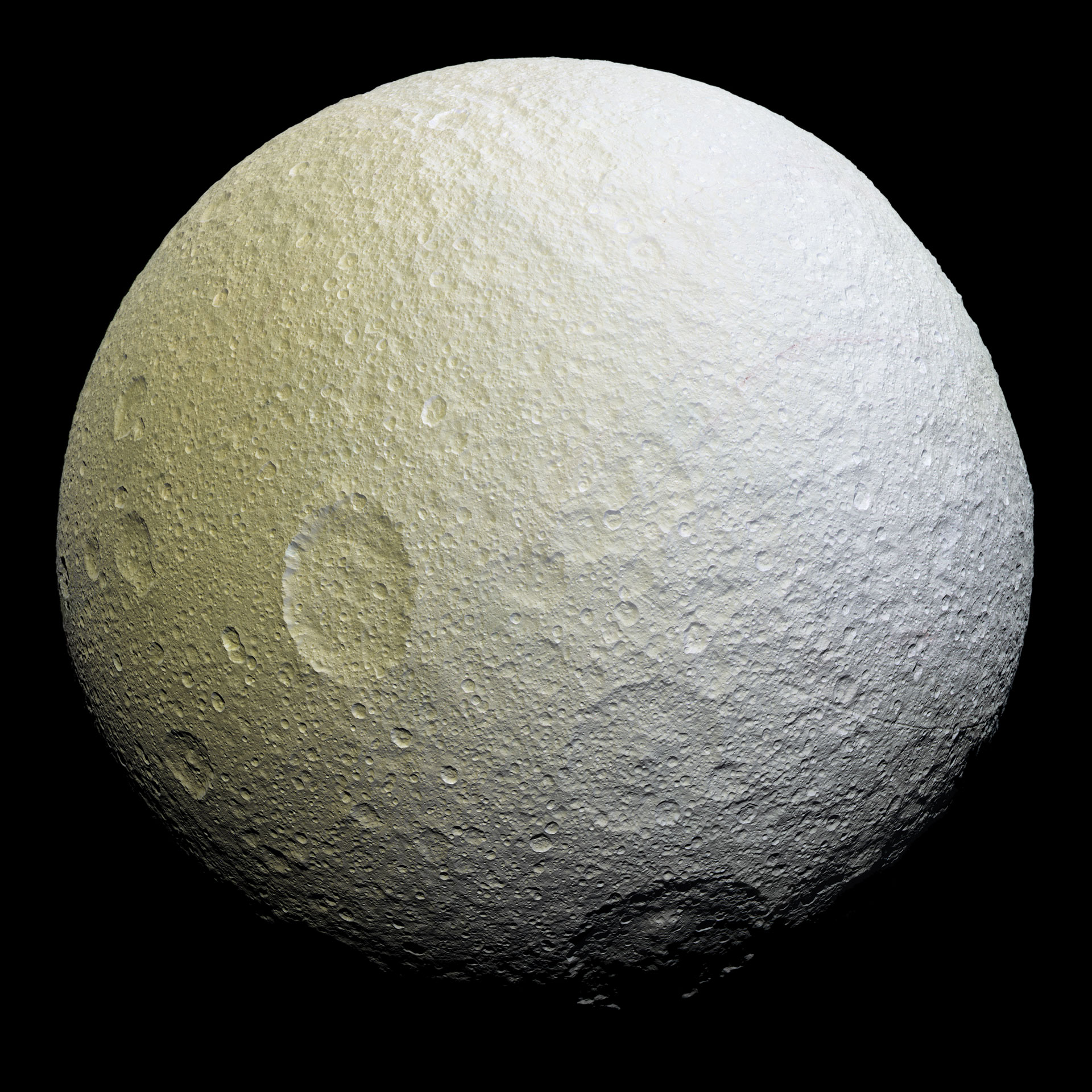
    Enhanced-Color Mosaic of Saturn's Icy Moon Tethys
    This enhanced-color mosaic of Saturn’s icy moon Tethys shows a range of features on the moon’s trailing hemisphere. Tethys is tidally locked to Saturn, so the trailing hemisphere is the side of the moon that always faces opposite its direction of motion as it orbits the planet. Credit: NASA/JPL-Caltech/Space Science Institute

    A few of the red arcs can be seen faintly in observations made earlier in the Cassini mission, which has been in orbit at Saturn since 2004. But the color images for this observation, obtained in April 2015, are the first to show large northern areas of Tethys under the illumination and viewing conditions necessary to see the arcs clearly. As the Saturn system moved into its northern hemisphere summer over the past few years, northern latitudes have become increasingly well illuminated. As a result, the arcs have become clearly visible for the first time.

    “The red arcs really popped out when we saw the new images,” said Cassini participating scientist Paul Schenk of the Lunar and Planetary Institute in Houston. “It’s surprising how extensive these features are.”

    The origin of the features and their reddish color is a mystery to Cassini scientists. Possibilities being studied include ideas that the reddish material is exposed ice with chemical impurities, or the result of outgassing from inside Tethys. They could also be associated with features like fractures that are below the resolution of the available images.

    Except for a few small craters on Saturn’s moon Dione, reddish-tinted features are rare on other moons of Saturn. Many reddish features do occur, however, on the geologically young surface of Jupiter’s moon Europa.

    “The red arcs must be geologically young because they cut across older features like impact craters, but we don’t know their age in years,” said Paul Helfenstein, a Cassini imaging scientist at Cornell University, Ithaca, New York, who helped plan the observations. “If the stain is only a thin, colored veneer on the icy soil, exposure to the space environment at Tethys’ surface might erase them on relatively short time scales.”

    The Cassini team is currently planning follow-up observations of the features, at higher resolution, later this year.

    “After 11 years in orbit, Cassini continues to make surprising discoveries,” said Linda Spilker, Cassini project scientist at NASA’s Jet Propulsion Laboratory in Pasadena, California. “We are planning an even closer look at one of the Tethys red arcs in November to see if we can tease out the source and composition of these unusual markings.”

    Never miss a breakthrough: Join the SciTechDaily newsletter.
    Follow us on Google and Google News.

    Astronomy Cassini-Huygens Mission NASA Planetary Science Popular Tethys
    Share. Facebook Twitter Pinterest LinkedIn Email Reddit

    Related Articles

    Ices and Shadows – Cassini Views Saturn’s Moon Tethys

    Cassini Spacecraft Image Shows the Difference between Janus and Tethys

    New Cassini Image Shows Tethys Dwarfed by Saturn and Its Rings

    Cassini Spacecraft to Begin Flyby of Saturn’s Moon Enceladus

    Cassini Reveals Global Ocean in Saturn’s Moon Enceladus

    New Cassini Night Side Image of Saturn and Tethys

    Cassini Reveals Incomplete Cooling Down of Saturn’s A Ring at Solar Equinox

    Cassini Observations Reveal the Complexity of Hazy Exoplanets

    Storm Spawns the Largest Tropospheric Vortex Ever Seen on Saturn

    1 Comment

    1. Madanagopal.V.C. on August 4, 2015 8:09 am

      The red arcs on the Saturn’s moon Tethys could be due to fracture of the land caused by heavy earthquake (sorry, moonquake probably), because they are young passing over the craters on it. Moreover the Tethys is almost a naked satelite like that of our moon and any event on its surface will be kept intact for a long time. Already it is tidally locked to Saturn and inner forces from the satelite’s (Tethys’)core could be impressed sharply on its surface.Thank You.

      Reply
    Leave A Reply Cancel Reply

    • Facebook
    • Twitter
    • Pinterest
    • YouTube

    Don't Miss a Discovery

    Subscribe for the Latest in Science & Tech!

    Trending News

    Scientists Discover How Coffee Impacts Memory, Mood, and Gut Health

    Why Did the Neanderthals Disappear? Scientists Reveal Humans Had a Hidden Advantage

    Physicists Propose Strange Experiment Where Time Goes Quantum

    Magnesium Magic: New Drug Melts Fat Even on a High-Fat, High-Sugar Diet

    Weight-Loss Drugs Like Ozempic May Come With an Unexpected Cost

    Mezcal “Worm” in a Bottle Mystery: DNA Testing Reveals a Surprise

    New Research Reveals That Your Morning Coffee Activates an Ancient Longevity Switch

    This Is What Makes You Irresistible to Mosquitoes

    Follow SciTechDaily
    • Facebook
    • Twitter
    • YouTube
    • Pinterest
    • Newsletter
    • RSS
    SciTech News
    • Biology News
    • Chemistry News
    • Earth News
    • Health News
    • Physics News
    • Science News
    • Space News
    • Technology News
    Recent Posts
    • This New Memory Technology Could Make Devices Last Months on One Charge
    • Scientists Turn Cancer’s Own Bacteria Against It in Breakthrough Therapy
    • Cannabis Can Make You Remember Things That Never Happened
    • Doctors Are Surprised by What This Vaccine Is Doing to the Heart
    • Quantum Breakthrough Turns Simple Forces Into Powerful New Interactions
    Copyright © 1998 - 2026 SciTechDaily. All Rights Reserved.
    • Science News
    • About
    • Contact
    • Editorial Board
    • Privacy Policy
    • Terms of Use

    Type above and press Enter to search. Press Esc to cancel.