
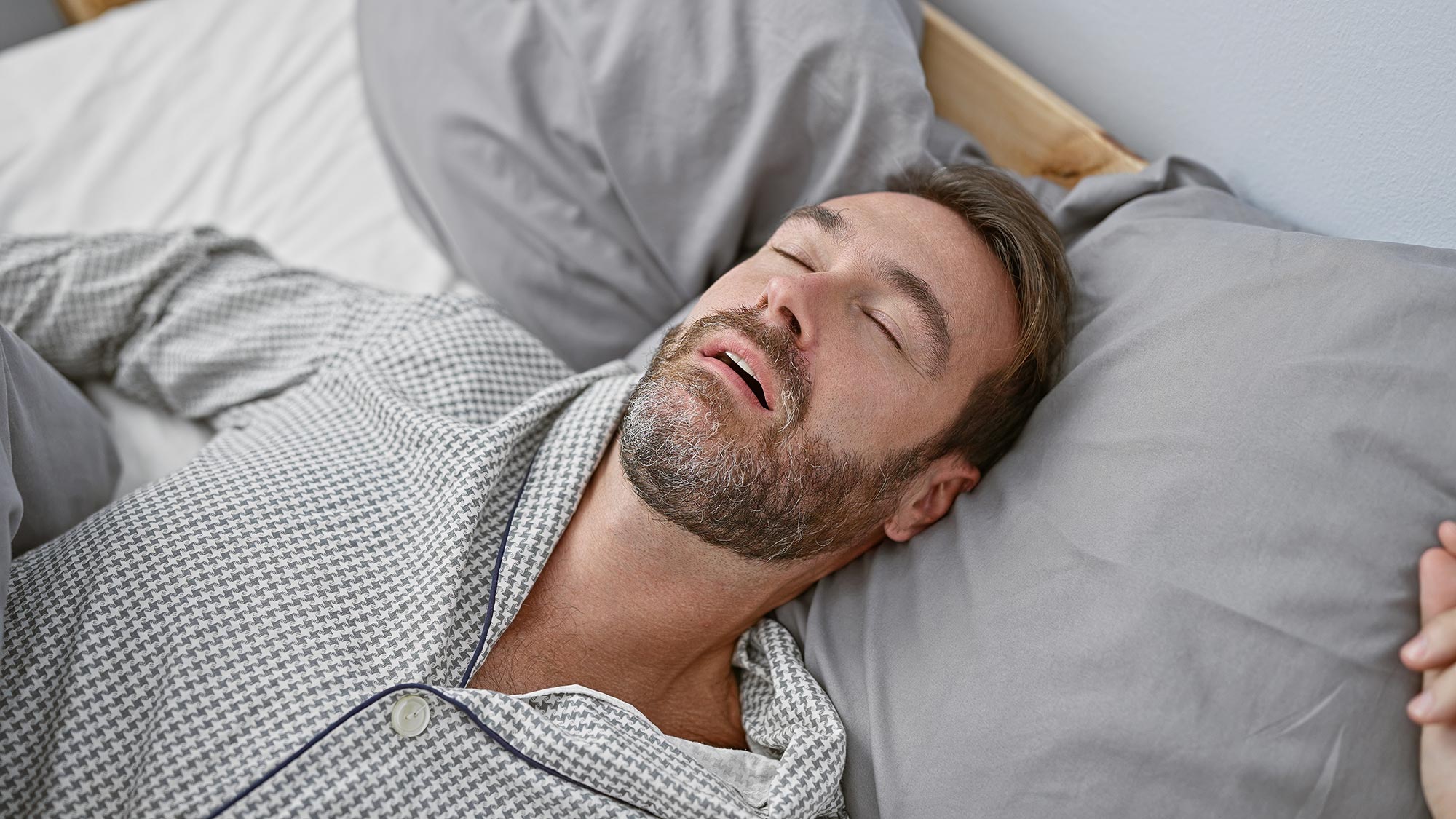
A large phase 3 clinical trial has revealed promising results for a once-nightly pill designed to treat obstructive sleep apnea by targeting the biological mechanisms that cause airway collapse during sleep.
A once-nightly pill significantly improved obstructive sleep apnea (OSA) symptoms in a large phase 3 clinical trial presented at the 2026 ATS International Conference. The medication, known as AD109, is the first treatment designed to address the underlying neuromuscular causes of airway collapse linked to OSA. The study was published in the American Journal of Respiratory and Critical Care Medicine.
The phase 3 SynAIRgy trial found that patients taking AD109 experienced fewer breathing interruptions during sleep, reduced oxygen deprivation, and improved overall blood oxygen levels. More than 40 percent of participants moved into a lower OSA severity category, while 18 percent achieved complete disease control.
“These results provide encouraging evidence that targeting neuromuscular dysfunction can translate into meaningful clinical outcomes, aligning with our evolving understanding of the disease biology,” said first author Patrick John Strollo, MD, a sleep medicine physician at the University of Pittsburgh Medical Center.
AD109 Offers an Alternative to CPAP
Continuous Positive Airway Pressure (CPAP) remains the standard treatment for OSA, but many patients struggle to tolerate it. Dr. Strollo said AD109 could provide a simpler option for people who cannot use CPAP successfully.
“In many other chronic diseases, such as cardiovascular disease, asthma, or type 2 diabetes, it would be unthinkable for the majority of diagnosed patients to remain untreated or undertreated. Yet that remains the reality in OSA,” he said. “An oral pill that targets the underlying neuromuscular drivers of airway collapse during sleep could help address this gap and broaden the range of effective options for patients who remain untreated today.”
AD109 combines aroxybutynin and atomoxetine, two medications that help keep throat muscles active and reduce the risk of airway collapse during sleep.
Phase 3 Trial Shows Significant Improvements
The six-month study included 646 adults with mild to severe OSA across 69 sites in the United States and Canada. All participants either could not tolerate CPAP or chose not to use it.
Patients treated with AD109 saw their apnea-hypoxia index, which tracks breathing interruptions per hour, drop by about 44 percent. The placebo group showed an 18 percent reduction. Researchers also reported improvements in the oxygen desaturation index (the number of times during the night that blood oxygen drops) and hypoxic burden (oxygen deficiency).
The benefits were consistent across patients with different body types and varying levels of disease severity.
Safety Profile and FDA Fast Track Status
Researchers said AD109 demonstrated an acceptable safety profile with mostly mild and expected side effects. The most commonly reported issues included dry mouth, nausea, insomnia, and difficulty urinating. About 21 percent of participants stopped treatment because of side effects.
Dr. Strollo added that the findings will appear alongside a companion mechanistic review by ATS in the American Journal of Respiratory Cell and Molecular Biology.
“Together, these peer-reviewed articles connect late-stage clinical outcomes with the biological mechanisms that drive the disease, targeted by the mechanism of action of AD109, providing a more complete and integrated view of OSA and strengthening confidence in the approach,” he said.
AD109 has received FDA Fast Track designation for the treatment of OSA, highlighting the need for more effective and well-tolerated drug therapies for the condition. Apnimed has already submitted a New Drug Application (NDA) for AD109 to the FDA. Based on feedback from the agency, the company expects a potential PDUFA target action date in the first quarter of 2027, pending FDA acceptance of the NDA for review.
References:
“Aroxybutynin and atomoxetine (AD109) for obstructive sleep apnea: a randomized phase 3 trial (SynAIRgy)” by Patrick J Strollo, Ron Farkas, Luigi Taranto-Montemurro, John Cronin, Sanjay R Patel, SynAIRgy Investigators, Akinyemi Ajayi, Bernadette Alejandrino, Jerome Alonso, Najib Ayas, Francisco Badar, Jacob Coleman, William Cooper, Bruce Corser, Ronald Cridland, Dominick D’Aunno, Matthew Davis, Bertrand De Silva, Michael Downing, Alaa El-Gendy, Tomas Fiel, Steven Geller, James Geyer, Andrew Gould, Nella Green, Mario Guillen, John Hemmersmeier, John Hudson, Monica Jaffe, Thomas Jarrett, John Khoury, John Kimoff, Oleg Kouskov, Michael Lacey, Judith Leech, David Lesch, Michael Lillestol, Reinero Linares – Mera, Alan Lowe, Kinjal Madhav, David Marks, Ronald Mayfield, James Maynard, Jessica McCoun, Tatyana Miroshnikova, Rizwana Mohseni, Andrew Pastewski, Paresh Patel, Sanjay Patel*, Susheel Patil, Nirupa Paulraj, Enrique Pelayo, Dena Petersen, Alec Platt, Lew Pliamm, Bruce Rankin, Syed Raza, Anne Romaker, Mark Rosenthal, Eugene Ryan, Hector Sanchez, Andrew Schreiber, Sonja Schuetz, Sudhir Sehgal, Colin Shapiro, Craig Shapiro, Gerald Shockey, Hermandeep Singh, Sushil Singhi, Steve Sitar, Eileen Sloan, Damien Stevens, Kenneth Stiel, Patrick J Strollo, Masayoshi Takashima, Stephen Thein, Patrick Whitten, Paul Wylie and Dragos Zanchi, 18 May 2026, American Journal of Respiratory and Critical Care Medicine.
DOI: 10.1093/ajrccm/aamag215
“Mechanisms of upper airway muscle control in sleep reveal therapeutic targets for obstructive sleep apnea” by Richard L Horner, D Andrew Wellman, Scott A Sands, Ali Azarbarzin and Luigi Taranto-Montemurro, 18 May 2026, American Journal of Respiratory Cell and Molecular Biology.
DOI: 10.1093/ajrcmb/aanag089
Never miss a breakthrough: Join the SciTechDaily newsletter.
Follow us on Google and Google News.
3 Comments
Having had trouble with sleep apnea extending to microsleeps at the wheel I got a CPAP machine. For some reason it was a disaster with no positive pressure or even adequate inflow with panic-induced negative pressure. The eventual cure – no chemicals, no machines – no fat loss – was to shave around my lips each night and tape my lips shut with 25 mm. blue leukoplast low allergenic tape, one piece is good for 3 nights. Apologies to big business.
Ya, You’re a Hero and Not Some Sad Loser Who Should Just Leave Everyone Else Alone. LOL!
This Is Why We NEED Eugenics.
DO NOT LET THE WEAK AND DAMAGED BREED! Imagine How Beautiful The World Would Be Without Peanut Allergy Losers. LOL!