
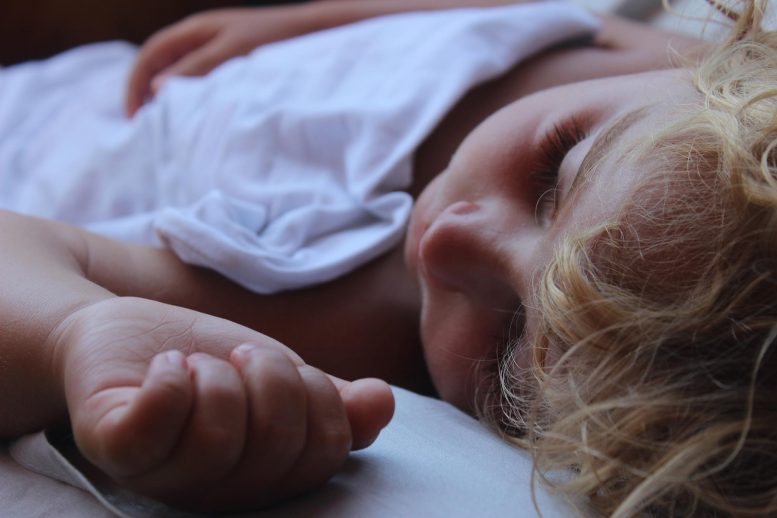
University of Maryland School of Medicine Study questions routine sleep studies to evaluate snoring in children and finds treatment solely based on sleep studies unreliable in children with sleep apnea.
Pediatricians routinely advise parents of children who snore regularly and have sleepiness, fatigue, or other symptoms consistent with sleep-disordered breathing, to get a sleep study; this can help determine whether their child has obstructive sleep apnea, which is often treated with surgery to remove the tonsils and adenoids (adenotonsillectomy). Often pediatricians make surgery recommendations based on the results of this sleep study.
But a new finding from the University of Maryland School of Medicine (UMSOM) suggests that the pediatric sleep study — used to both diagnose pediatric sleep apnea and to measure improvement after surgery – may be an unreliable predictor of who will benefit from having an adenotonsillectomy.
About 500,000 children under age 15 have adenotonsillectomies every year in the U.S. to treat obstructive sleep apnea. The American Academy of Pediatrics (AAP) recommends the surgery as a first-line therapy to treat the condition, which can cause behavioral issues, cardiovascular problems, poor growth, and developmental delays. The premise is that surgically removing or reducing the severity of the obstruction to the upper airway will improve sleep and reduce other problems caused by the disorder.
In 2012, the AAP recommended that pediatricians should screen children who snore regularly for sleep apnea, and refer children suspected of having the condition for an overnight in-laboratory sleep study. The group also recommended an adenotonsillectomy based on the results of the test. But results from the new UMSOM study, published in the September issue of the journal Pediatrics, call into question those recommendations because the data they analyzed found no relationship between improvements in sleep studies following surgery and resolution of most sleep apnea symptoms.
“Resolution of an airway obstruction measured by a sleep study performed after an adenotonsillectomy has long been thought to correlate with improvement in sleep apnea symptoms, but we found this may not be the case,” said study lead author Amal Isaiah, MD, Ph.D., an Assistant Professor of Otorhinolaryngology–Head and Neck Surgery and Pediatrics at UMSOM. “Our finding suggests that using sleep studies alone to manage sleep apnea in children may be a less than satisfactory way of determining whether surgery is warranted.”
To conduct the study, Dr. Isaiah and his colleagues, Kevin Pereira, MD, from UMSOM and Gautam Das, Ph.D., at the University of Texas at Arlington conducted a new analysis of findings from 398 children, ages 5 to 9 years, who participated in the Childhood Adenotonsillectomy Trial (CHAT), a randomized trial published in 2013 that compared adenotonsillectomy with watchful waiting to treat sleep apnea. They found that the resolution of sleep apnea, as determined by sleep study results, did not correlate with improvements in the majority of outcome measures including behavior, cognitive performance, sleepiness, and symptoms of attention deficit hyperactivity disorder.
“This is an important finding that should be carefully considered by the pediatric medical community to determine whether recommendations concerning the management of sleep apnea need to be updated,” said E. Albert Reece, MD, Ph.D., MBA, Executive Vice President for Medical Affairs, UM Baltimore, and the John Z. and Akiko K. Bowers Distinguished Professor and Dean, University of Maryland School of Medicine. “Practice guidelines, in every field of medicine, should reflect the current state of the science.”
In the CHAT Trial, the researchers found that 79 percent of children who had the surgery had a normal sleep study 7 months later compared to 46 percent of those who had watchful waiting. Sleep apnea resolved spontaneously in about half of the children who underwent watchful waiting. It also demonstrated no significant improvement in how children performed on cognitive tests to assess how well they could focus, analyze and solve problems, and recall what they had just learned.
The CHAT researchers did find, however, that those who had early adenotonsillectomy had improved symptoms, quality of life, and behavior.
Reference: “Polysomnography and Treatment-Related Outcomes of Childhood Sleep Apnea” by Amal Isaiah, Kevin D. Pereira and Gautam Das, September 2019, Pediatrics.
DOI: 10.1542/peds.2019-1097
Never miss a breakthrough: Join the SciTechDaily newsletter.
Follow us on Google and Google News.