
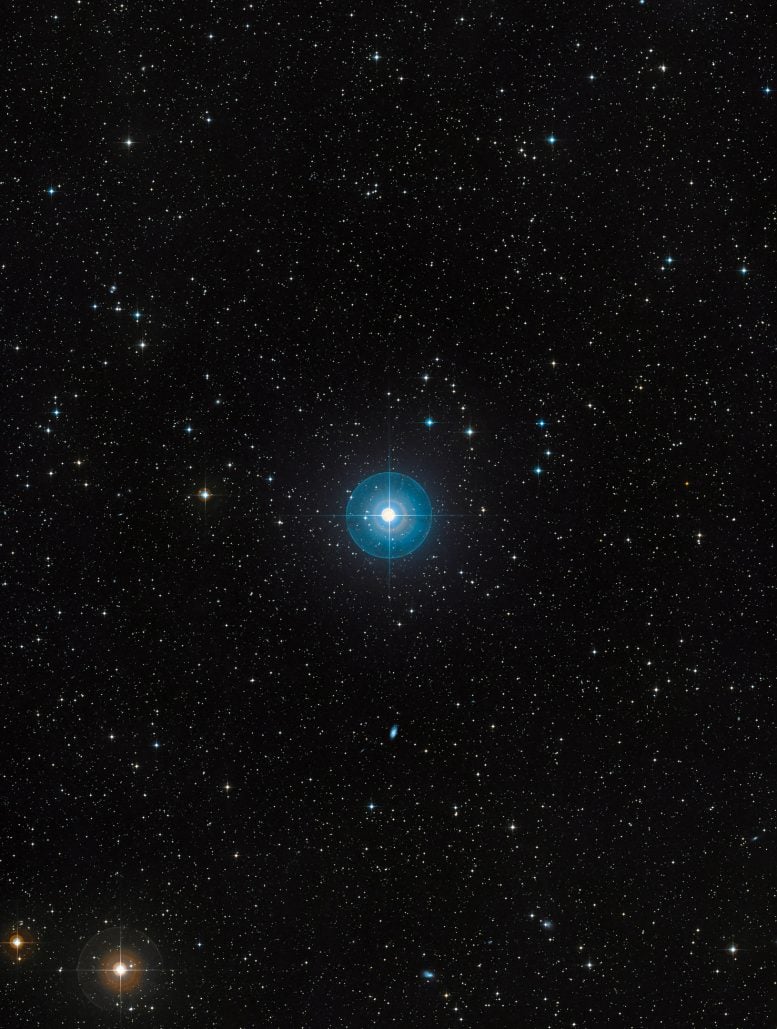
ESO/Digitized Sky Survey 2
A giant planet spent more than a decade concealed inside one of astronomy’s most closely watched star systems.
Astronomers have discovered a planet named Beta Pictoris d orbiting a young star just 63 light-years from Earth. The gas giant is about 100 times fainter than Beta Pictoris b, the first planet found in the system, making it the faintest exoplanet ever directly imaged from the ground. Researchers later discovered that it had been hiding in telescope observations for as long as 11 years.
“This was a serendipitous discovery,” says Ben Sutlieff, an astronomer at the University of Edinburgh, United Kingdom, and co-lead of one of two studies published in The Astrophysical Journal Letters. “We initially wanted to look more at a known planet in the system, Beta Pictoris b, to see how it changed over time,” he adds.
An Unexpected Point of Light
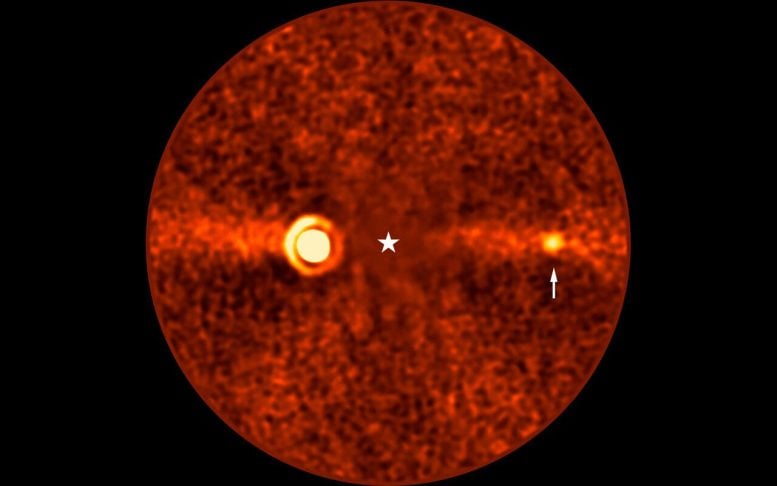
Instead, images from the ERIS instrument on the European Southern Observatory’s Very Large Telescope (ESO’s VLT) revealed an unexpected point of light separate from Beta Pictoris b.
“‘There’s something else there; did you see it?’” Markus Bonse, an ESO astronomer in Germany and the study’s other co-lead, recalls saying while examining the observations.
That faint object turned out to be a previously unknown planet.
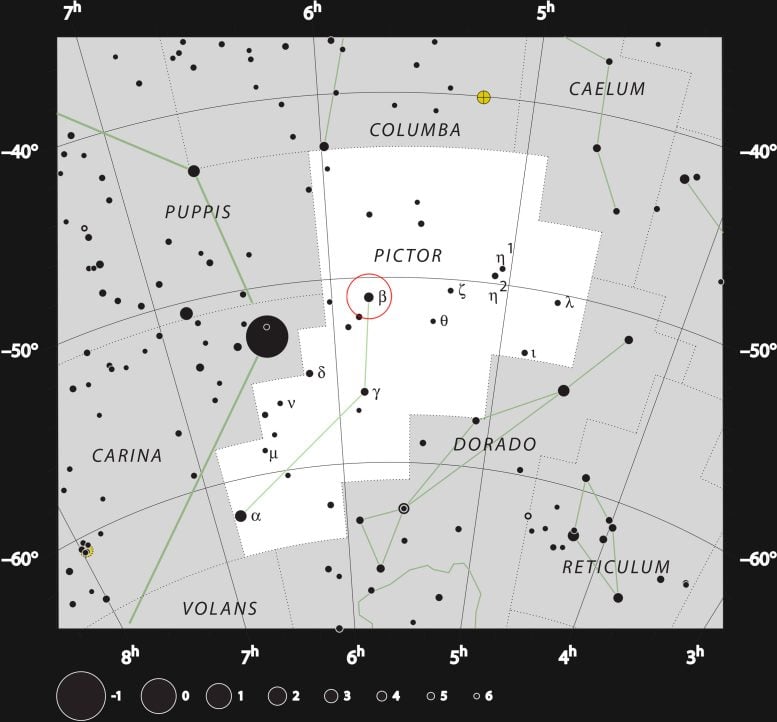
ESO, IAU, and Sky & Telescope
A Young Planetary System
Beta Pictoris is only about 20 million years old, compared with the Sun’s age of roughly 4.6 billion years. Its youth makes the system especially valuable because astronomers can observe giant planets and a surrounding debris disk while the system is still settling into its long-term structure. Smaller rocky planets may even still be forming amid ongoing collisions between asteroids, comets, and other leftover material.
The researchers searched the ESO archive to determine whether the suspected planet had appeared in earlier observations. They found it in multiple images collected over an 11-year period, including data from SPHERE, another instrument on the VLT. In one image, Beta Pictoris d was barely visible beside the much brighter Beta Pictoris b.
“Planet d, it seems, has been playing a game of hide-and-seek with us for over a decade, and only now can we say ‘found you!’” says Jayne Birkby, a study co-author and astronomer at the University of Oxford, United Kingdom.
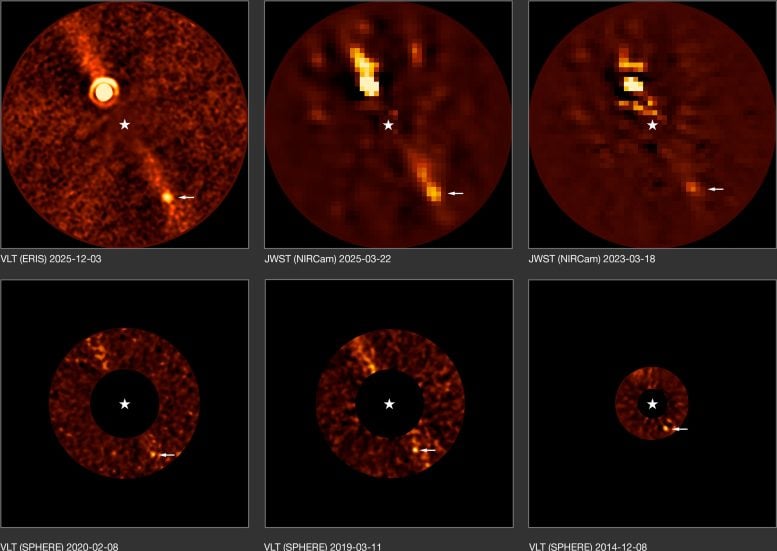
Tracking the object across those archival images showed that it was moving with the system and following an orbit, rather than being an unrelated background star. The observations indicate that Beta Pictoris d circles its star at an average distance of about 26 astronomical units, although the precise orbit remains uncertain. One astronomical unit is the average distance between Earth and the Sun. The planet may take roughly 91 years to complete one orbit.
A Fainter, Lighter Gas Giant
Like Beta Pictoris b and c, the newly identified world is a gas giant. However, it is far less massive than its neighbors. Planets b and c are each about 10 times as massive as Jupiter, while estimates place Beta Pictoris d at roughly 2.4 Jupiter masses, with some models suggesting a broader range of two to four Jupiter masses. It is also relatively cool, causing it to emit far less infrared light than the system’s brighter planets.
Finding such a faint world through direct imaging is exceptionally difficult. Most known exoplanets are detected indirectly, often when they pass in front of their stars or cause their stars to wobble. Direct imaging instead attempts to capture light coming from the planet itself. The star can be millions or billions of times brighter, so instruments must suppress its glare while separating the planet from surrounding dust and other sources of light.
“The new planet is 100 times fainter than Beta Pictoris b, the famous planet in the same system, making it the faintest exoplanet ever imaged directly from Earth,” explains Bonse.
A Fainter, Lighter Gas Giant
An independent team led by Aidan Gibbs at the University of California, San Diego, discovered the same planet with the James Webb Space Telescope (JWST). The two groups detected it independently using different instruments and methods, providing unusually strong confirmation that the signal was real.
The JWST team found Beta Pictoris d in observations from the telescope’s NIRSpec instrument and later confirmed it with additional NIRSpec and MIRI data. Rather than relying only on a conventional image, the researchers searched for the distinct molecular fingerprints of a planetary atmosphere. The planet’s spectrum revealed evidence of methane, carbon monoxide, and water vapor.
This approach allowed the team to distinguish the planet from the bright debris disk surrounding Beta Pictoris. Dust can scatter starlight and produce structures that resemble faint companions, but molecules in a planetary atmosphere leave recognizable patterns in the light that dust cannot easily imitate.
The ground-based researchers also found Beta Pictoris d in archived observations from NIRCam, another instrument aboard JWST.
An Atmosphere Revealed by Molecules
“To our joy, out it popped in previous SPHERE observations,” says Birkby. Once the teams knew the planet’s position and expected motion, the old signals became much easier to recognize.
“It turns out it was hiding in the data all along!” she says.
Co-author Valentin Christiaens, a researcher at CEA Paris-Saclay, France, adds, “The detections in the archival SPHERE data are not only very exciting on their own, but also because they suggest a number of treasures are still hidden in the archives of VLT instruments!”
A Rare Three-Planet Laboratory
Beta Pictoris is now only the second planetary system, after HR 8799, in which astronomers have directly imaged more than two planets. Such systems are rare because direct imaging generally favors young, massive worlds traveling far from their stars.
“Systems with multiple directly imaged exoplanets are the ‘holy grails’ of discoveries because they can teach us a lot about what different exoplanets are like in the same formation environment,” says Sutlieff.
Because all three planets formed around the same star and from the same original disk of gas and dust, astronomers can compare them without many of the uncertainties that arise when studying unrelated planetary systems. Differences in their masses, temperatures, atmospheres, and orbits could reveal how giant planets develop and influence one another.
Beta Pictoris d may also solve a puzzle involving the system’s debris disk. The disk has a sharply defined inner boundary and other unusual structures that suggested an unseen planet was shaping the material through gravity. The newly discovered world appears to have the right mass and location to help clear that region and sculpt the disk.
The Search for More Hidden Worlds
ESO’s Extremely Large Telescope (ELT), now under development, should push direct imaging toward even fainter and less massive planets. Researchers suspect that several famous systems containing directly imaged giants may also harbor smaller worlds that remain hidden in the glare.
“Planets seem to have friends,” says Beth Biller, an astronomer at the University of Edinburgh and co-author of the study. “Many of the famous directly imaged exoplanet systems seem to have multiple giant planets in the same system, and likely there are even more lower-mass planets hiding in these systems that might be revealed with instruments on the ELT.”
Reference: “Direct Imaging Discovery of Giant Exoplanet β Pictoris d: A Decade-long Game of Hide-and-seek” by Ben J. Sutlieff, Markus J. Bonse, Valentin Christiaens, Clémence Fontanive, Elisabeth C. Matthews, Luke T. Parker, Tim D. Pearce, Jayne L. Birkby, Beth A. Biller, Trent J. Dupuy, Emily O. Garvin, Leyla Iskandarli, Jens Kammerer, Yifan Zhou, Robert J. De Rosa, Aarynn L. Carter, Sasha Hinkley, Matthew A. Kenworthy, William O. Balmer, Iain Hammond, James Mang, Caroline V. Morley, Mark J. Neeser, Olivier Absil, Anthony Boccaletti, Mariangela Bonavita, Brendan P. Bowler, Xueqing Chen, Felix A. Dannert, Julien H. Girard, Markus Kasper, Anne-Marie Lagrange, Pengyu Liu, Gilles Orban de Xivry, Michael Poon, Sascha P. Quanz, Benoît Serra, Johanna M. Vos, Kevin Wagner, Jason Wang, Bernhard Schölkopf, Guido Agapito, Alex Agudo Berbel, Dániel Apai, Andrea Baruffolo, Martin Black, Marco Bonaglia, Runa Briguglio, Yixian Cao, Luca Carbonaro, Lee Chapman, Giovanni Cresci, Yigit Dallilar, Richard Davies, Matthias Deysenroth, Ivan Di Antonio, Amico Di Cianno, Gianluca Di Rico, David Doelman, Mauro Dolci, Frank Eisenhauer, Simone Esposito, Debora Ferruzzi, Helmut Feuchtgruber, Natascha Förster-Schreiber, Kyle Franson, Reinhard Genzel, Stefan Gillessen, Eileen C. Gonzales, Michael Hartl, Jean Hayoz, Heinrich Huber, Christoph Keller, Kateryna Kravchenko, Jarron Leisenring, John Lightfoot, David Lunney, Dieter Lutz, Mike Macintosh, Filippo Mannucci, Stanimir Metchev, Thomas Ott, David Pearson, Alfio Puglisi, Sebastian Rabien, Christian Rau, Armando Riccardi, Bernardo Salasnich, Taro Shimizu, Frans Snik, Eckhard Sturm, Genaro Suárez, Linda Tacconi, Xianyu Tan, William Taylor, Christopher Waring and Marco Xompero, 15 July 2026, The Astrophysical Journal Letters.
DOI: 10.3847/2041-8213/ae80a0
Never miss a breakthrough: Join the SciTechDaily newsletter.
Follow us on Google and Google News.