

Researchers found that the enzyme acid ceramidase can make aging cells more vulnerable to ferroptosis, a form of cell death, and may be a promising target for promoting healthy aging.
As more people live into advanced age, the challenge is no longer simply extending life but preserving health for as many of those years as possible. The United Nations estimates that the global population older than 85 will triple by 2050. Researchers at the Salk Institute are investigating the cellular processes behind age-related decline in hopes of extending healthspan (the number of years we spend healthy).
Their latest work connects two processes commonly found in aging cells: 1) senescence, in which cells stop dividing without dying, and 2) ferroptosis, a form of cell death that occurs when cells can no longer control damaging fats.
In laboratory experiments with human lung cells, the researchers found that high levels of an enzyme called acid ceramidase made senescent cells more vulnerable to ferroptosis. Those cells could also transmit this vulnerability to neighboring cells.
Experimental drugs that act on acid ceramidase are already being developed for other medical purposes, showing that the enzyme can be targeted and providing a possible starting point for future efforts to extend healthspan.
The study was published in Cell Death and Disease.
Two aging pathways converge
“Senescent cells are linked to many age-related conditions, including arthritis, poor wound healing, and neurodegenerative diseases like Alzheimer’s or Parkinson’s,” says senior and co-corresponding author Pam Maher, PhD, a research professor at Salk. “Our findings are a big milestone in the ongoing public health effort to support healthy aging, as we now have a novel target for developing new therapeutics that could be applied to a multitude of diseases and disorders.”
Maher first identified this cell death pathway and named it “oxytosis” in 2001. Now known as ferroptosis, it is an iron-dependent process in which lipid peroxides, damaged fats produced through oxidation, accumulate to toxic levels. Healthy cells use the antioxidant glutathione to control these compounds and resist ferroptosis.
A growing body of research has connected ferroptosis with Alzheimer’s and Parkinson’s diseases, including recent work from Maher’s laboratory. In a Cell Death Discovery paper, her group found that prolonged exposure to excess iron gradually weakened neurons and increased their vulnerability to neurodegeneration.
That finding adds to evidence linking ferroptosis with neurodegenerative disease. Researchers are now investigating the pathway as a possible therapeutic target for age-related conditions, alongside another increasingly important area of study: senescence.
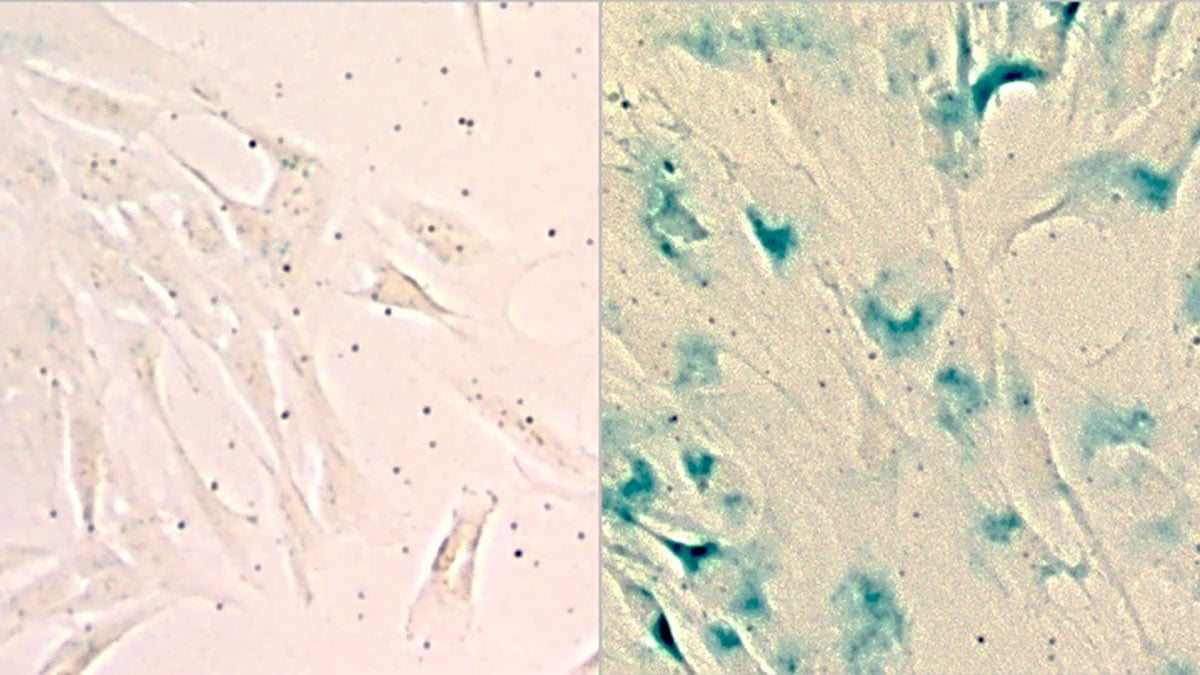
Cellular senescence leaves cells in an unusual state. They no longer divide, but they do not fully die, earning them the nickname “zombie” cells. Senescent cells are a hallmark of aging and can sometimes remain harmless. In other circumstances, however, they release damaging substances into nearby tissue and may contribute to diseases and disorders, including cancer.
Because ferroptosis and senescence have each been associated with age-related dysfunction and identified as potential therapeutic targets, the Salk researchers set out to determine whether the two processes were connected.
Acid ceramidase exposes a hidden weakness
The researchers grew senescent human lung cells in the laboratory and triggered ferroptosis. Compared with young, healthy cells, the senescent cells were far more sensitive to this form of cell death. That vulnerability appeared as the cells produced steadily increasing amounts of acid ceramidase, an enzyme (a type of protein that can speed up chemical reactions inside cells).
After finding that excess acid ceramidase increased sensitivity to ferroptosis, the researchers removed the enzyme from both senescent and nonsenescent cells. Its removal made both young and old cells more resistant to induced ferroptosis.

“This is an entirely novel pathway that is independent of the mechanisms usually associated with ferroptosis-induced cell death, as it doesn’t involve any changes in iron or glutathione levels but instead modulates the lipid metabolism,” says first author David Soriano-Castell, PhD, a postdoctoral researcher in Maher’s lab.
Senescent cells spread their vulnerability
The researchers also found that vulnerable senescent cells could transfer their increased sensitivity to neighboring cells. This observation may help explain how a small number of senescent cells can eventually affect a much larger area of tissue.
“We have unraveled a new mechanistic connection between ferroptosis and senescence,” explains Soriano-Castell. “This gives us a clear target that would eliminate two birds with one stone, eliminating senescent cells and keeping neighboring cells healthy for longer.”
Existing drugs offer a starting point
Scientists working independently of the Salk study have already developed drugs that target acid ceramidase for diseases in which the enzyme also plays a role. The new findings suggest another possible application for those compounds, while their existing development provides proof of concept that the enzyme can be targeted with drugs.
“This is only the beginning,” says Soriano-Castell. “The next step is finding a more complete pathway and translating into animals and tissues, then clinical trials of our own, and so on. But what is important is that acid ceramidase is targetable, and other labs have already gotten that work started—later on, we can hopefully build on what they learn.”
“The more we learn about ferroptosis,” adds Maher, “the more possibilities there are for healthy aging innovations. This is an exciting time to be studying aging, resilience, and longevity, and I look forward to continuing to see how ferroptosis can be a useful target.”
References: “Acid ceramidase modulates the lipid profile and exacerbates sensitivity to ferroptosis in WI-38 replicative senescent cells” by David Soriano-Castell, Marie Goujon, Nawab John Dar, Antonio Currais and Pamela Maher, 10 July 2026, Cell Death & Disease.
DOI: 10.1038/s41419-026-09108-y
“Sustained dysregulation of iron and glutathione homeostasis induces chronoferroptosis, a persistent ferroptotic adaptation in neuronal cells” by Nawab John Dar, David Soriano-Castell and Pamela Maher, 18 June 2026, Cell Death Discovery.
DOI: 10.1038/s41420-026-03208-6
Never miss a breakthrough: Join the SciTechDaily newsletter.
Follow us on Google and Google News.