
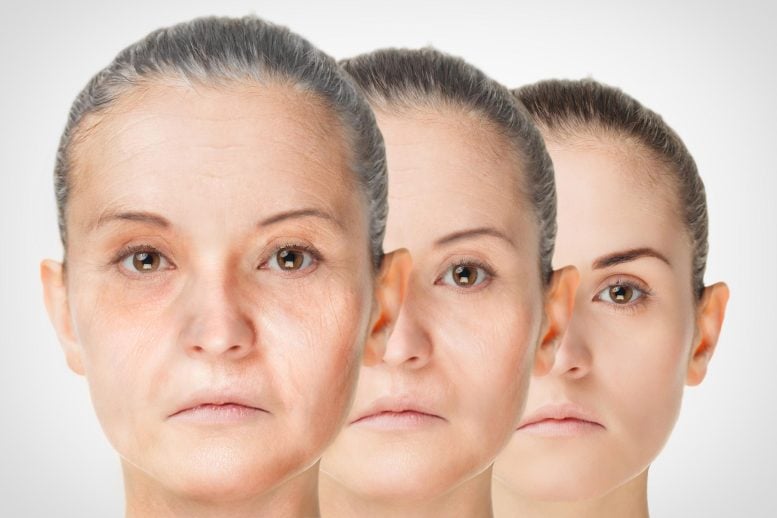
Salk researchers treated mice with anti-aging regimen beginning in middle age and found no increase in cancer or other health problems later on.
Age may be just a number, but it’s a number that often carries unwanted side effects, from brittle bones and weaker muscles to increased risks of cardiovascular disease and cancer. Now, scientists at the Salk Institute, in collaboration with Genentech, a member of the Roche group, have shown that they can safely and effectively reverse the aging process in middle-aged and elderly mice by partially resetting their cells to more youthful states.
“We are elated that we can use this approach across the life span to slow down aging in normal animals. The technique is both safe and effective in mice,” says co-corresponding author Juan Carlos Izpisua Belmonte, professor in Salk’s Gene Expression Laboratory and holder of the Roger Guillemin Chair. “In addition to tackling age-related diseases, this approach may provide the biomedical community with a new tool to restore tissue and organismal health by improving cell function and resilience in different disease situations, such as neurodegenerative diseases.”
Yamanaka Factors in Cellular Rejuvenation
As organisms age, it is not just their outward appearances and health that change; every cell in their bodies carries a molecular clock that records the passage of time. Cells isolated from older people or animals have different patterns of chemicals along their DNA—called epigenetic markers—compared to younger people or animals. Scientists know that adding a mixture of four reprogramming molecules—Oct4, Sox2, Klf4, and cMyc, also known as “Yamanaka factors”—to cells can reset these epigenetic marks to their original patterns. This approach is how researchers can dial back adult cells, developmentally speaking, into stem cells.
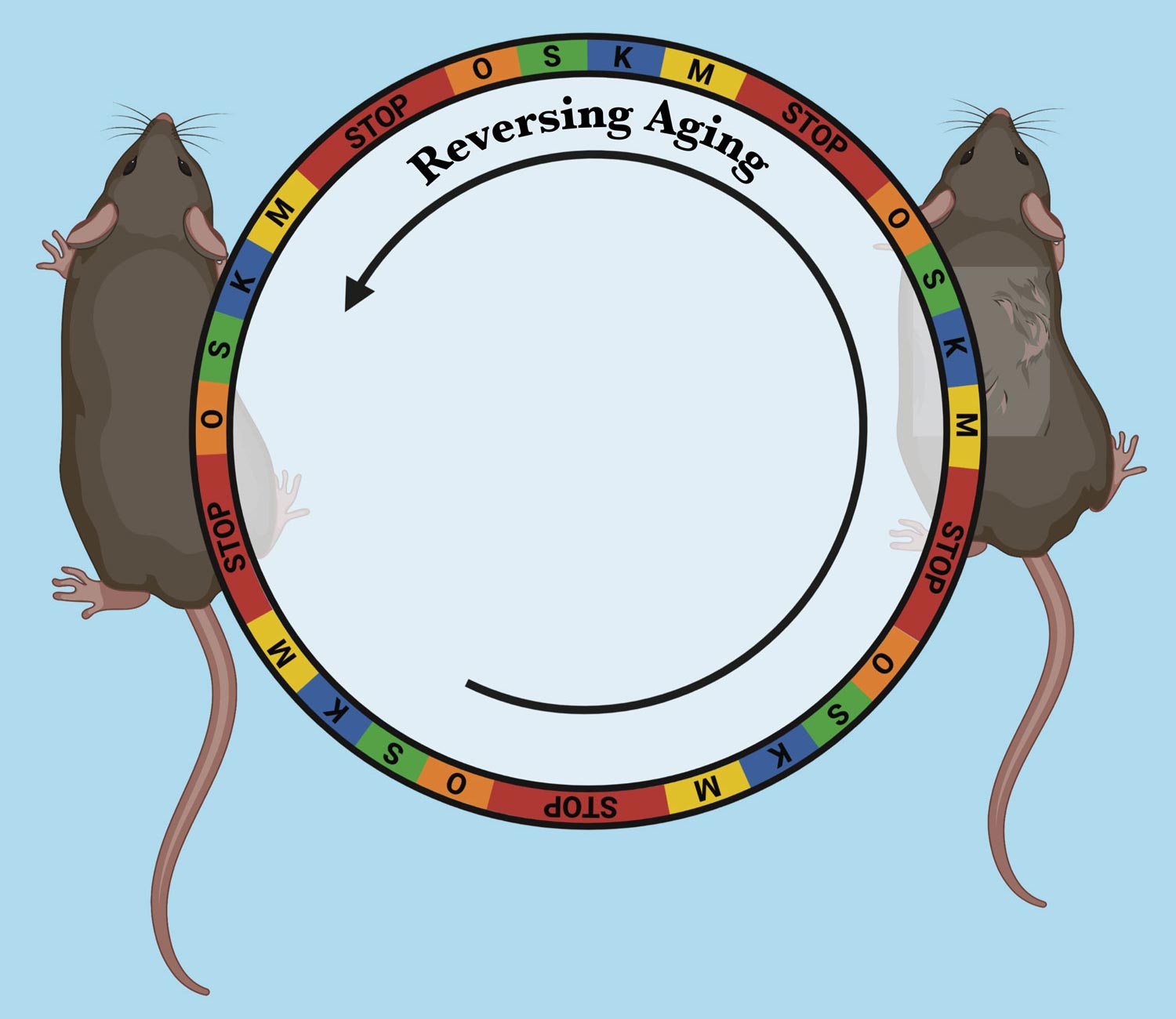
In 2016, Izpisua Belmonte’s lab reported for the first time that they could use the Yamanaka factors to counter the signs of aging and increase life span in mice with a premature aging disease. More recently, the team found that, even in young mice, the Yamanaka factors can accelerate muscle regeneration. Following these initial observations, other scientists have used the same approach to improve the function of other tissues like the heart, brain, and optic nerve, which is involved in vision.
In the new study, Izpisua Belmonte and his colleagues tested variations of the cellular rejuvenation approach in healthy animals as they aged. One group of mice received regular doses of the Yamanaka factors from the time they were 15 months old until 22 months, approximately equivalent to age 50 through 70 in humans. Another group was treated from 12 through 22 months, approximately age 35 to 70 in humans. A third group was treated for just one month at age 25 months, similar to age 80 in humans.
“What we really wanted to establish was that using this approach for a longer time span is safe,” says Pradeep Reddy, a Salk staff scientist and co-first author of the new paper. “Indeed, we did not see any negative effects on the health, behavior, or body weight of these animals.”
Compared to control animals, there were no blood cell alterations or neurological changes in the mice that had received the Yamanaka factors. Moreover, the team found no cancers in any of the groups of animals.
Youthfulness Restored
When the researchers looked at normal signs of aging in the animals that had undergone the treatment, they found that the mice, in many ways, resembled younger animals. In both the kidneys and skin, the epigenetics of treated animals more closely resembled epigenetic patterns seen in younger animals. When injured, the skin cells of treated animals had a greater ability to proliferate and were less likely to form permanent scars—older animals usually show less skin cell proliferation and more scarring. Moreover, metabolic molecules in the blood of treated animals did not show normal age-related changes.
This youthfulness was observed in the animals treated for seven or 10 months with the Yamanaka factors, but not the animals treated for just one month. What’s more, when the treated animals were analyzed midway through their treatment, the effects were not yet as evident. This suggests that the treatment is not simply pausing aging, but actively turning it backwards—although more research is needed to differentiate between the two.
The team is now planning future research to analyze how specific molecules and genes are changed by long-term treatment with the Yamanaka factors. They are also developing new ways of delivering the factors.
“At the end of the day, we want to bring resilience and function back to older cells so that they are more resistant to stress, injury, and disease,” says Reddy. “This study shows that, at least in mice, there’s a path forward to achieving that.”
Reference: “In vivo partial reprogramming alters age-associated molecular changes during physiological aging in mice” by Kristen C. Browder, Pradeep Reddy, Mako Yamamoto, Amin Haghani, Isabel Guillen Guillen, Sanjeeb Sahu, Chao Wang, Yosu Luque, Javier Prieto, Lei Shi, Kensaku Shojima, Tomoaki Hishida, Zijuan Lai, Qingling Li, Feroza K. Choudhury, Weng R. Wong, Yuxin Liang, Dewakar Sangaraju, Wendy Sandoval, Concepcion Rodriguez Esteban, Estrella Nuñez Delicado, Pedro Guillen Garcia, Michal Pawlak, Jason A. Vander Heiden, Steve Horvath, Heinrich Jasper and Juan Carlos Izpisua Belmonte, 7 March 2022, Nature Aging.
DOI: 10.1038/s43587-022-00183-2
Belmonte is currently an Institute Director at Altos Labs, Inc., in addition to being a professor at the Salk Institute.
Other authors included Mako Yamamoto, Isabel Guillen Guillen, Sanjeeb Sahu, Chao Wang, Yosu Luque, Javier Prieto, Lei Shi, Kensaku Shojima, Tomoaki Hishida and Concepcion Rodriguez Esteban of Salk; Kristen Browder, Zijuan Lai, Qingling Li, Feroza Choudhury, Weng Wong, Yuxin Liang, Dewakar Sangaraju, Wendy Sandoval, Michal Pawlak, Jason Vander Heiden and Heinrich Jasper of Genentech, Inc.; Amin Haghani and Steve Horvath of UCLA; Estrella Nuñez Delicado of Universidad Católica San Antonio de Murcia; and Pedro Guillen Garcia of Clínica CEMTRO.
The study was supported by Universidad Católica San Antonio de Murcia (UCAM), and Fundación Dr. Pedro Guillén.
Never miss a breakthrough: Join the SciTechDaily newsletter.
Follow us on Google and Google News.
6 Comments
Great it works so far in mice, I am sure all the old mice in the world will be very happy. It’s hardly a breakthrough for humans though, because humans are, emm not mice, so these results mean absolutely nothing with regard to anti-aging in humans.
Now what is Gene Therapy
Great news. Putin will be cutting the Yamanaka factors out of his Ukrainian prisoners and eating them like a madman to live forever now. B
The same Yamanka factors are also upregulated in cancer…
I believe this research is going to be a great milestone in human history. Nearly every drug, medical device and treatments that saves human lives today, has been tested on animals in pre-clinical phase, and adapted for human use.
Hi, how are you? Do you happen to know of any anti-aging/reversal of aging clinical trials are being conducted (and recruiting potential volunteers)? I would love to participate and am a 50 year old, healthy female showing signs of aging after a few very trying years!!! Any information you are able to provide would be greatly appreciated and thank you for your time and attention!