
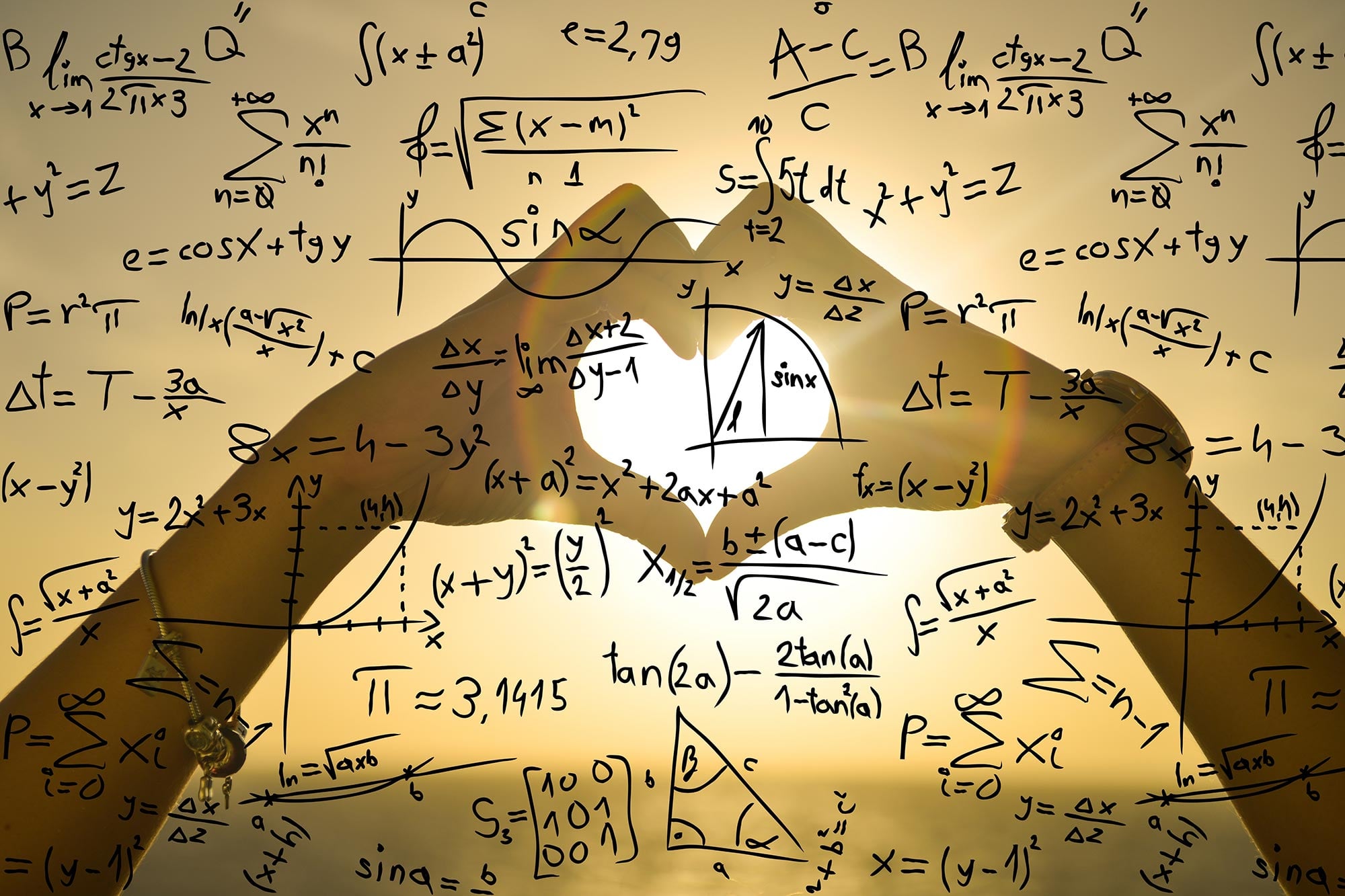
By expanding dynamical systems theories to account for forgetting rates, attraction levels, and reaction patterns, math can now identify ‘relationship danger zones’.
Could the course of a romantic relationship be traced through equations? Three decades of research suggest that love can follow recognizable patterns, allowing mathematics to identify signs that a couple may be approaching trouble.
Professor Laurent Pujo-Menjouet of the University of Lyon I has worked with researchers around the world to develop models that describe romantic feelings as dynamical systems, meaning systems that change over time in response to interacting forces.
In his book Love! Valour! Equations!, which brings together mathematics, literature, psychology, cinema and everyday experience, he writes: “There is no mysterious enchantment or magic potion. By now, that would be known. Is all hope lost then? Certainly not. That is precisely where everything becomes interesting.”
Population models enter romantic relationships
The mathematical trail begins not with human couples, but with rabbits.
Models first created to describe population changes have become the foundation for predicting how relationships develop. These include the Malthus model, used to examine the spread of rabbits in Australia, and predator-prey models describing interactions such as those between Canadian lynxes and snowshoe hares. Researchers have also applied the Allee effect, which describes how populations below a critical threshold may collapse while those above it can flourish, to romantic relationships.
“Just as we can predict population growth or endangered species, we can model the evolution of feelings within a couple,” explains Pujo-Menjouet. “We’re not trying to predict who you’ll fall in love with; we’re trying to understand why some couples remain stable despite life’s inevitable shocks while others slowly drift apart.”
Pujo-Menjouet’s work draws on a long mathematical history, beginning with Thomas Malthus’s population models from the 18th century and the Lotka-Volterra predator-prey equations introduced in the 1920s. Later researchers, including psychologist John Gottman, economist José Manuel Rey, physicist Sergio Rinaldi and mathematician Steven Strogatz, extended dynamical systems theory to romantic relationships.
Psychologist Dr. John Gottman, widely known as ‘Doctor Love’, showed that researchers could model relationship outcomes by coding interactions between couples and representing those exchanges on graphs.
More recent models account for additional complexities, including delayed reactions introduced by Polish researchers Bielezyk, Forys, and Marek Bodnar. These delays reflect how taking time to process a conflict can either calm tensions or allow them to intensify.
Relationships can cross a critical threshold
A central feature of Pujo-Menjouet’s model is the idea that every relationship has a minimum level of strength. If the relationship remains below this critical threshold, the equations predict that it will continue moving toward separation.
“If your feelings fall below this threshold and stay there, the mathematics predicts an inevitable decline toward separation,” says Pujo-Menjouet. “However, understanding this threshold gives couples a powerful tool: they can recognize danger zones and take corrective action.”
Pujo-Menjouet’s team created a model that includes common disruptions such as arguments, stress and outside pressures, while also measuring how effectively couples recover from them.
“The important question isn’t whether couples argue,” says Pujo-Menjouet. “It’s whether they have enough resilience to return to equilibrium afterward.”
The model highlights three main factors influencing long-term stability: the attraction between partners, the gradual weakening of feelings over time, and how each partner responds to the other’s emotions. Their interaction determines how well a relationship can withstand disruption.
Pujo-Menjouet relates the concept to The Three Little Pigs: “Life will always send its wolves: stress, illness, work, children, financial difficulties. Mathematics helps us understand how to build the brick house rather than the straw one.”
AI could flag relationship danger zones
Future versions of these systems could combine mathematical modeling with artificial intelligence to warn couples when their relationship is approaching a risky state, potentially giving them “time to course-correct.”
“Think of it as a relationship GPS,” says Pujo-Menjouet. “It shows you where you are, where you’re heading, and suggests routes to reach your desired destination. The models don’t tell you who to love, it helps explain how love evolves and what couples can do to protect it.”
Equations predict patterns, not certainty
Despite their potential, the models have important limitations.
Most are based largely on Western relationship patterns. The forces behind relationship success or failure differ across cultures, religions, economic circumstances and generations, so building a broadly applicable model would require far greater complexity.
Human behavior is also unpredictable and often irrational. These equations estimate tendencies rather than fixed outcomes, and couples may move beyond the predicted path through commitment, therapy or personal growth.
“Mathematics can illuminate patterns and provide guidance,” Pujo-Menjouet explains, “but ultimately, the success of a relationship depends on two people choosing, every day, to nurture their connection. The equations can show you the path, but you still have to walk it together.”
Never miss a breakthrough: Join the SciTechDaily newsletter.
Follow us on Google and Google News.
1 Comment
I like this ~ it’s a reminder and an orange flag being raised to warn our couple that we’re gradually heading down that slippery slope, yet there is time, there are attitudes and strategies to save us from going asymptotic.