
Close Menu
    Facebook X (Twitter) Instagram
    SciTechDaily
    • Biology
    • Chemistry
    • Earth
    • Health
    • Physics
    • Science
    • Space
    • Technology
    Facebook X (Twitter) Pinterest YouTube RSS
    SciTechDaily
    Home»Space»New Cassini Image Shows Tethys Dwarfed by Saturn and Its Rings
    Space

    New Cassini Image Shows Tethys Dwarfed by Saturn and Its Rings

    By SciTechDailyDecember 8, 20151 Comment1 Min Read
    Facebook Twitter Pinterest Telegram LinkedIn WhatsApp Email Reddit
    Share
    Facebook Twitter LinkedIn Pinterest Telegram Email Reddit
    New Cassini Image Crescent Tethys and Rings
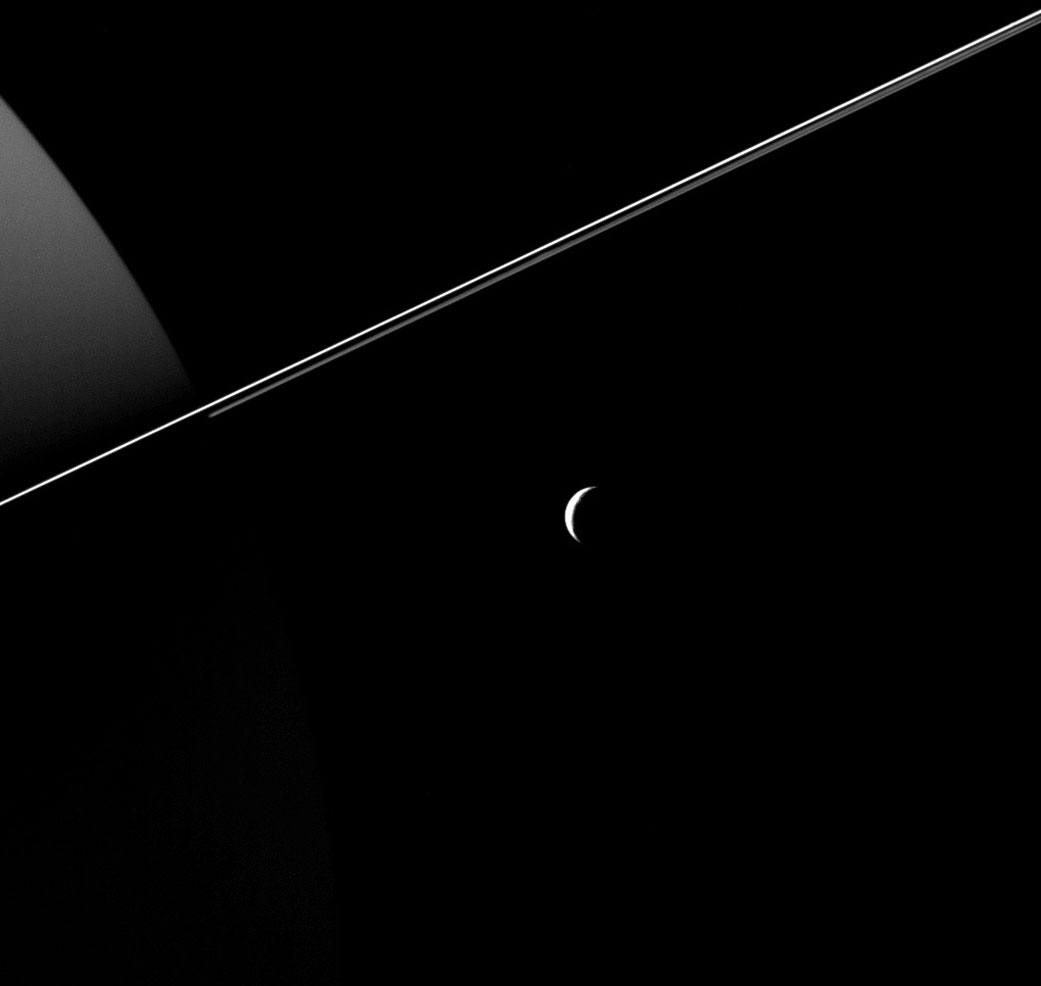
    Tethys dwarfed by Saturn and its rings. Credit: NASA/JPL-Caltech/Space Science Institute

    This newly released Cassini image shows Tethys dwarfed by Saturn and its rings.

    Tethys, dwarfed by the scale of Saturn and its rings, appears as an elegant crescent in this image taken by NASA’s Cassini Spacecraft. Views like this are impossible from Earth, where we only see Saturn’s moons as (more or less) fully illuminated disks.

    The region of Saturn seen at left is on the planet’s night side. Reflected light from the rings dimly illuminates the planet’s northern hemisphere.

    This view looks toward the anti-Saturn side of Tethys. North on Tethys is up and rotated 24 degrees to the left. The image was taken in visible light with the Cassini spacecraft wide-angle camera on August 18, 2015.

    The view was acquired at a distance of approximately 184,000 miles (296,000 kilometers) from Tethys. The image scale is 11 miles (18 kilometers) per pixel.

    Never miss a breakthrough: Join the SciTechDaily newsletter.
    Follow us on Google and Google News.

    Astronomy Cassini-Huygens Mission NASA Planetary Science Popular Saturn Tethys
    Share. Facebook Twitter Pinterest LinkedIn Email Reddit

    Related Articles

    Ices and Shadows – Cassini Views Saturn’s Moon Tethys

    Cassini Spacecraft Image Shows the Difference between Janus and Tethys

    Cassini Reveals a Gored Clump in Saturn’s F Ring

    Cassini Spacecraft to Begin Flyby of Saturn’s Moon Enceladus

    Cassini Reveals Global Ocean in Saturn’s Moon Enceladus

    New Cassini Night Side Image of Saturn and Tethys

    Cassini Reveals Incomplete Cooling Down of Saturn’s A Ring at Solar Equinox

    Cassini Reveals Unusual Red Arcs on Saturn’s Moon Tethys

    Storm Spawns the Largest Tropospheric Vortex Ever Seen on Saturn

    1 Comment

    1. Madanagopal.V.C. on December 10, 2015 7:47 am

      Excellent crescent of Tethys illuminated by just reflection from Saturn’s ring speaks of the highly luminous cloud ring of Saturn in the sky which in turn is already lit by Sun’s glow. If such a luminous cloud were there for earth, no doubt, out nights should have been brightened by glow. Thank You.

      Reply
    Leave A Reply Cancel Reply

    • Facebook
    • Twitter
    • Pinterest
    • YouTube

    Don't Miss a Discovery

    Subscribe for the Latest in Science & Tech!

    Trending News

    Scientists Say This Simple Supplement May Actually Reverse Heart Disease

    Warming Oceans Could Trigger a Dangerous Methane Surge

    This Simple Movement Could Be Secretly Cleaning Your Brain

    Male Birth Control Breakthrough: Scientists Find Way To Turn Sperm Production Off and Back On

    A Common Vitamin Could Hold the Key to Treating Fatty Liver Disease

    New Research Shows Vitamin B12 May Hold the Key to Healthy Aging

    These Simple Daily Habits Can Quickly Improve Blood Pressure and Heart Risk Factors

    A Common Nutrient May Play a Surprising Role in Anxiety

    Follow SciTechDaily
    • Facebook
    • Twitter
    • YouTube
    • Pinterest
    • Newsletter
    • RSS
    SciTech News
    • Biology News
    • Chemistry News
    • Earth News
    • Health News
    • Physics News
    • Science News
    • Space News
    • Technology News
    Recent Posts
    • Scientists Just Exposed a 300 Million-Year-Old Fossil Mistake
    • Ravens Don’t Follow Wolves, They Predict Them
    • This Common Knee Surgery May Be Doing More Harm Than Good
    • Scientists Discover a New Way To Control Metals at the Atomic Scale
    • Scientists Create “Quantum Sound” Device That Works Near Absolute Zero
    Copyright © 1998 - 2026 SciTechDaily. All Rights Reserved.
    • Science News
    • About
    • Contact
    • Editorial Board
    • Privacy Policy
    • Terms of Use

    Type above and press Enter to search. Press Esc to cancel.