
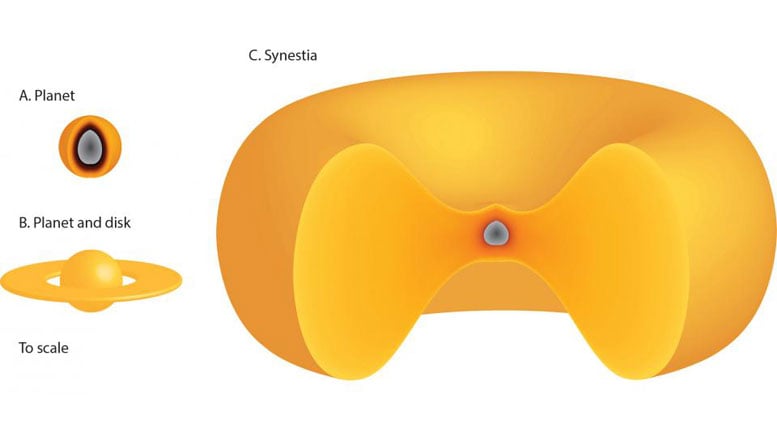
Scientists reveal that planet-sized bodies can form a new, much larger structure called a synestia – an indented disk rather like a red blood cell or a donut with the center filled in.
There’s something new to look for in the heavens, and it’s called a “synestia,” according to planetary scientists Simon Lock at Harvard University and Sarah Stewart at the University of California, Davis. A synestia, they propose, would be a huge, spinning, donut-shaped mass of hot, vaporized rock, formed as planet-sized objects smash into each other.
And at one point early in its history, the Earth itself was likely a synestia, said Stewart, who is a professor in the Department of Earth and Planetary Sciences at UC Davis. Lock and Stewart describe the new object in a paper published May 22 in the Journal of Geophysical Research: Planets.
Lock, who is a graduate student at Harvard, and Stewart study how planets can form from a series of giant impacts. Current theories of planet formation hold that rocky planets such as the Earth, Mars, and Venus formed early in the existence of our solar system as smaller objects collided with each other. These collisions were so violent that the resulting bodies melted and partially vaporized, eventually cooling and solidifying to the (nearly) spherical planets we know today.
Lock and Stewart are particularly interested in collisions between spinning objects. A rotating object has angular momentum, which must be conserved in a collision. Think of a skater spinning on ice: If she extends her arms, she slows her rate of spin, and to spin faster she holds her arms close. Her angular momentum is the same.
Now consider two ice skaters turning on ice: if they catch hold of each other, the angular momentum of each adds together, so their total angular momentum must be the same.
Lock and Stewart modeled what happens when the “ice skaters” are Earth-sized rocky planets colliding with other large objects with both high energy and high angular momentum.
“We looked at the statistics of giant impacts, and we found that they can form a completely new structure,” Stewart said.
The researchers found that over a range of high temperatures and high angular momentum, planet-sized bodies could form a new, much larger structure, an indented disk rather like a red blood cell or a donut with the center filled in. The object is mostly vaporized rock, with no solid or liquid surface.
They have dubbed the new object a “synestia,” from “syn-,” “together” and “Hestia,” Greek goddess of architecture and structures.
A new type of structure
The key to synestia formation is that some of the structure’s material actually goes into orbit. In a spinning solid sphere, every point from the core to the surface is rotating at the same rate. But in a giant impact, the material of the planet can become molten or gaseous and expands in volume. If it gets big enough and is moving fast enough, parts of the object pass the velocity needed to keep a satellite in orbit, and that’s when it forms a huge, disk-shaped synestia.
Previous theories had suggested that giant impacts might cause planets to form a disk of solid or molten material surrounding the planet. But for the same mass of planet, a synestia would be much larger than a solid planet with a disk.
Most planets likely experience collisions that could form a synestia at some point during formation, Stewart said. For an object like the Earth, the synestia would not last very long — perhaps a hundred years — before it lost enough heat to condense back into a solid object. But synestias formed from larger or hotter objects such as gas giant planets or stars could potentially last much longer, she said.
The synestia structure also suggests new ways to think about lunar formation, Stewart said. Earth’s moon is remarkably similar to Earth in composition, and most current theories about how the moon formed involve a giant impact that threw material into orbit. But such an impact could have instead formed a synestia from which the Earth and moon both condensed.
No one has yet observed a synestia directly, but they might be found in other solar systems once astronomers start looking for them alongside rocky planets and gas giants.
The work was supported by NASA and the U.S. Department of Energy.
Reference: “The structure of terrestrial bodies: Impact heating, corotation limits, and synestias” by Simon J. Lock and Sarah T. Stewart, 22 May 2017, JGR Planets.
DOI: 10.1002/2016JE005239
Never miss a breakthrough: Join the SciTechDaily newsletter.
Follow us on Google and Google News.
2 Comments
So is one of these orbiting star KIC 8462852, causing it to dim and brighten?
Great Interesting