
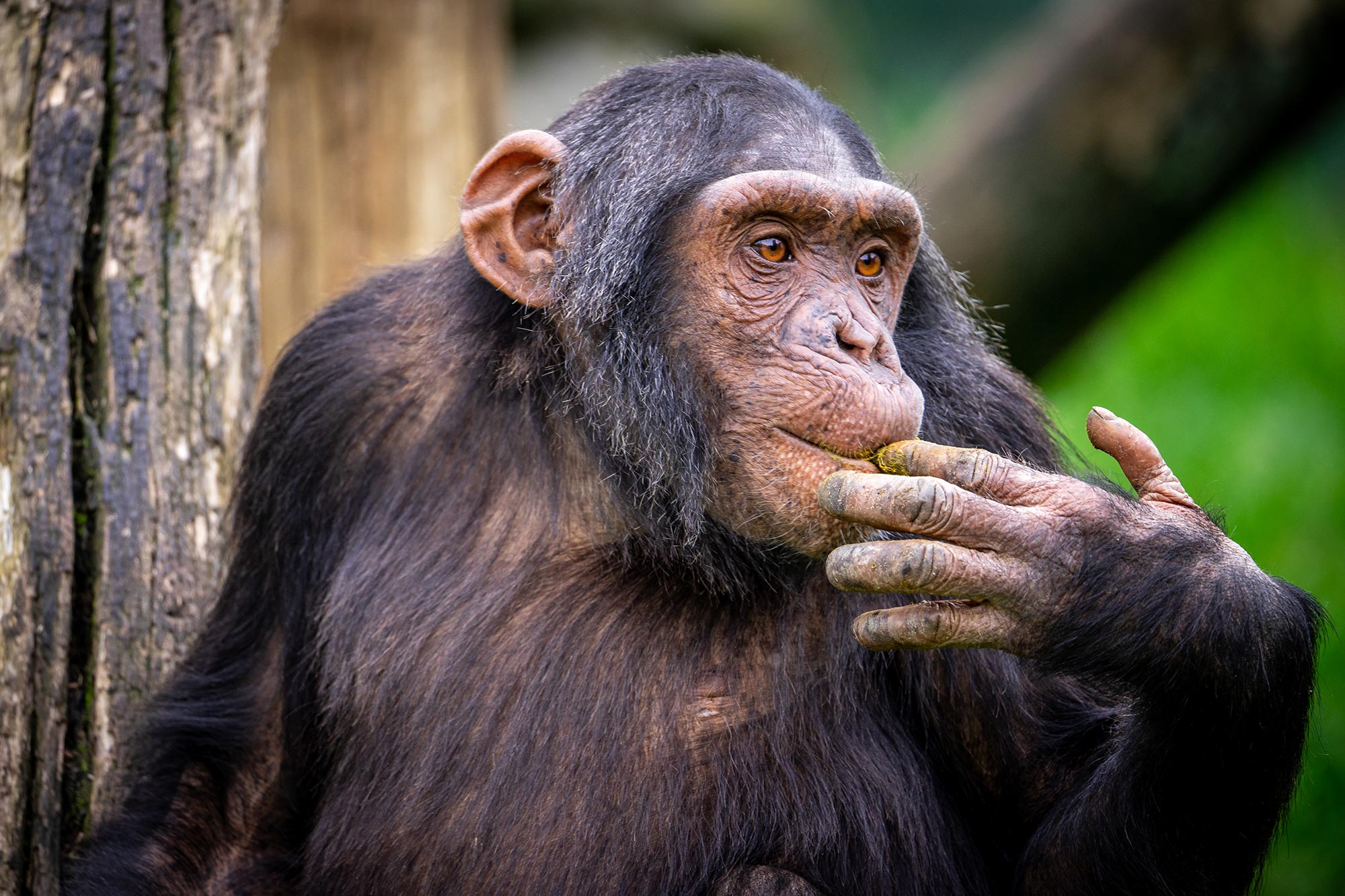
A controlled experiment with chimpanzees reveals that friendship can subtly change how individuals treat one another during conflict.
Chimpanzees appear to treat close companions differently even when food is at stake. In a controlled experiment, researchers found that the animals were less likely to steal pineapple from strongly bonded partners than from chimps with whom they had weaker relationships. Friendship also changed how both animals reacted when theft occurred.
The findings suggest that chimpanzee social bonds influence not only cooperative behaviors such as grooming and food sharing, but also the restraint animals show during potentially hostile interactions. Researchers say those relationship-specific expectations may offer clues to the evolutionary foundations of human friendship and cooperation.
Friends Steal From Each Other Less Often
Researchers from the University of California, Berkeley, studied 26 chimpanzees at the Ngamba Island Chimpanzee Sanctuary in Uganda. Before testing them, the team spent more than 800 hours observing their everyday behavior, recording grooming, social interactions, and how often particular animals remained within arm’s reach of one another. Those patterns allowed the researchers to identify pairs with especially close social bonds.
They then placed two chimpanzees in adjoining rooms. One chimp had access to three trays containing pieces of pineapple. A rope attached to those trays extended into the second room, where another chimp could leave it untouched or pull it and take the fruit. Each animal experienced trials involving both a close partner and a less closely bonded chimp.
Chimps stole food in 70% of trials involving nonfriends, compared with 61% of trials involving friends. Because the same animals were tested under both relationship conditions, the researchers could compare how each chimp behaved toward different partners rather than relying only on differences between individuals.
“Ours is the first study to show that they’re able to hold back antisocial behavior with their friends,” said Oded Ritov, the paper’s first author and a Berkeley psychology Ph.D. student who works with the Social Origins Lab.
Friendship Changed the Emotional Fallout
The researchers also tracked how the animals responded emotionally after a theft. Victims showed behaviors including stomping, fist pounding, and screeching. When a friend took their food, they initially reacted more strongly, but their agitation subsided faster than when the thief was a nonfriend.
The thieves behaved differently as well. Chimps stealing from nonfriends displayed negative behavior for longer, which the researchers interpreted as evidence that those encounters were more hostile. Theft between close partners, by contrast, produced a different emotional pattern on both sides.
“This suggests that there may be mutual expectations in chimps from both sides of the friendship, which makes it seem more like the complex friendships we see in humans,” Ritov said.
Social Expectations May Run Deep
Previous research has shown that chimpanzees favor particular partners when grooming or sharing food, supporting the idea that their social relationships are selective rather than interchangeable.
Jan Engelmann, an associate professor of psychology and principal investigator with Berkeley’s Social Origins Lab, said the new results point beyond preferential treatment toward relationship-specific expectations.
“We expect more of our friends,” said Engelmann, a senior author of the paper. “These findings really deepen our understanding of the evolutionary roots of friendships. This is, to my knowledge, the first evidence showing that also chimpanzees expect and maybe demand special treatment from their friends. These kinds of social expectations might form the basis of human moral principles.”
Ritov studies the evolutionary roots of human behavior, including fairness, social norms, and emotions across species and cultures. The new work supports the possibility that expectations governing close relationships existed before the emergence of the much broader moral and cooperative systems found in humans.
“We think that these expectations might be the basic building blocks of the larger-scale cooperation we see in humans,” Ritov said. “The expectations that chimpanzees have from their friends or close collaborative partners might have scaled up to more generalized expectations for how we should treat each other.”
Reference: “Chimpanzees steal less from their friends and expect them to do the same” by Oded Ritov, Christoph J. Völter, Liran Samuni, Avi Benozio, Dacher Keltner, Jan M. Engelmann, Laura S. Lewis and Esther Herrmann, 1 September 2026, Evolution and Human Behavior.
DOI: 10.1016/j.evolhumbehav.2026.106948
Never miss a breakthrough: Join the SciTechDaily newsletter.
Follow us on Google and Google News.