
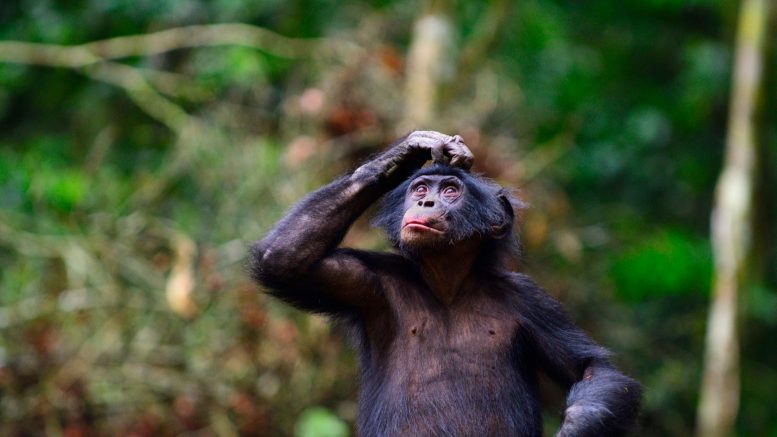
Bonobos form vocal combinations that reflect structured meaning, suggesting language-like traits evolved millions of years ago.
Bonobos, our closest living relatives, produce intricate and meaningful call combinations that resemble how humans combine words. In a new study, researchers from the University of Zurich and Harvard University challenge long-standing beliefs about the uniqueness of human language. Their findings suggest that some core features of language may have deep evolutionary roots.
The research focused on wild bonobos living in the Kokolopori Community Reserve in the Democratic Republic of Congo. Using innovative methods adapted from linguistics, the team showed for the first time that bonobo vocal communication makes extensive use of compositionality, much like human language.
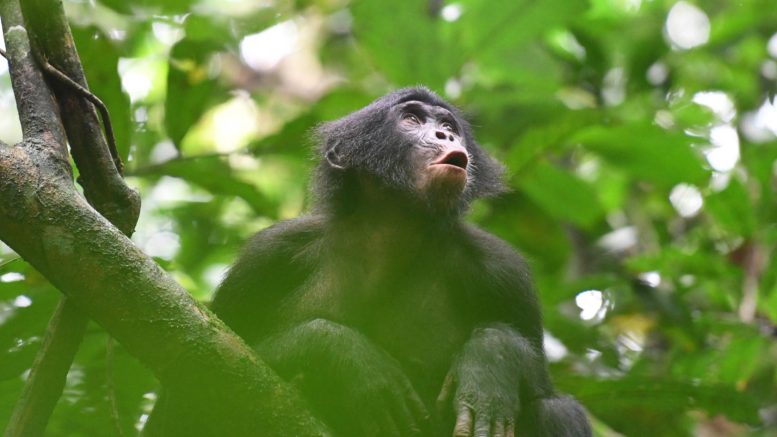
Compositionality refers to the ability to combine meaningful elements into phrases, where the overall meaning depends on both the individual parts and how they are structured. In more trivial compositionality, the meaning of the combination is the addition of its parts: for example, “blond dancer” refers to a person who is both blond and a dancer. However, in more complex, nontrivial compositionality, one part of the combination modifies the other. For example, “bad dancer” does not refer to a bad person who is also a dancer: “bad” in this case does not have an independent meaning but complements “dancer”.
A bonobo dictionary
In a first step, the researchers applied a method developed by linguists to quantify the meaning of human words.
“This allowed us to create a bonobo dictionary of sorts – a complete list of bonobo calls and their meaning,” says Mélissa Berthet, a postdoctoral researcher at the Department of Evolutionary Anthropology of UZH and lead researcher of the study.
A bonobo emits a subtle peep before the whistle, to denote tensed social situations. (Here, the bonobo is performing a display in front of the other group members by dragging a branch.) Credit: Mélissa Berthet
“This represents an important step towards understanding the communication of other species, as it is the first time that we have determined the meaning of calls across the whole vocal repertoire of an animal.”
Compositionality is not unique to humans
After determining the meaning of single bonobo vocalizations, the researchers then moved on to investigating call combinations, using another approach borrowed from linguistics.
“With our approach, we were able to quantify how the meaning of bonobo single calls and call combinations relate to each other,” says Simon Townsend, UZH Professor and senior author of the study. The researchers found numerous call combinations whose meaning was related to the meaning of their single parts, a key hallmark of compositionality.
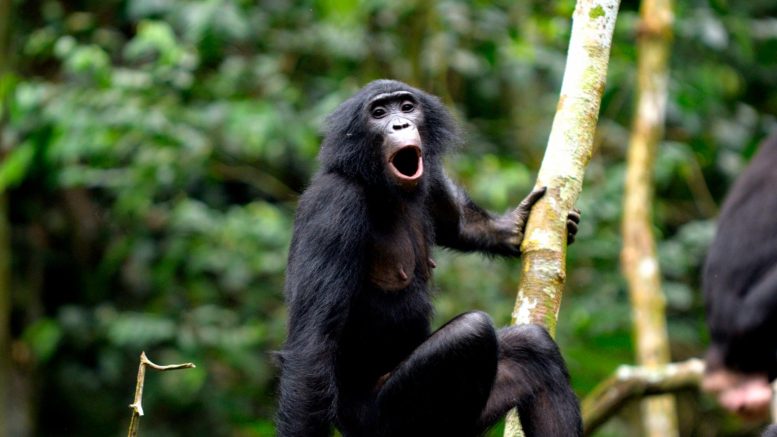
Furthermore, some of the call combinations bore a striking resemblance to the more complex nontrivial compositional structures in human language. “This suggests that the capacity to combine call types in complex ways is not as unique to humans as we once thought,” says Mélissa Berthet.
Older than previously thought
An important implication of this research is the potential light it sheds on the evolutionary roots of language’s compositional nature.
A bonobo whistling in the forest, to coordinate group movements over larger distances. Credit: Mélissa Berthet
“Since humans and bonobos had a common ancestor approximately 7 to 13 million years ago, they share many traits by descent, and it appears that compositionality is likely one of them,” says Harvard Professor Martin Surbeck, co-author of the study. “Our study therefore suggests that our ancestors already extensively used compositionality at least 7 million years ago, if not more,” adds Simon Townsend.
The findings also indicate that the ability to construct complex meanings from smaller vocal units existed long before human language emerged, and that bonobo vocal communication shares more similarities with human language than previously thought.
Reference: “Extensive compositionality in the vocal system of bonobos” by M. Berthet, M. Surbeck and S. W. Townsend, 3 April 2025, Science.
DOI: 10.1126/science.adv1170
Never miss a breakthrough: Join the SciTechDaily newsletter.
Follow us on Google and Google News.
1 Comment
thank you for this