
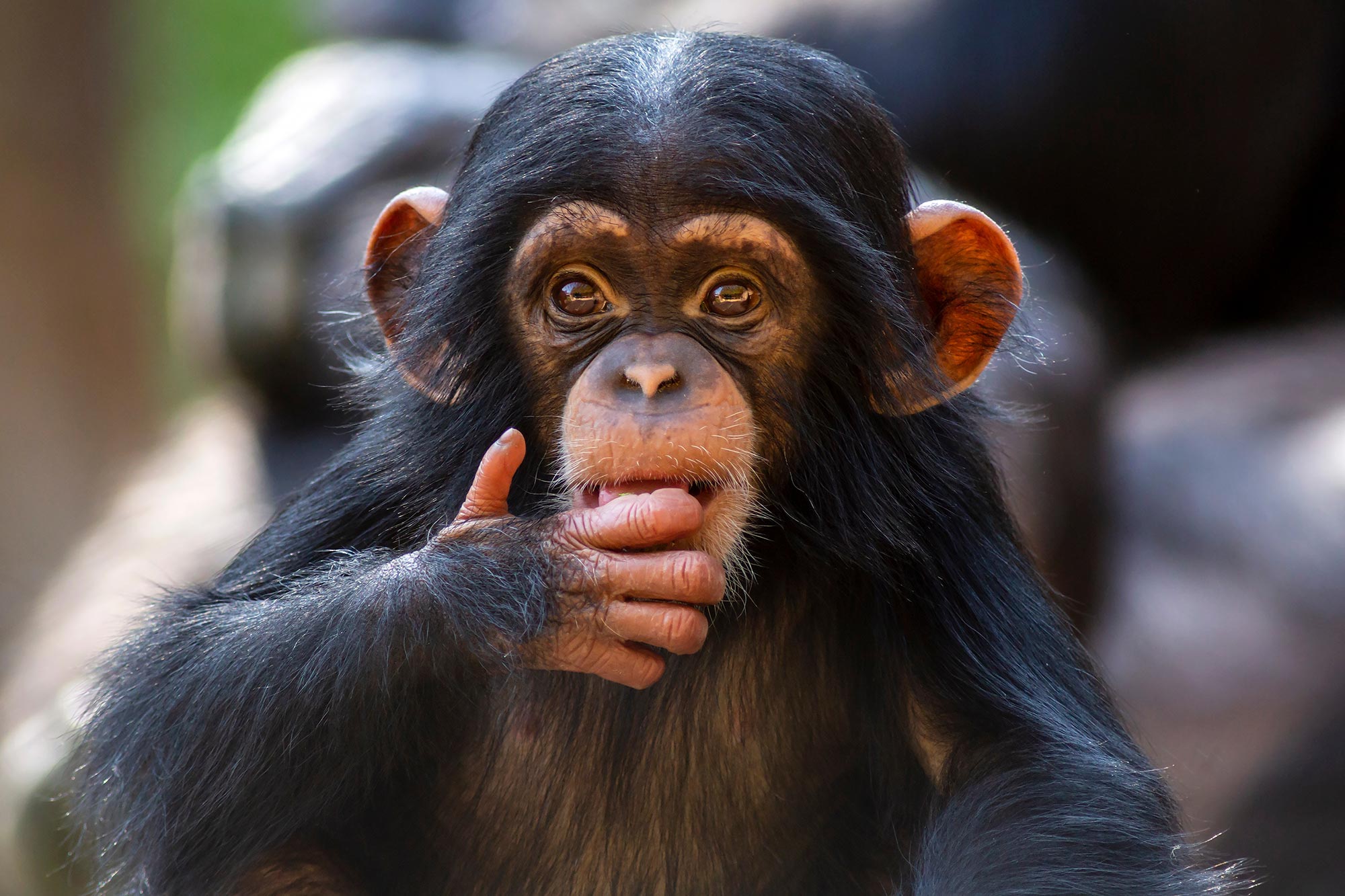
A new study published in Science shows that chimpanzees are capable of rationally revising their beliefs when they receive new information.
Chimpanzees may share more cognitive similarities with humans than scientists once believed. According to a new study published in Science, researchers have found that chimpanzees are capable of rationally updating their beliefs when they encounter new evidence.
The research was led by a collaborative team including UC Berkeley Psychology Postdoctoral Researcher Emily Sanford, UC Berkeley Psychology Professor Jan Engelmann, and Utrecht University Psychology Professor Hanna Schleihauf. Their results indicate that chimpanzees, much like humans, can adjust their decisions based on the reliability of the information available, a defining trait of rational thinking.
At the Ngamba Island Chimpanzee Sanctuary in Uganda, the team tested this ability by showing the chimps two boxes, only one of which contained food. First, the animals were given a hint about which box held the treat. Later, they received stronger evidence favoring the other box. In many cases, the chimpanzees changed their choice once they recognized that the new clue offered better guidance.
“Chimpanzees were able to revise their beliefs when better evidence became available,” said Sanford, who is a researcher in the UC Berkeley Social Origins Lab. “This kind of flexible reasoning is something we often associate with 4-year-old children. It was exciting to show that chimps can do this too.”
Testing Rationality Through Models
To ensure the findings reflected genuine reasoning rather than instinct, the team incorporated tightly controlled experiments and computational modeling. These analyses ruled out simpler explanations, such as the chimps favoring the latest signal (recency bias) or reacting to the most obvious cue. The models confirmed that the chimps’ decision-making aligned with rational strategies of belief revision.
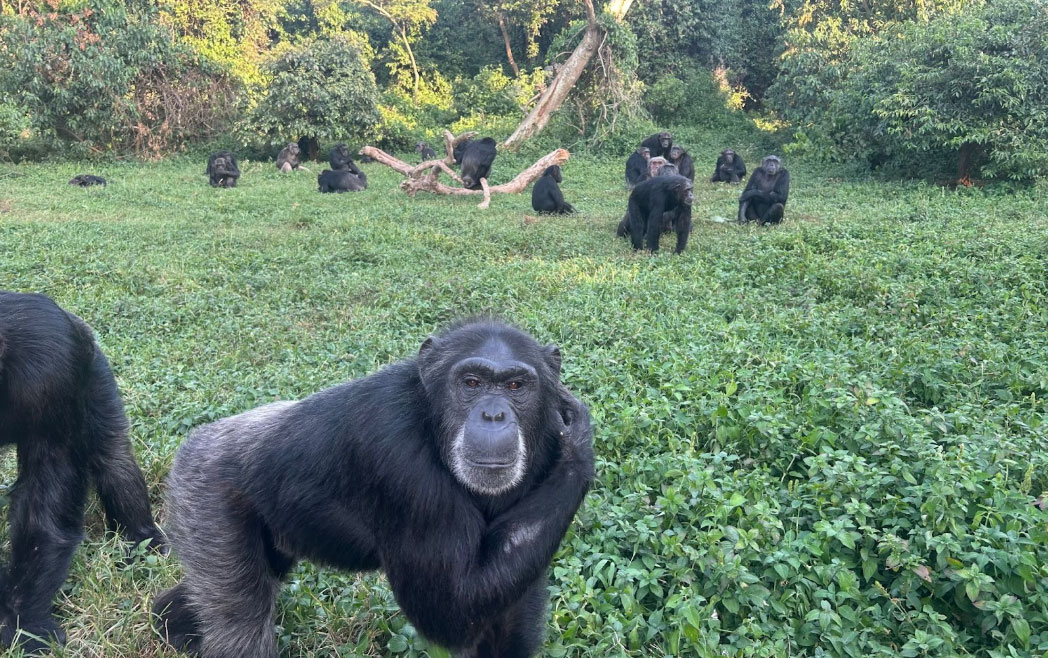
“We recorded their first choice, then their second, and compared whether they revised their beliefs,” Sanford said. “We also used computational models to test how their choices matched up with various reasoning strategies.”
The study challenges the traditional view that rationality — the ability to form and revise beliefs based on evidence — is exclusive to humans.
“The difference between humans and chimpanzees isn’t a categorical leap. It’s more like a continuum,” Sanford said.
Broader Implications for Science and AI
Sanford also sees broader applications for this research. Understanding how primates revise beliefs could reshape how scientists think about learning, child development, and even artificial intelligence.
“This research can help us think differently about how we approach early education or how we model reasoning in AI systems,” she said. “We shouldn’t assume children are blank slates when they walk into a classroom.”
The next phase of her study brings the same tasks to children. Sanford’s team is currently collecting data from two- to four-year-olds to compare how toddlers and chimps revise beliefs.
“It’s fascinating to design a task for chimps, and then try to adapt it for a toddler,” she said.
Eventually, she hopes to extend the study to other primate species as well, building a comparative map of reasoning abilities across evolutionary branches. While Sanford has worked on everything from dog empathy to numerical cognition in children, one lesson remains constant: animals are capable of much more than we assume.
“They may not know what science is, but they’re navigating complex environments with intelligent and adaptive strategies,” she said. “And that’s something worth paying attention to.”
Reference: “Chimpanzees rationally revise their beliefs” by Hanna Schleihauf, Emily M. Sanford, Bill D. Thompson, Snow Zhang, Joshua Rukundo, Josep Call, Esther Herrmann and Jan M. Engelmann, 30 October 2025, Science.
DOI: 10.1126/science.adq5229
Other members of the research team include: Bill Thompson (UC Berkeley Psychology); Snow Zhang (UC Berkeley Philosophy); Joshua Rukundo (Ngamba Island Chimpanzee Sanctuary/Chimpanzee Trust, Uganda); Josep Call (School of Psychology and Neuroscience, University of St Andrews); and Esther Herrmann (School of Psychology, University of Portsmouth).
Never miss a breakthrough: Join the SciTechDaily newsletter.
Follow us on Google and Google News.
3 Comments
most animals can think rationally. Some are just better at it than others.
We now have proof that chimpanzees are smarter than trumpanzees.
Funny I have performed the same exercies with my dogs at home with similar results.
What a joke of a conclusion.