
Close Menu
    Facebook X (Twitter) Instagram
    SciTechDaily
    • Biology
    • Chemistry
    • Earth
    • Health
    • Physics
    • Science
    • Space
    • Technology
    Facebook X (Twitter) Pinterest YouTube RSS
    SciTechDaily
    Home»Biology»World’s Smallest Primate Issues High-Frequency Calls Like Bats
    Biology

    World’s Smallest Primate Issues High-Frequency Calls Like Bats

    By SciTechDailyFebruary 7, 20121 Comment3 Mins Read
    Facebook Twitter Pinterest Telegram LinkedIn WhatsApp Email Reddit
    Share
    Facebook Twitter LinkedIn Pinterest Telegram Email Reddit
    tarsier-ultrasound-vocalization
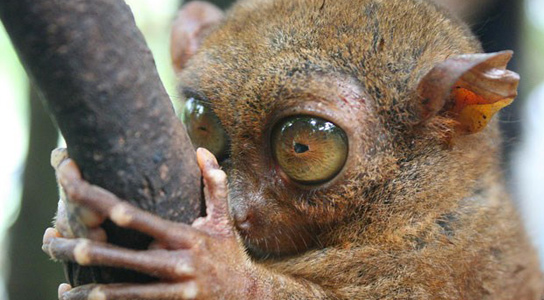
    Philippine tarsier

    It was recently discovered by a team of scientists that the Philippine tarsier (Tarsius syrichta) can communicate in pure ultrasound, issuing calls that are so high-pitched that human ears cannot perceive them. The huge-eyed tarsier definitely has arresting looks.

    Researcher Marissa Ramiser, an evolutionary biologist at Humboldt State University, California, noted that it was previously thought that the tarsiers are quiet nocturnal creatures. It turns out that they’re actually screaming so high that no one could hear them.

    Human ears can hear up to 20 kHz. The Philippine tarsier can hear up to 91 kHz, and it cries out at the 70-kHz range. This implies that tarsiers’ hearing abilities are similar to the ones of bats, and far beyond any other primates on Earth.

    T.syrichta, one of the smallest primate species, can only be found on the islands of the Philippines. Fully grown, they’re the size of a human fist. Tarsiers lack a tapetum lucidum, the layer of tissue in retinas that allow for strong night vision. Instead, tarsiers have giant eyes. They resemble lemurs and lorises in many ways.
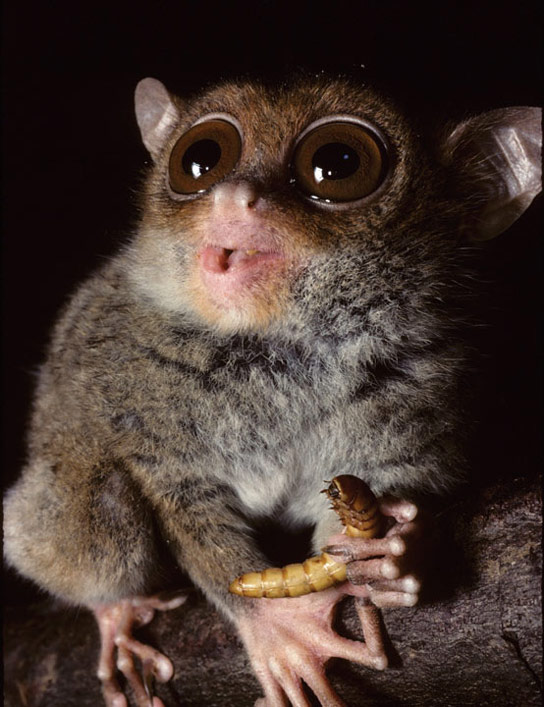
    tarsier-eating-grubs

    Tarsiers are difficult test subjects, since they are endangered and don’t respond well to captivity. Ramsier and her colleagues captured six tarsiers on the island of Mindanao and placed each in a sound-dampening chamber, in which they were exposed to noises of varying frequencies. Electrodes were placed on their skulls to measure the responses of their brains.

    Once the tests were completed, the tarsiers were released into the wild. Each one was kept for about an hour.

    To find out if tarsiers could make ultrasonic noises, the researchers recorded them on the islands of Bohol and Leyte. Sharon Gursky-Doyen, a Texas A&M anthropologist, noticed that the animals opened their mouths and she couldn’t hear their cries. She took a bat detector and was able to record some vocalizations.

    The researchers captured the calls of 35 wild tarsiers using the microphone, and discovered that the animals cried out in ultrasound, ranging from 67 to 79 kHz. Their results were published on February 7th in the journal Biology Letters.

    Other primates do have ultrasonic elements in their calls, but the dominant frequencies are audible to humans. The other mammals that use ultrasonic communication are whales, dolphins, bats, rodents, and domestic cats.

    By communicating this way, tarsiers may be able to keep predators from hearing them. They might also use their hearing skills to locate insects. It’s doubtful that tarsiers can use echolocation like bats.

    Reference: “Primate communication in the pure ultrasound” by Marissa A. Ramsier, Andrew J. Cunningham, Gillian L. Moritz, James J. Finneran, Cathy V. Williams, Perry S. Ong, Sharon L. Gursky-Doyen and Nathaniel J. Dominy, 8 February 2012, Biology Letters.
    DOI: 10.1098/rsbl.2011.1149

    Never miss a breakthrough: Join the SciTechDaily newsletter.
    Follow us on Google and Google News.

    Evolutionary Biology Popular Primates Primatology Ultrasound
    Share. Facebook Twitter Pinterest LinkedIn Email Reddit

    Related Articles

    Decoding Lifespan: Cornell Study Links Motherly Care to Extended Human Life

    Does Fruit Really Fuel Brain Growth? New Study Challenges Old Ideas

    Tracing Ghosts of Evolution: The Hidden Genetic Lineage in Gorillas

    New Research Unlocks Hidden Secrets of Primate Evolution

    Scientists Discover Surprising Similarities in Stone Tools of Early Humans and Monkeys

    Helium Reveals Gibbons’ Developed & Far Ranging Vocalizations

    Pentaradially Symmetrical Brittle Stars Move Bilaterally, Like People

    Bonobo Great Apes Are Domesticating Themselves

    Researchers Complete Genome Sequence of a Denisovan Human Finger Bone

    1 Comment

    1. Missy Lady on May 13, 2025 10:09 pm

      Amazing God’s creation which marvel me greatly .

      Reply
    Leave A Reply Cancel Reply

    • Facebook
    • Twitter
    • Pinterest
    • YouTube

    Don't Miss a Discovery

    Subscribe for the Latest in Science & Tech!

    Trending News

    The Universe Is Expanding Too Fast and Scientists Can’t Explain Why

    “Like Liquid Metal”: Scientists Create Strange Shape-Shifting Material

    Early Warning Signals of Esophageal Cancer May Be Hiding in Plain Sight

    Common Blood Pressure Drug Shows Surprising Power Against Deadly Antibiotic-Resistant Superbug

    Scientists Uncover Dangerous Connection Between Serotonin and Heart Valve Disease

    Scientists Discover a “Protector” Protein That Could Help Reverse Hair Loss

    Bone-Strengthening Discovery Could Reverse Osteoporosis

    Scientists Uncover Hidden Trigger Behind Stem Cell Aging

    Follow SciTechDaily
    • Facebook
    • Twitter
    • YouTube
    • Pinterest
    • Newsletter
    • RSS
    SciTech News
    • Biology News
    • Chemistry News
    • Earth News
    • Health News
    • Physics News
    • Science News
    • Space News
    • Technology News
    Recent Posts
    • A Common Diabetes Drug May Hold the Key to Stopping HIV From Coming Back
    • Ancient “Syphilis-Like” Disease in Vietnam Challenges Key Scientific Assumptions
    • Drinking Alcohol To Cope in Your 20s Could Damage Your Brain for Life
    • Scientists Crack Alfalfa’s Chromosome Mystery After Decades of Debate
    • Ancient Ant-Plant Alliance Collapses As Predatory Wasps Move In
    Copyright © 1998 - 2026 SciTechDaily. All Rights Reserved.
    • Science News
    • About
    • Contact
    • Editorial Board
    • Privacy Policy
    • Terms of Use

    Type above and press Enter to search. Press Esc to cancel.