

Chimpanzees select materials for tools based on flexibility, revealing early engineering instincts linked to human tool evolution.
A multidisciplinary team of researchers from the School of Anthropology and Museum Ethnography at the University of Oxford, the Max Planck Institute for Evolutionary Anthropology, the Jane Goodall Institute in Tanzania, the University of Algarve, and the University of Porto in Portugal, and the University of Leipzig has discovered that chimpanzees in Gombe Stream National Park, Tanzania, use a form of engineering in their tool-making. Specifically, they deliberately select plants that yield more flexible materials when crafting tools for termite fishing.
The findings, published in the journal iScience, provide important insights into the technical skills involved in making perishable tools, an area that remains largely unknown in the study of human technological evolution.

Termites are a valuable food source for chimpanzees, offering energy, fat, vitamins, minerals, and protein. To access them, chimpanzees use thin probes to extract termites from their nests. Since the interior of termite mounds consists of narrow, winding tunnels, researchers proposed that flexible tools would be more effective than rigid ones for navigating these spaces and retrieving the insects.
Testing chimpanzee tool materials for flexibility
To test this, first author Alejandra Pascual-Garrido took a portable mechanical tester to Gombe and measured how much force it took to bend plant materials used by the apes compared to plant materials that were available but never used. Findings showed that plant species never used by chimpanzees were 175 percent more rigid than their preferred materials.
Furthermore, even among plants growing near termite mounds, those that showed obvious signs of regular use by the apes produced more flexible tools than nearby plants that showed no signs of use.
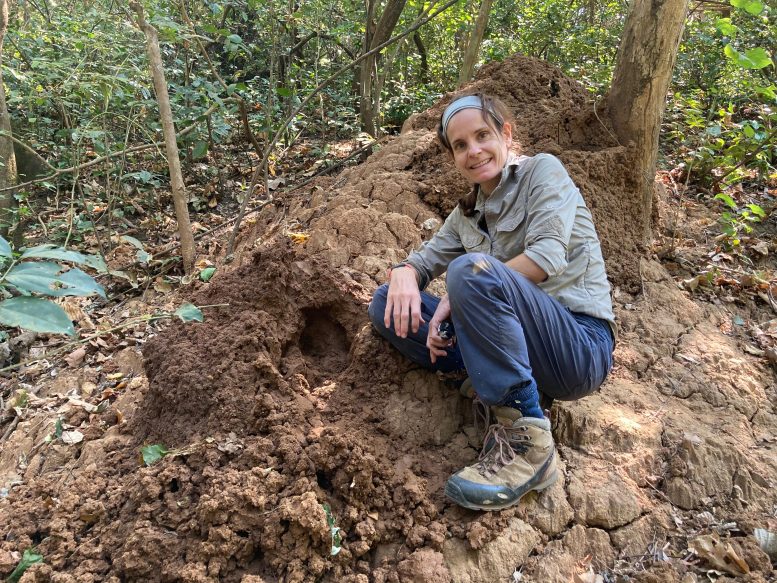
“This is the first comprehensive evidence that wild chimpanzees select tool materials for termite fishing based on specific mechanical properties,” says Alejandra Pascual-Garrido, who has been studying the raw materials used in chimpanzee tools in Gombe for more than a decade.
Notably, certain plant species, such as Grewia spp., also constitute tool material for termite fishing chimpanzee communities living up to 5,000 kilometers away from Gombe, implying that the mechanics of these plant materials could be a foundation for such ubiquitous preferences and that rudimentary engineering may be deeply rooted in chimpanzee tool-making culture.
Chimpanzees show an intuitive understanding of material function
Wild chimpanzees may therefore possess a kind of “folk physics” – an intuitive comprehension of material properties that helps them choose the best tools for the job.
Their natural engineering ability is not just about using any stick or plant that is available; chimpanzees specifically select materials with mechanical properties that can make their foraging tools more effective.
Dr Alejandra Pascual-Garrido, Research Affiliate at the School of Anthropology and Museum Ethnography, University of Oxford, said: “This novel approach, which combines biomechanics with animal behavior, helps us better understand the cognitive processes behind chimpanzee tool construction and how they evaluate and select materials based on functional properties.”

The findings raise important questions about how this knowledge is learned, maintained, and transmitted across generations, for example, by young chimpanzees observing and using their mothers’ tools, and whether similar mechanical principles determine chimpanzees’ selection of materials for making other foraging tools, such as those used for eating ants or harvesting honey.
Linking chimpanzee tool use to human evolution
“This finding has important implications for understanding how humans might have evolved their remarkable tool-using abilities,” explains Adam van Casteren, Department of Human Origins, Max Planck Institute for Evolutionary Anthropology, a specialist in biomechanics and evolutionary biology. “While perishable materials like wood rarely survive in the archaeological record, the mechanical principles behind effective tool construction and use remain constant across species and time.”
By studying how chimpanzees select materials based on specific structural and/or mechanical properties, we can better understand the physical constraints and requirements that would have applied to early human tool use. Using such a comparative functional framework provides new insights into aspects of early technology that are not preserved in the archaeological record.
Reference: “Engineering skills in the manufacture of tools by wild chimpanzees” by Alejandra Pascual-Garrido, Susana Carvalho, Deus Mjungu, Ellen Schulz-Kornas, and Adam van Casteren, 24 March 2025, iScience.
DOI: 10.1016/j.isci.2025.112158
Never miss a breakthrough: Join the SciTechDaily newsletter.
Follow us on Google and Google News.