
Close Menu
    Facebook X (Twitter) Instagram
    SciTechDaily
    • Biology
    • Chemistry
    • Earth
    • Health
    • Physics
    • Science
    • Space
    • Technology
    Facebook X (Twitter) Pinterest YouTube RSS
    SciTechDaily
    Home»Biology»Breaking Barriers in Biology: Universal Equation Links Wingbeats of Whales to Mosquitoes
    Biology

    Breaking Barriers in Biology: Universal Equation Links Wingbeats of Whales to Mosquitoes

    By PLOSJune 24, 2024No Comments3 Mins Read
    Facebook Twitter Pinterest Telegram LinkedIn WhatsApp Email Reddit
    Share
    Facebook Twitter LinkedIn Pinterest Telegram Email Reddit
    Whale With Bird Above Concept Art
    Danish researchers developed a universal equation that predicts the wingbeat and fin stroke frequencies of various animals using body mass and wing area. Credit: SciTechDaily.com

    Researchers from Roskilde University in Denmark have developed a universal equation that can effectively predict the frequency of wingbeats and fin strokes made by birds, insects, bats, and whales. This groundbreaking research was recently published in the journal PLOS ONE.

    The capability of flight has evolved independently across different animal groups. Biologists have theorized that to minimize energy expenditure during flight, the natural resonance frequency of the wings should dictate the wing flapping frequency. However, finding a universal mathematical description of flapping flight has proved difficult.

    In their study, the researchers used dimensional analysis to calculate an equation that describes the frequency of wingbeats of flying birds, insects, and bats, and the fin strokes of diving animals, including penguins and whales.

    Empirical Validation of the Universal Equation

    The scientists discovered that flying and diving animals beat their wings or fins at a frequency that is proportional to the square root of their body mass, divided by their wing area. They tested the accuracy of the equation by plotting its predictions against published data on wingbeat frequencies for bees, moths, dragonflies, beetles, mosquitos, bats, and birds ranging in size from hummingbirds to swans.
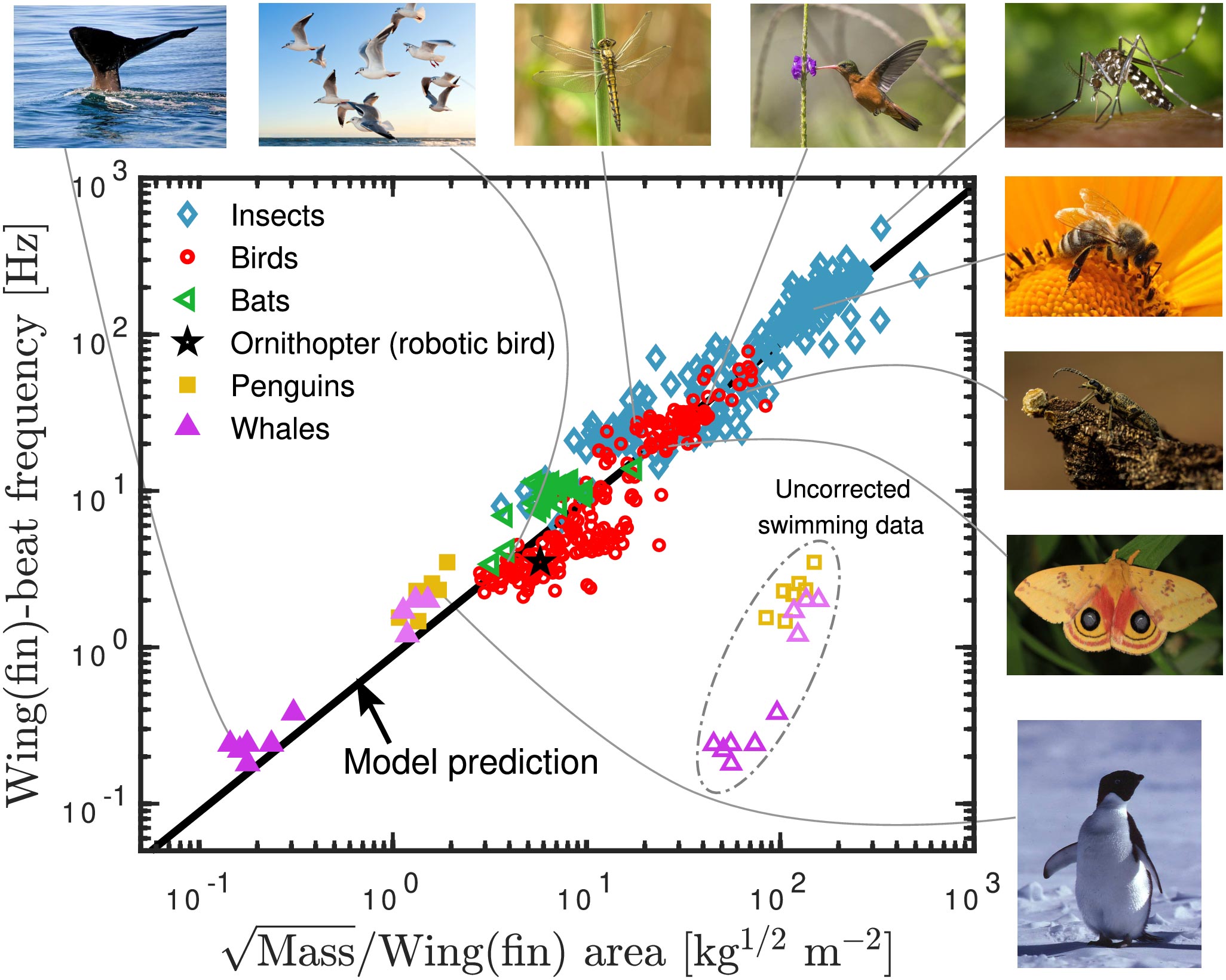
    Universal Wing and Fin Beat Frequency Equation
    Wing-beat-frequency data for a variety of flying animals versus the square-root of the animal mass divided by the wing/fin area. Credit: Jensen et al., 2024, PLOS ONE, CC-BY 4.0 (https://creativecommons.org/licenses/by/4.0/)

    Cross-Species Comparison and Historical Insight

    They also compared the equation’s predictions against published data on fin stroke frequencies for penguins and several species of whale, including humpbacks and northern bottlenose whales. The relationship between body mass, wing area, and wingbeat frequency shows little variation across flying and diving animals, despite huge differences in their body size, wing shape, and evolutionary history.

    Additionally, the researchers demonstrated how their equation could provide insights into the wingbeat frequency of extinct species. Using their equation, the researchers estimated that the extinct pterosaur Quetzalcoatlus northropi, the largest known flying animal, beat its 10-meter-square wings at a frequency of 0.7 hertz.

    Implications for Biology and Future Technologies

    The study shows that despite huge physical differences, animals as distinct as butterflies and bats have evolved a relatively constant relationship between body mass, wing area, and wingbeat frequency. The researchers note that for swimming animals they didn’t find publications with all the required information; data from different publications was pieced together to make comparisons, and in some cases, animal density was estimated based on other information. Furthermore, extremely small animals — smaller than any yet discovered — would likely not fit the equation, because the physics of fluid dynamics changes at such a small scale. This could have implications in the future for flying nanobots. The authors say that the equation is the simplest mathematical explanation that accurately describes wingbeats and fin strokes across the animal kingdom.

    The authors add: “Differing almost a factor 10000 in wing/fin-beat frequency, data for 414 animals from the blue whale to mosquitoes fall on the same line. As physicists, we were surprised to see how well our simple prediction of the wing-beat formula works for such a diverse collection of animals.”

    Reference: “Universal wing- and fin-beat frequency scaling” by Jens Højgaard Jensen, Jeppe C. Dyre and Tina Hecksher, 5 June 2024, PLOS ONE.
    DOI: 10.1371/journal.pone.0303834

    Funding: This study was supported by the VILLUM Foundation’s Matter grant VIL16515.

    Never miss a breakthrough: Join the SciTechDaily newsletter.
    Follow us on Google and Google News.

    Animal Sciences Birds Butterflies Evolutionary Biology Insect Mathematics PLOS Whales
    Share. Facebook Twitter Pinterest LinkedIn Email Reddit

    Related Articles

    Groundbreaking Study Reveals Animals Form Long-Term Friendships, Just Like Humans

    Caterpillar or Hummingbird? Bizarre Baby Bird Discovery Stuns Scientists in Panama

    Barb Geometry of Asymmetrical Feathers Sheds Light on Evolution of Flight

    A Natural Example of a Functioning Gear Mechanism Discovered in an Insect

    Insects Help Scientists Understand the Predictability of Evolution

    Female Butterflies Prefer Flashier Mates

    Evidence Shows that Birds are Essentially Living Dinosaurs

    “Map of Life” to Illustrate All Living Things Geographically

    Patterns of Flocks of Starlings Mathematically Behave How Magnets Would Move

    Leave A Reply Cancel Reply

    • Facebook
    • Twitter
    • Pinterest
    • YouTube

    Don't Miss a Discovery

    Subscribe for the Latest in Science & Tech!

    Trending News

    Monster Storms on Jupiter Unleash Lightning Beyond Anything on Earth

    Scientists Create “Liquid Gears” That Spin Without Touching

    The Simple Habit That Could Help Prevent Cancer

    Millions Take These IBS Drugs, But a New Study Finds Serious Risks

    Scientists Unlock Hidden Secrets of 2,300-Year-Old Mummies Using Cutting-Edge CT Scanner

    Bread Might Be Making You Gain Weight Even Without Eating More Calories

    Scientists Discover Massive Magma Reservoir Beneath Tuscany

    Europe’s Most Active Volcano Just Got Stranger – Here’s Why Scientists Are Rethinking It

    Follow SciTechDaily
    • Facebook
    • Twitter
    • YouTube
    • Pinterest
    • Newsletter
    • RSS
    SciTech News
    • Biology News
    • Chemistry News
    • Earth News
    • Health News
    • Physics News
    • Science News
    • Space News
    • Technology News
    Recent Posts
    • New Brain Discovery Challenges Long-Held Theory of Teenage Brain Development
    • Sharks Are Overheating as Warming Oceans Push Them to the Edge
    • Scientists Discover Plants “Scream” – We Just Couldn’t Hear Them Until Now
    • 25-Year Study Uncovers Hidden Paths and Early Warning Signs of Blood Cancer
    • Not Just Snoring – New Research Reveals Sleep Apnea May Be Damaging Your Muscles
    Copyright © 1998 - 2026 SciTechDaily. All Rights Reserved.
    • Science News
    • About
    • Contact
    • Editorial Board
    • Privacy Policy
    • Terms of Use

    Type above and press Enter to search. Press Esc to cancel.