
Close Menu
    Facebook X (Twitter) Instagram
    SciTechDaily
    • Biology
    • Chemistry
    • Earth
    • Health
    • Physics
    • Science
    • Space
    • Technology
    Facebook X (Twitter) Pinterest YouTube RSS
    SciTechDaily
    Home»Biology»Patterns of Flocks of Starlings Mathematically Behave How Magnets Would Move
    Biology

    Patterns of Flocks of Starlings Mathematically Behave How Magnets Would Move

    By SciTechDailyMarch 14, 2012No Comments2 Mins Read
    Facebook Twitter Pinterest Telegram LinkedIn WhatsApp Email Reddit
    Share
    Facebook Twitter LinkedIn Pinterest Telegram Email Reddit
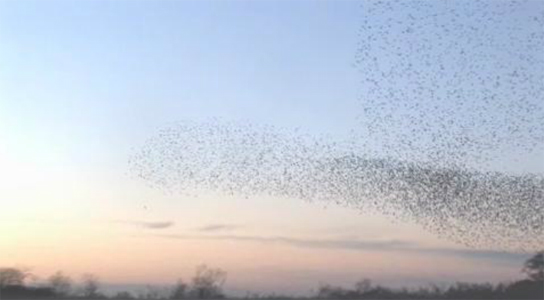
    starling-flock
    Starling flock

    Starlings, a small to medium-sized passerine bird in the family Sturnidae, achieve extraordinary coordination in flight and they behave mathematically as metals being magnetized. A new study published its findings in the journal Proceedings of the National Academy of Sciences.

    The researchers described some of the aspects of starling flockings with equations used to model avalanches. The birds’ aerial formations transcend biology and span multiple physical phenomena.
    starling-velocities
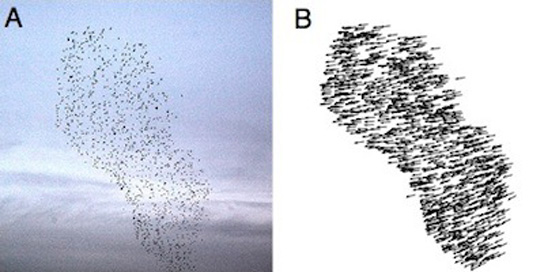
    (A) snapshot of a murmuration containing 1,246 starlings and their velocities (B). Image: Bialek et al./PNAS

    Murmurations of Sturnus vulgaris vulargis can be found across North America and Western Europe. Flocks in Rome are renowned for their size. The team used video cameras and software to track the trajectories of individual birds and then analyzed the flock dynamics from second to second using mathematical modeling tools.

    It’s already been shown that changes in the velocity of one bird affect the whole flock. The scale-free correlation is seen in systems poised at the edge of criticality, just like snow crystals in the moments before an avalanche. The researchers looked at velocity and orientation in the flock.
    lamprotornis-hildebrandt-tanzania-starling

    The orientation changes affected seven of the bird’s closest neighbors to alter their flight. This number stayed constant regardless of the flock density, which in turn made the equations describing them topological, invariant to properties that remain after continuous deformation of the flock, rather than critical in nature.

    Even without criticality, changes ripple quickly through flocks, going from 7 birds to 49, etc. In physics, the closest statistical fit for this behavior is in magnetism, and it describes when particles align with their neighbors as metals become magnetized.

    Starling flocks seem to be optimized to evade predators.

    Reference: “Statistical mechanics for natural flocks of birds” by William Bialek, Andrea Cavagna, Irene Giardina, Thierry Mora, Edmondo Silvestri, Massimiliano Viale and Aleksandra M. Walczak, 16 March 2012, Proceedings of the National Academy of Sciences.
    DOI: 10.1073/pnas.1118633109

    Never miss a breakthrough: Join the SciTechDaily newsletter.
    Follow us on Google and Google News.

    Birds Flock Mathematics Movement Passerine Starling Statistics Topology
    Share. Facebook Twitter Pinterest LinkedIn Email Reddit

    Related Articles

    Breaking Barriers in Biology: Universal Equation Links Wingbeats of Whales to Mosquitoes

    How Do Birds Flock? Researchers Reveal Previously Unknown Aerodynamic Phenomenon

    Pigeons Ability to Hear Magnetic Fields Finally Linked to the Lagena in Inner Ear

    Hummingbirds Notice Location, Not Flower Color

    Hearing Loss Rapidly Changes Brain Motor Areas That Control Song

    “Area X” of Zebra Finch May Provide Insights to Human Speech Disorders

    Researchers Believe Triceratops had Upright Forelimbs

    Collecting All Pennies From 1959 to 1997 Is Easily Feasible

    Earth Loses 50,000 Metric Tons of Mass Every Year

    Leave A Reply Cancel Reply

    • Facebook
    • Twitter
    • Pinterest
    • YouTube

    Don't Miss a Discovery

    Subscribe for the Latest in Science & Tech!

    Trending News

    This Experimental Drug Repaired the Gut and Reversed Severe Fatty Liver Disease

    Physicists Just Turned a Black Hole Energy Theory Into Reality

    Stanford Scientists Solve a 252-Million-Year-Old Mass Extinction Mystery

    The Ancient Survival Mechanism Making Weight Loss So Difficult

    Just 3,000 Steps a Day May Help Protect the Brain From Alzheimer’s

    “Weird Clams” Reveal a New Invasion Along the U.S. Northeast Coast

    Archaeologists Decapitated Tutankhamun and Glued His Body Back Together

    New Black Hole Theory Solves a 50-Year-Old Problem

    Follow SciTechDaily
    • Facebook
    • Twitter
    • YouTube
    • Pinterest
    • Newsletter
    • RSS
    SciTech News
    • Biology News
    • Chemistry News
    • Earth News
    • Health News
    • Physics News
    • Science News
    • Space News
    • Technology News
    Recent Posts
    • Quantum Computer Stores Data in Vibrations Like Notes on a Guitar
    • Astronomers Discover Two Super Puff Planets Lighter Than Cotton Candy
    • One Asteroid Collision May Have Rocked Earth, Mars, and the Moon
    • Scientists Restore the Sense of Touch With Electrical Brain Stimulation
    • New Study Reveals Herpesvirus Infection May Accelerate Alzheimer’s Disease
    Copyright © 1998 - 2026 SciTechDaily. All Rights Reserved.
    • Science News
    • About
    • Contact
    • Editorial Board
    • Privacy Policy
    • Terms of Use

    Type above and press Enter to search. Press Esc to cancel.