
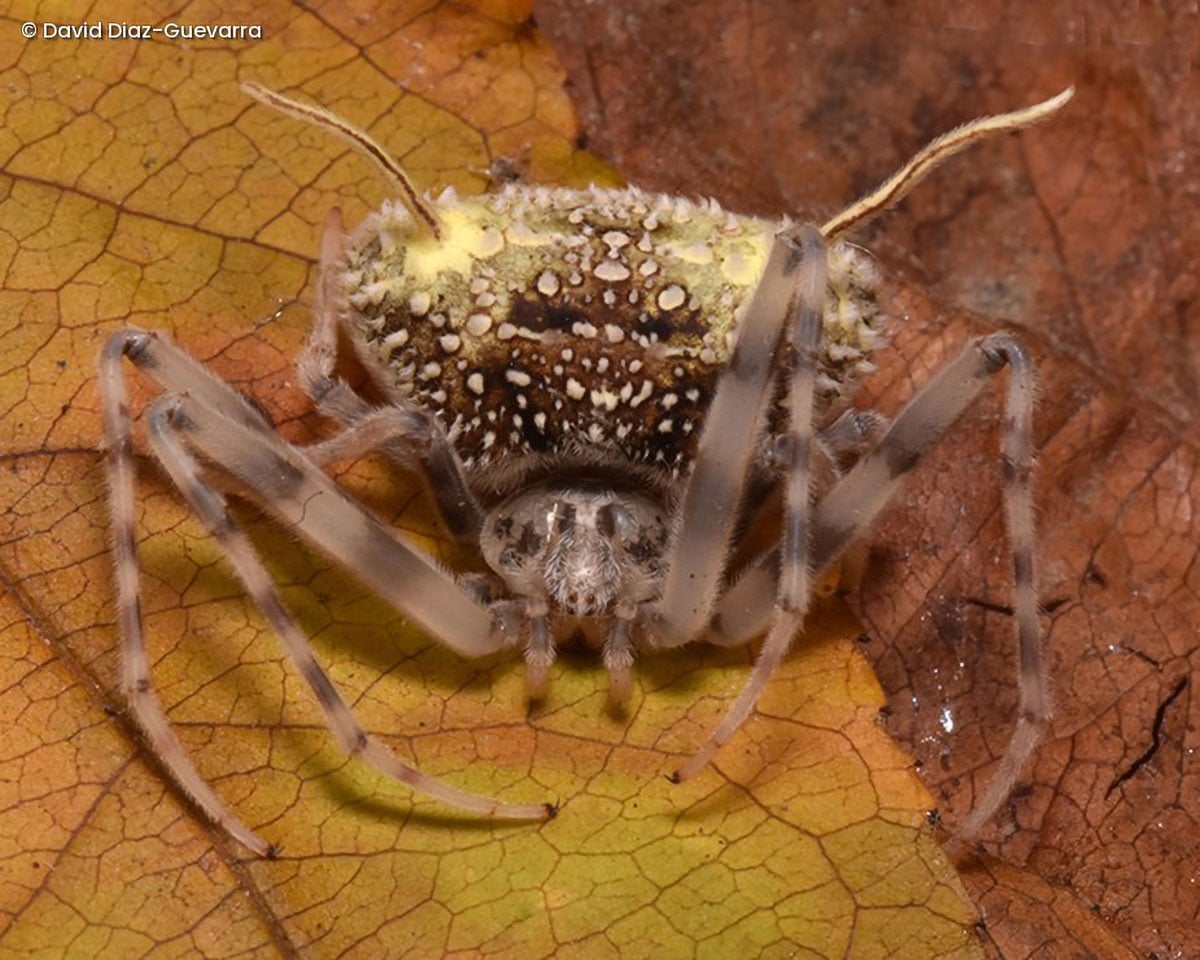
Scientists have discovered a new spider species in Ecuador’s Amazon rainforest that uses an unprecedented form of mimicry.
Deep in Ecuador’s Amazon rainforest, researchers encountered what appeared to be an ordinary mushroom clinging to the underside of a leaf. On closer inspection, however, the strange growth revealed itself to be something far more unexpected: a previously unknown species of spider.
The discovery has unveiled a form of mimicry never before documented in spiders. An international team of scientists, including researchers from the Leibniz Institute for the Analysis of Biodiversity Change (LIB), found the new species and published their findings in the journal Zootaxa. The study provides a rare glimpse into the evolution of deception in nature and highlights how many of the Amazon’s species remain undiscovered.
Researchers found the spider during a nighttime survey in Ecuador’s Llanganates-Sangay Corridor, a region considered one of the world’s richest biodiversity hotspots.
The newly identified species, Taczanowskia waska, closely resembles the fruiting body of a Gibellula fungus, a parasite that grows on spiders. The spider has elongated projections on its abdomen and a pale surface that resembles fungal growth. It also stays motionless on the undersides of leaves, the same location where Gibellula fungi are commonly found.
Researchers say this combination of appearance and behavior reflects a highly specialized adaptation. By blending into its surroundings as an unremarkable object, the spider may avoid detection by predators while also increasing its chances of surprising prey.
Rare Spider Reveals New Mimicry Strategy
According to the study, this is the first known example of a spider imitating a parasitic fungus that infects spiders. The finding offers new insight into how mimicry evolves and the ecological functions such adaptations can serve.
Spiders in the genus Taczanowskia are rarely encountered and remain poorly understood. As a result, many details about their ecology are still unknown.
Nadine Dupérré of the Museum of Nature Hamburg at the LIB participated in the research. She examined reference specimens from scientific collections and helped classify the newly discovered species.
The discovery traces back to an observation posted on the citizen science platform iNaturalist. Users recognized that what appeared to be a mushroom was actually a spider, prompting further scientific investigation. The case highlights the growing role of citizen science in biodiversity studies.
Scientific Collections Unlock New Discoveries
“Finds like these demonstrate the value of scientific collections. They enable us to classify new species and compare them with historical specimens. Combined with international collaboration and citizen science, this opens up new opportunities for researching biodiversity,” explains Nadine Dupérré.
The finding also underscores the extraordinary biodiversity found in tropical regions, much of which has yet to be documented. It further demonstrates how international partnerships, scientific collections, and emerging data sources are helping researchers build a better understanding of global biodiversity.
Reference: ““The Cordyceps spider”: Taczanowskia waska sp. nov. (Araneae: Araneidae), a new spider species and a novel case of mimicry of an araneopathogenic fungus (Cordycipitaceae: Gibellula)” by David R. Díaz-Guevara, Alexander Griffin Bentley and Nadine Dupérré, 26 February 2026, Zootaxa.
DOI:10.11646/zootaxa.5760.5.4
Never miss a breakthrough: Join the SciTechDaily newsletter.
Follow us on Google and Google News.
1 Comment
So many new species. I wonder how many are due to changing environment, and how many have have been hiding (for who knows how long). It’s all very exciting.