
Scientists have uncovered compelling evidence of long-term, reciprocal helping behavior among African starlings, challenging long-held assumptions about cooperation among non-relatives in the animal kingdom.
It’s no surprise that humans often help one another, even when they’re not related. Just think about the mutual support that keeps your oldest friendships going strong.
But proving that this kind of cooperation also happens among animals has been much harder.
Now, a new study of African starlings offers powerful evidence that it does. Led by Alexis Earl, a former PhD student in the lab of Professor Dustin Rubenstein, the research team spent over 20 years observing these birds. Their findings reveal that starlings engage in “reciprocity”—helping one another with the understanding that the favor will be returned in the future.
“Starling societies are not just simple families, they’re much more complex, containing a mixture of related and unrelated individuals that live together, much in the way that humans do,” Rubenstein said.
Helping Beyond Family Ties
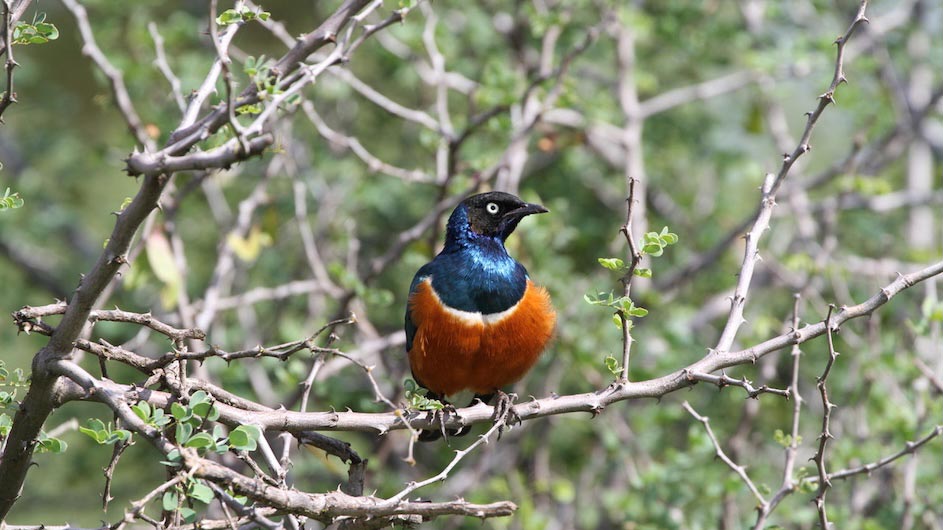
The fact that animals help their direct blood relatives, or kin, with the goal of boosting their genetic fitness and prolonging their genes, has long been known in the scientific community. Starlings do preferentially help their relatives, but many birds also help non-relatives. Earl and colleagues discovered that this non-relative helping occurs through the formation of these reciprocal helping relationships, which sometimes take place over many years.
Proving that this type of reciprocal behavior extends to animals other than direct relatives is difficult, though, since it requires large amounts of data gathered over long stretches of time. The new paper, published this week in the journal Nature, draws on 20 years of research that Rubenstein and his colleagues have conducted on African starlings living in the harsh climate of east African savannahs.
From 2002 to 2021, the researchers studied thousands of interactions between hundreds of the birds, and collected DNA from individuals in the population to examine genetic relationships. By combining 40 breeding seasons’ worth of behavioral and genetic data, the team could ask questions like: Did the birds preferentially help relatives? Did they help non-relatives even when relatives were available? And did they reciprocate help with specific individuals over the years?
Friendships in the Animal World
Ultimately, the researchers found that helpers preferentially aided relatives, but also frequently and consistently helped specific non-relative birds, even when relatives were available to help. “Many of these birds are essentially forming friendships over time,” Rubenstein said. “Our next step is to explore how these relationships form, how long they last, why some relationships stay robust, while others fall apart.”
The data builds on decades of research collected by Rubenstein and his colleagues and students on how and why animals socialize. They have examined animal societies not just in birds, but also in a diversity of species around the globe, including snapping shrimp throughout the Caribbean, wasps in Africa, beetles in Asia, and mice and lizards in Australia.
“I think this kind of reciprocal helping behavior is likely going on in a lot of animal societies, and people just haven’t studied them long enough to be able to detect it,” Rubenstein said.
Reference: “A cryptic role for reciprocal helping in a cooperatively breeding bird” by Alexis D. Earl, Gerald G. Carter, Arden G. Berlinger, Elkana Korir, Shailee S. Shah, Wilson N. Watetu and Dustin R. Rubenstein, 7 May 2025, Nature.
DOI: 10.1038/s41586-025-08958-4
Funding: Sigma Xi, The Scientific Research Society, Society for Integrative and Comparative Biology, U.S. National Science Foundation, U.S. National Science Foundation, U.S. National Science Foundation, U.S. National Science Foundation
Never miss a breakthrough: Join the SciTechDaily newsletter.
Follow us on Google and Google News.
4 Comments
I see this in my backyard almost daily.
A pair of sparrows has a nest on the back side of my house.
Let the cats out to be with us in the evenings.
The pair of sparrows starts dive bombing the cats and within 10 minutes they fly away and come back with more pairs of sparrows and then they all start dive bombing the cats together.
If we weren’t so into ourselves and our, “I’m better than anything else in the world ” attitude toward everything else in the universe; we would have known that thousands of years ago. Our own egos make us blind to not only ourselves but bars us from the love and enjoyment of life itself.
Very true.
Our human centric view of the world makes us a menace to other life. We are causing extinction of other species at a record pace. But then we were worse before – humans had a race centric view, and believed that other races of humans were born to serve the superior race.
It’s not so much that we forget that other species are like us, it’s that we ignore that we are animals much of the time.
For more info on this subject, search Temple Grandin on the web. She’s autistic as the day is long, and smarter than 99% of her peers.