

A hummingbird chick in Panama mimics a poisonous caterpillar to avoid predators—a rare case of bird-to-insect mimicry.
When Jay Falk and Scott Taylor first spotted the white-necked Jacobin hummingbird chick in Panama’s dense rainforest, the bird biologists weren’t sure what they were looking at.
The chick, just a day old and no bigger than a pinky finger, was covered in brown fuzz. As they approached the nest, it began twitching and shaking its head, movements neither researcher had ever observed in a bird before.
They soon realized the chick might be mimicking a venomous caterpillar native to the same region, using the behavior as a defense against predators. In a paper published March 17 in the journal Ecology, Taylor, a CU Boulder associate professor of ecology and evolutionary biology, and his team documented this type of mimicry in hummingbirds for the first time.
“We know so little about how birds behave in tropical nests,” said Falk, the study’s lead author and a postdoctoral researcher in Taylor’s lab. “This could be much more common than we realize if we spent more time observing and exploring the natural world.”
A chance discovery
White-necked Jacobin hummingbirds are common in Central and South America. Male birds have shimmering blue and green feathers, while females tend to sport low-key green plumage.
The tropical rainforest is a dangerous place for small birds, said Falk, who’s also a researcher at the Smithsonian Tropical Research Institute. Snakes, monkeys, birds, and even insects all prey on them. Prior studies have suggested bird chicks in the tropics are more likely to be eaten by predators than those in temperate forests.
The hummingbird chick began shaking its head like a caterpillar when the researchers approached the nest. Credit: Jay Falk/CU Boulder and The Smithsonian Tropical Research Institute
So how can tiny hummingbird chicks survive? Falk may have stumbled on the answer during a trip to Soberanía National Park in Panama in 2024.
Despite the birds’ frequent visits to Falk’s feeders outside his research station in Panama, Falk had never seen a white-necked jacobin chick or its nest before.
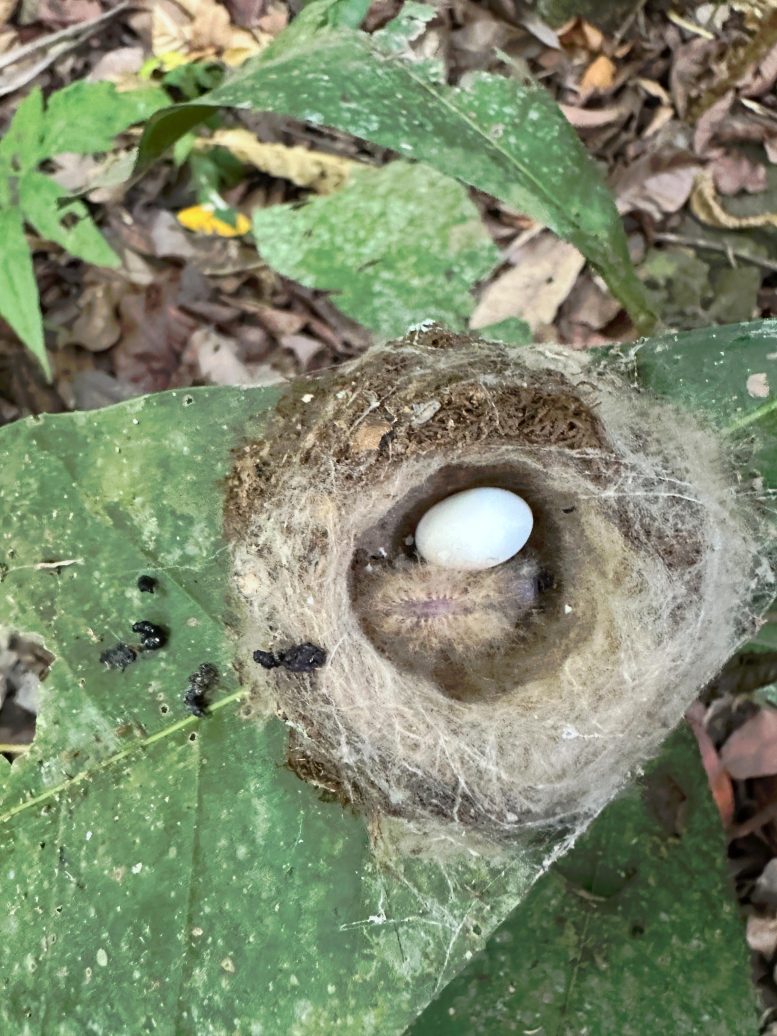
But last March, co-authors Michael Castaño at the Smithsonian Tropical Research Institute and Sebastian Gallan-Giraldo at the University of Antioquia in Colombia discovered a female Jacobin hummingbird incubating an egg in its nest, not far from a forest trail. The nest, smaller than Falk’s palm, was made of plant parts to blend in perfectly with the surrounding environment.
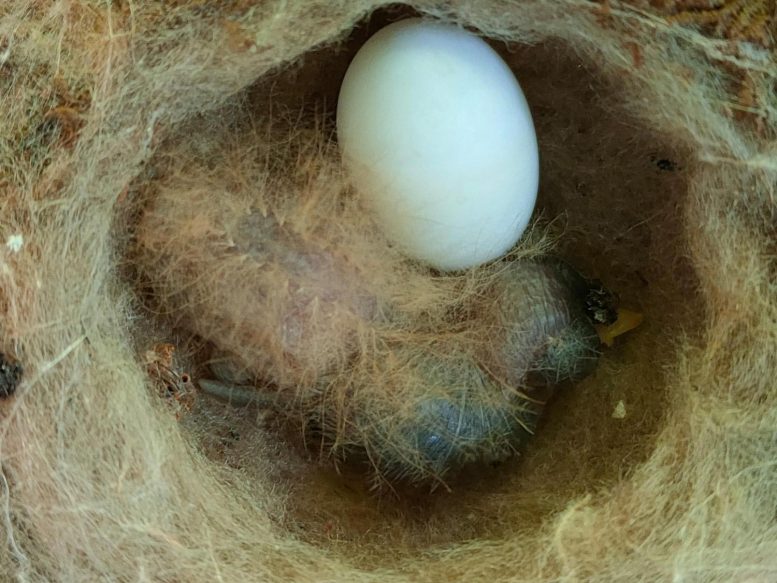
Over the following month, the team closely monitored the nest and witnessed a chick hatch from the egg. Unlike most hummingbirds that are born naked, the Jacobin chick was covered in long brown feathers, looking nearly identical to the nest material. That’s when the team witnessed the chick’s unusual jerking behavior. Scientists had never reported a similar behavior in any other hummingbird species.
“I started texting a video to people and asking them, ‘What does this look like?’” said Taylor. “And invariably, they said, ‘That looks like a caterpillar.’ It was very exciting.”
On the second day after the egg hatched, the team saw a predatory wasp approach the chick when the mother was away. As the wasp hovered above the nest, the chick started to twitch its body vigorously like it had for the researchers, swinging its head from side to side. A few seconds later, the wasp flew away.
Surviving the tropical rainforest
The Jacobin hummingbird chick reminded Falk and Taylor of a paper they came across previously. Another team of researchers reported that a young cinereous mourner, a songbird native to the Amazonian rainforest, might resemble toxic orange caterpillars from the region by having a bright orange coat and waving its head from side to side when disturbed.
Falk and his colleagues looked into other caterpillars in this region of Panama and found that many have similar-looking brown hairs that can give painful stings to predators and even kill them. Some of these caterpillars also shake their heads when they feel threatened, much like the chick.
Scientists refer to this survival strategy of mimicking the defensive signaling of a harmful species as Batesian mimicry. For example, some non-venomous milk snakes have developed a pattern of red, yellow, and black coloring similar to that of venomous coral snakes to ward off predators.
“A lot of these really classic examples of Batesian mimicry involve butterflies mimicking other butterflies, or snakes mimicking other snakes. But here, we have a bird potentially mimicking an insect, a vertebrate mimicking an invertebrate,” Taylor said.
While the study described a single observation, the researchers hope to test their theory in the future through experiments like placing artificial chicks with different looks and behaviors in nests to see which are more likely to be attacked by predators. They also hope to encourage birdwatchers and citizen scientists to document more hummingbird nests.
“Our perception of the natural world is very biased by our own thoughts about what could be possible,” Taylor said. “It’s incredible what we can discover, but we really have think broadly.”
Reference: “Potential caterpillar mimicry in a tropical hummingbird” by Jay J. Falk, Michael Castaño-Diaz, Sebastian Gallan-Giraldo, Joseph See and Scott Taylor, 17 March 2025, Ecology.
DOI: 10.1002/ecy.70060
Never miss a breakthrough: Join the SciTechDaily newsletter.
Follow us on Google and Google News.