
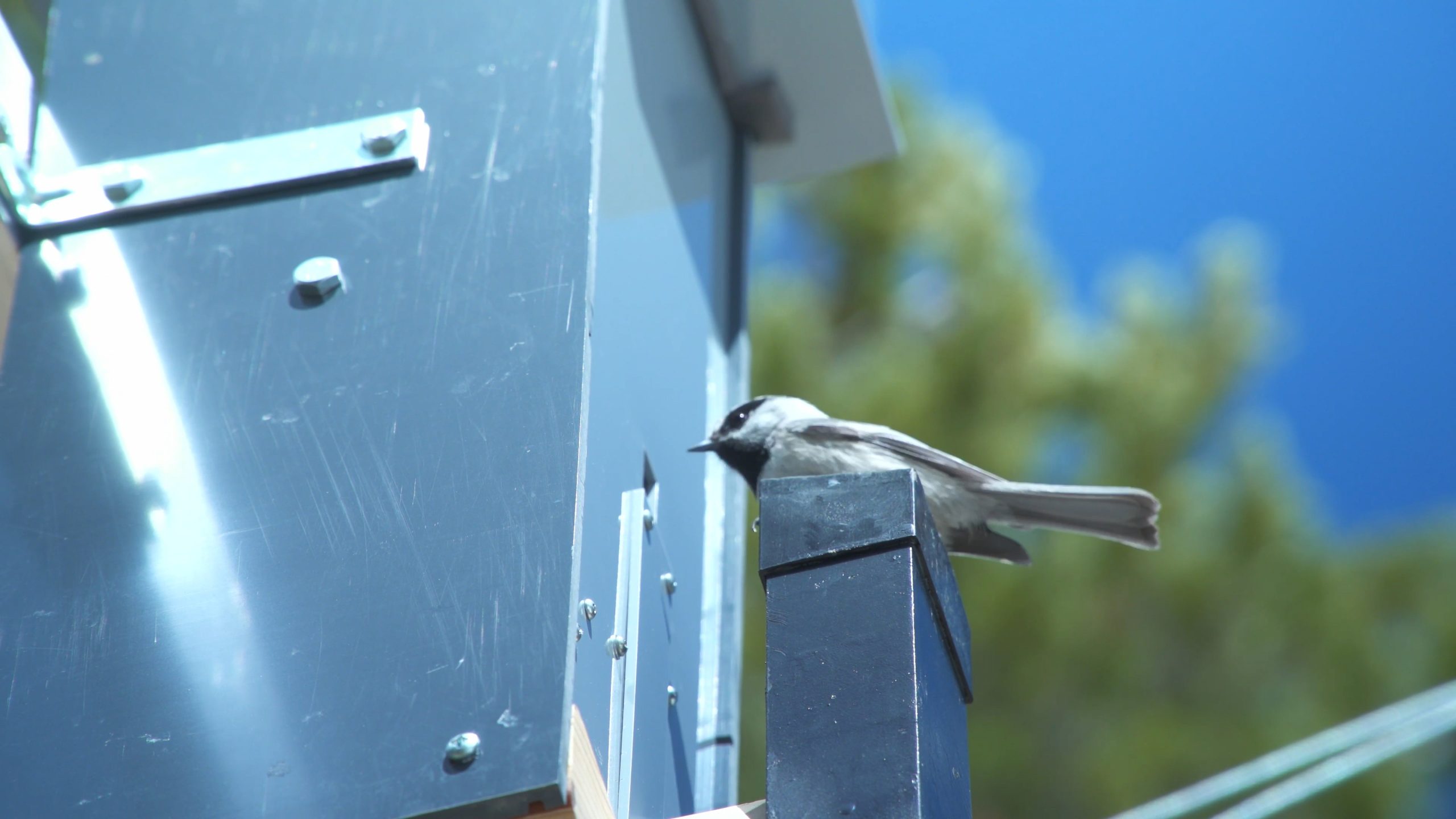
Mountain chickadees demonstrate remarkable spatial memory for surviving winters by recalling numerous food cache locations, with new research uncovering the genetic basis of this trait and its implications for adaptation.
Lost your keys? Can’t remember where you parked the car? If only you had the memory of a mountain chickadee.
These tiny birds, each weighing half an ounce and possessing brains just a bit larger than a pea, store tens of thousands of seeds in various hiding spots like tree bark, beneath dead leaves, and within pinecones throughout the mountains. As winter sets in, they are able to remember the precise locations of these stashes, a remarkable ability that aids their survival through harsh winters and heavy snowfall.
In a new study recently published in the journal Current Biology, researchers at the University of Colorado Boulder and the University of Nevada, Reno identify nearly a hundred genes associated with the birds’ spatial memory, or ability to recall the locations of objects. The paper also suggests a potential trade-off may exist between having a solid long-term memory and being able to quickly ditch old memories to form new ones.
The findings could help biologists better understand the evolution of spatial memory in animals, including humans.
“Chickadees are impressive birds,” said Scott Taylor, the director of CU Boulder’s Mountain Research Station and associate professor in the Department of Ecology and Evolutionary Biology. “They can remember tens of thousands of locations where they cached food across an entire winter and a new set of those the next winter. Their spatial memory is much more developed than many other birds that don’t have to have this strategy to survive cold winters.”
To evaluate the spatial memory of wild mountain chickadees, Taylor’s collaborators at the University of Nevada, Reno, led by biologist professor, Vladimir Pravosudov, designed a clever test. They hung multiple feeder arrays, each with eight bird feeders with seeds in California’s Sierra Nevada mountains. Each feeder has a gate with a radio frequency reader that can detect a tag researchers put on chickadees. The team then programmed each gate to only open to certain birds, so that the chickadees had to remember the location of the feeders that would open to them.
Pravosudov and his team then counted how many times each chickadee landed on the wrong feeders before they recalled the right one. The theory is that birds with better spatial memory would have a lower error rate.
Using blood samples, the team at CU Boulder also sequenced the entire genome of 162 tagged chickadees, creating the largest dataset ever collected for evaluating the genetic basis of chickadee cognitive ability. By comparing the birds’ genomes with their performance on the feeder test, the team identified 97 genes associated with chickadees’ spatial learning and memory. Birds with specific genetic variants at these genes made fewer wrong attempts before landing on their designated feeders.
A large proportion of these variants are associated with neuron formation in the hippocampus, a part of the brain that’s responsible for learning and memory, according to paper co-author Sara Padula, a Ph.D. student in the Department of Ecology and Evolutionary Biology.
“Understanding the genetic basis of this trait will allow us to understand how the trait evolves,” Taylor said.
Taylor notes that the common ancestor of all North American chickadees cached food. But of the seven species of chickadees now found here, two do not.
“They live in a milder environment where food is generally available year-round. Now that we know the gene regions that underlie spatial memory, we can look at what variation looks like in these species that have lost caching,” he said.
‘This study substantially advanced our understanding of the genetics of spatial memory in birds and behavioral genetics more broadly,” said Georgy Semenov, the paper’s co-author and a research associate in the Department of Ecology and Evolutionary Biology.
A trade-off
Chickadees that have exceptional spatial memory can live up to nine years, which is a long time for a small bird, Taylor said. But the study suggests that having good long-term memory may come at a price.
After running the initial task for a few days, Pravosudov’s team assigned new feeders to the birds.
To the team’s surprise, chickadees that performed better in the initial test tended to struggle with switching to the new feeder. They seemed to have a harder time abandoning their initial memories and creating new ones.
“In a more variable environment, what our collaborators found suggests that chickadees with good long-term memory may have a disadvantage. For example, if there is an unexpected snowstorm, these birds may keep trying to visit caches that have been buried in the snow, rather than forgetting them and looking for other caches,” Padula said.
A shifting climate
Facing a rapidly changing climate, birds that can quickly form new memories may survive better.
“Because of climate change, we might expect these selective pressures that have been shaping chickadee’s special memory for thousands of years to shift significantly,” Taylor said.
This winter, Taylor and his team set up the same type of feeder array at the university’s Mountain Research Station west of Boulder.
For the last one million years, the mountain chickadees in the Rocky Mountains have evolved independently from those in the Sierra Nevada Mountains. The team hopes to investigate whether the two groups of birds have evolved spatial memory in the same way across different geographic regions.
The team is also interested in learning if black-capped chickadees, which coexist with mountain chickadees in the Rocky Mountains, exhibit different spatial memory skills. They’ll continue the feeder experiment at the Mountain Research Station during the upcoming winters to collect more data.
“We don’t have to travel to a remote part of the world like Antarctica to study how animals might respond to climate change. We can do it with these birds that most North Americans are familiar with. I think that’s something special about chickadees,” Taylor said.
Reference: “Genes and gene networks underlying spatial cognition in food-caching chickadees” by Georgy A. Semenov, Benjamin R. Sonnenberg, Carrie L. Branch, Virginia K. Heinen, Joseph F. Welklin, Sara R. Padula, Ajay M. Patel, Eli S. Bridge, Vladimir V. Pravosudov and Scott A. Taylor, 17 April 2024, Current Biology.
DOI: 10.1016/j.cub.2024.03.058
Never miss a breakthrough: Join the SciTechDaily newsletter.
Follow us on Google and Google News.