
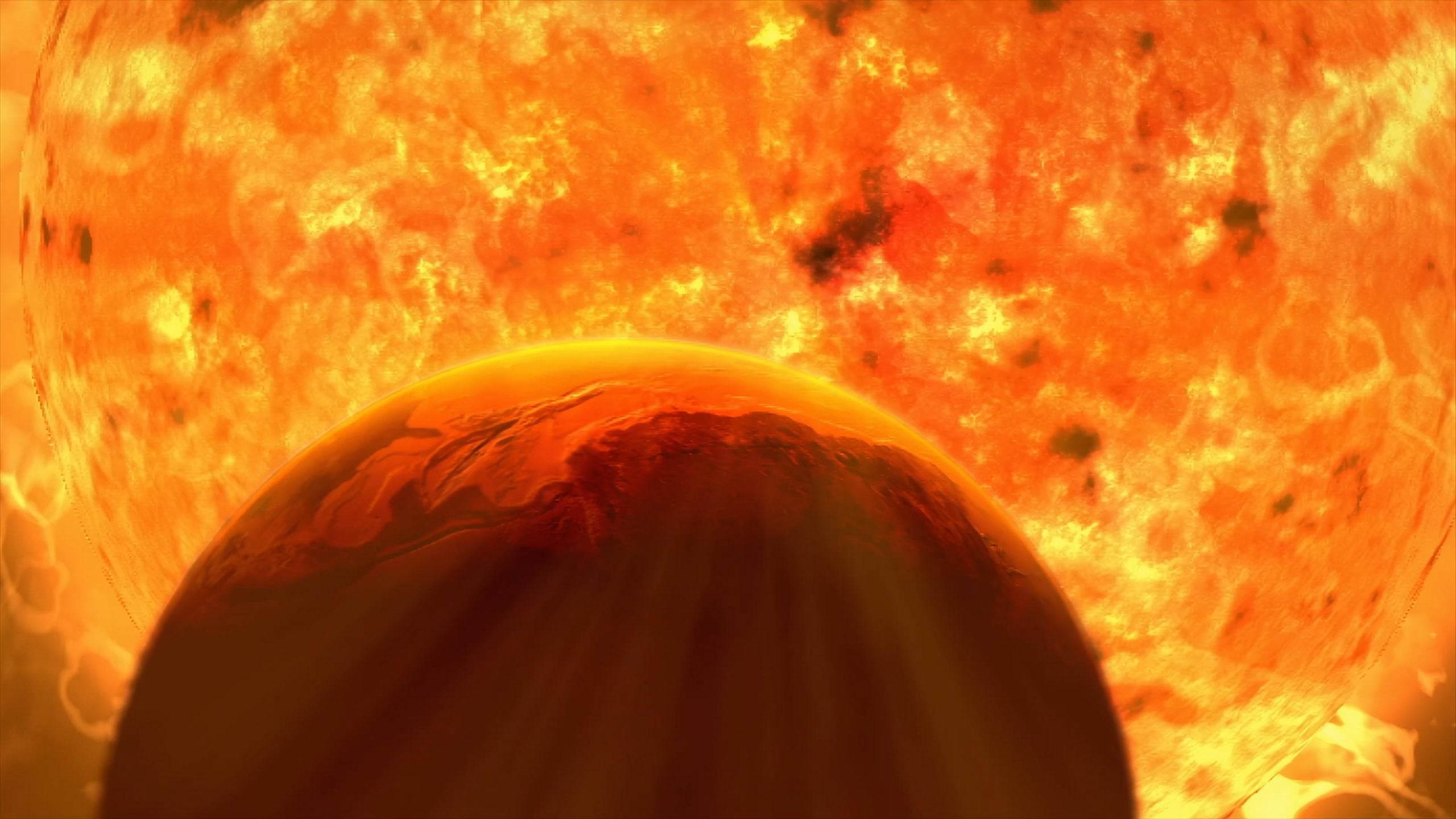
Astronomers have discovered an extraordinary ring system surrounding a dead star, offering a possible preview of what awaits our Solar System billions of years from now. Using the European Southern Observatory’s Very Large Telescope (ESO’s VLT), researchers identified two separate rings of planetary debris with a distinct gap between them. The unusual structure may be maintained by two planetary bodies that survived the death of their star, including one potentially as large as Pluto or even the Moon.
“We have known for some time that planets may survive beyond the transformation of their central star, but this is the first example of a complex system with a double debris disc and potentially two surviving planetesimals,” says Nicola Gentille Fusillo, an astronomer at the Università degli Studi di Trieste in Italy and lead author of the study published in Nature Astronomy.
At the center of this remarkable system is J1328−1450, a white dwarf. These incredibly dense stellar remnants are what remain when stars similar to our Sun exhaust their nuclear fuel and reach the end of their lives.
A Planetary Graveyard Unlike Any Seen Before
When a Sun-like star approaches the end of its life, it swells dramatically before shedding its outer layers. During this transformation, nearby planets can be swallowed and destroyed. Other rocky objects may survive the initial upheaval, only to break apart later and create rotating discs of debris around the star’s remaining core.
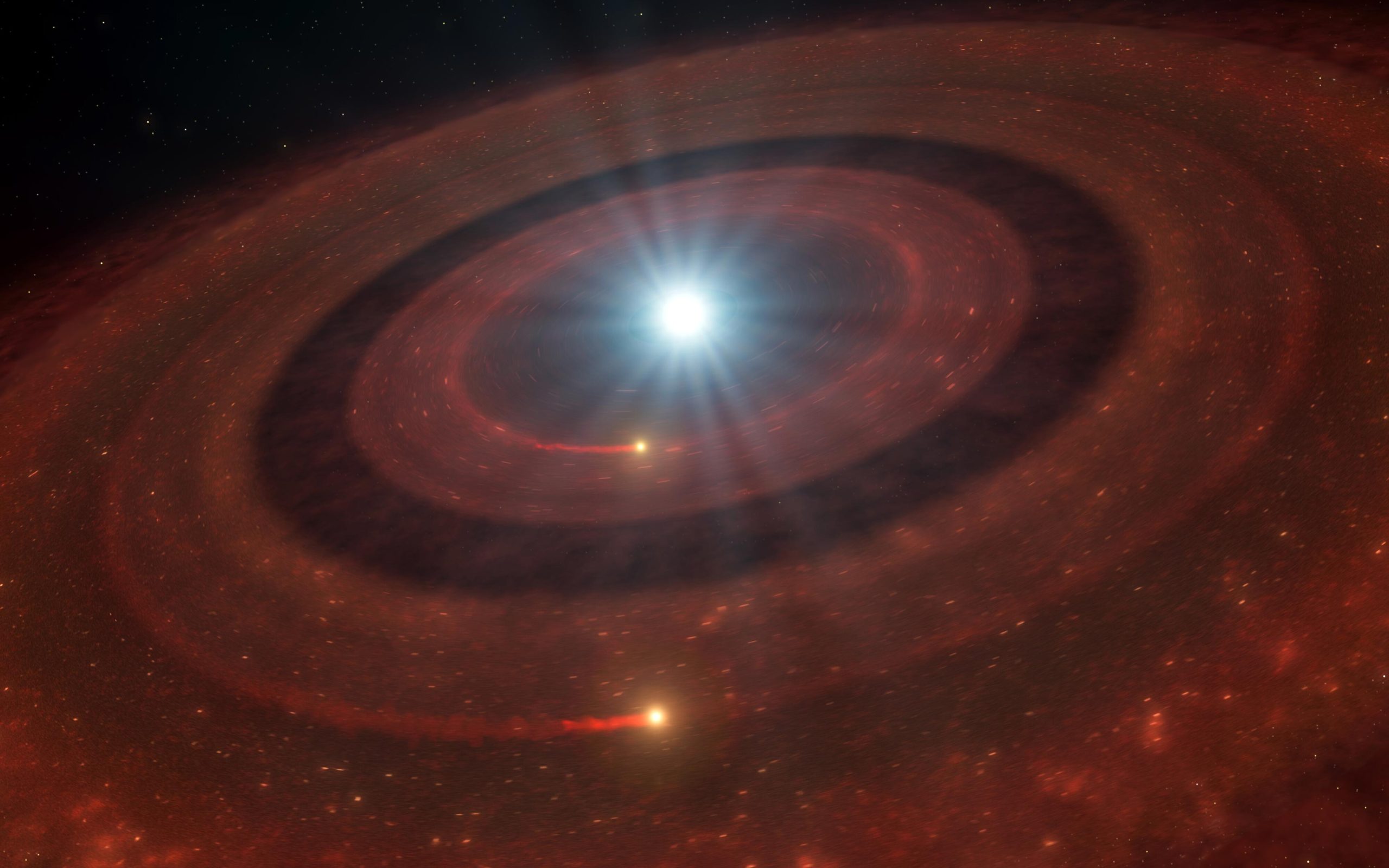
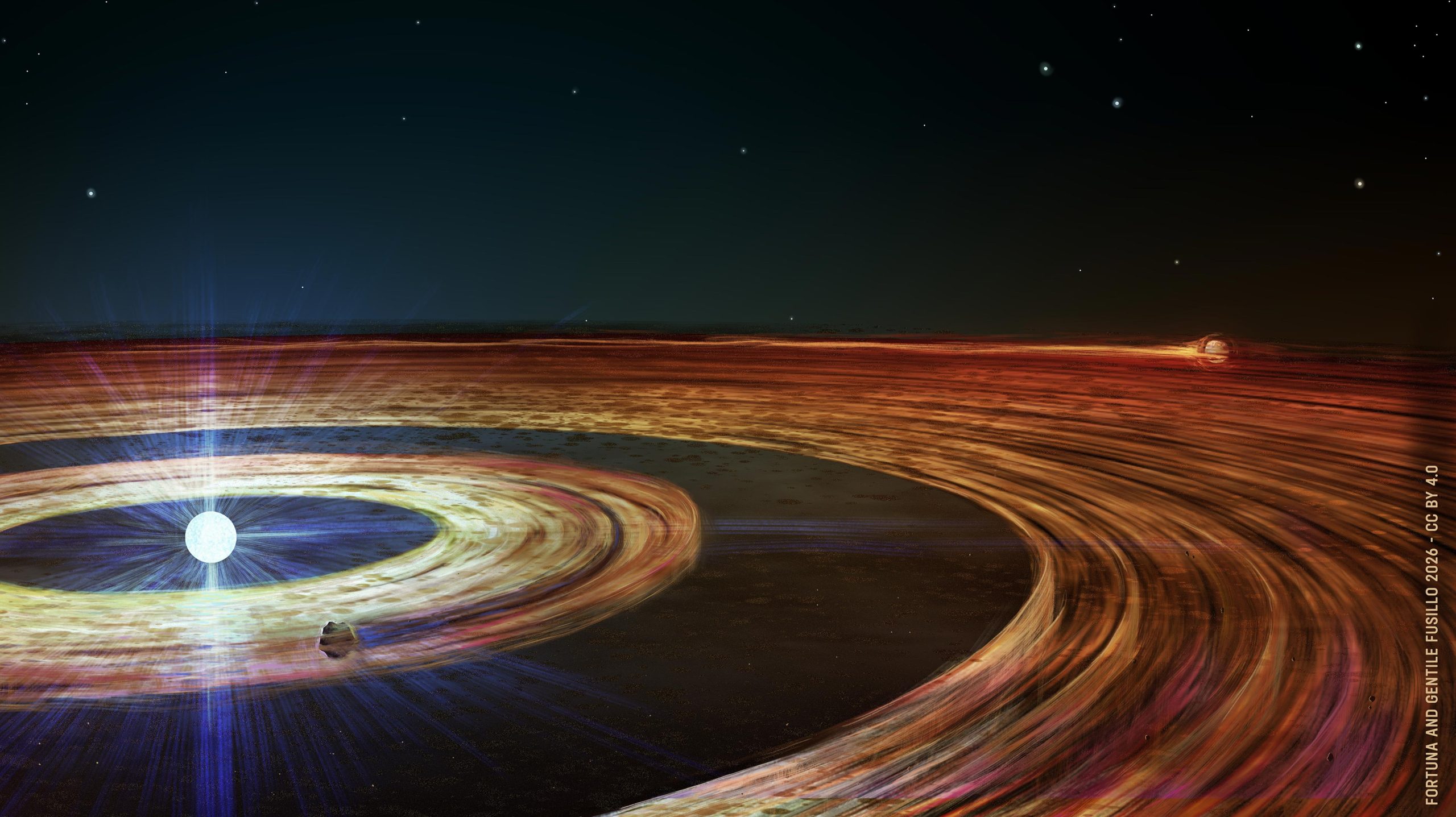
Astronomers have observed such debris discs around white dwarfs before, but J1328−1450 stands out. Instead of a single ring of vaporized planetary material, it has two concentric rings of gas separated by a well-defined gap.
“The structure we see in this system is particularly intriguing because the two gaseous rings are remarkably stable and remain separated by a gap,” says co-author Felipe Lagos-Vilches, an astronomer at the University of Warwick in the UK and at the Universidad Técnica Federico Santa María in Chile.
“The system is a rare glimpse of the violent, chaotic process by which a planetary system meets its end, and it hints that dead stars can have disc structures far more complex than previously realized,” adds Gentile Fusillo, who is also affiliated with the INAF-Astronomical Observatory of Trieste.
Two Surviving Worlds May Explain the Mysterious Rings
What keeps the two rings separated? The researchers suspect that two surviving planet-like bodies, traveling along different orbits, are helping maintain the unusual arrangement.
The smaller object, associated with the inner ring, could be comparable to a typical asteroid, measuring just a few kilometers across. The larger body, associated with the outer ring, may be roughly the size of Pluto or even Earth’s Moon. Although their presence has not been directly confirmed, these objects could explain why the debris remains divided into two stable rings.
Until now, astronomers had identified debris discs around white dwarfs through a characteristic observational signature associated with a single, flat, rotating disc. However, observations of J1328−1450 revealed something entirely different.
Using the X-Shooter instrument installed on ESO’s VLT in Chile’s Atacama Desert, the researchers detected the distinctive signature of a double disc, showing that planetary debris around dead stars can form more complicated structures than previously recognized.
Chemical Clues Reveal the Remains of Destroyed Planets
The rings also contain important clues about the worlds that once orbited the star. Astronomers detected calcium, oxygen, magnesium, and iron, elements commonly found in rocky planetary material throughout our Solar System.
Even more intriguing, the two rings have noticeably different chemical compositions. The inner ring contains abundant magnesium gas, while the outer ring has very little. This difference suggests that the debris feeding the rings may have come from two separate planets with distinct compositions.
Another possibility is that the material originated from different layers of the same planetary body. For example, one ring could contain debris from a planet’s crust, while the other holds material from its core.
A Glimpse of Our Solar System’s Distant Future
The discovery may also reveal something unsettling about our own cosmic future. Billions of years from now, the Sun will undergo a similar transformation, expanding as it nears the end of its life before eventually becoming a white dwarf. Earth could be destroyed during this process, while other planetary bodies may survive and leave behind rings of debris.
The unusual system around J1328−1450 suggests that the aftermath of a star’s death can be far more complex than a simple cloud of shattered planetary remains. Even after a planetary system experiences catastrophic destruction, some of its original bodies may endure and continue shaping the wreckage.
“The system therefore offers a remarkable glimpse of what the future of planetary systems, including systems like our own, might look like,” concludes Lagos-Vilches.
Reference: “A double debris disc around a white dwarf sculpted by two planetary bodies” by Nicola Pietro Gentile Fusillo, Felipe Lagos-Vilches, Boris T. Gänsicke, Christopher J. Manser and Detlev Koester, 26 October 2026, Nature Astronomy.
DOI: 10.1038/s41550-026-03004-3
The team is composed of Nicola Pietro Gentile Fusillo (Dipartimento di Fisica, Universita‘ di Trieste and INAF-Osservatorio Astronomico di Trieste, Italy), Felipe Lagos-Vilches (Department of Physics, University of Warwick, UK and Departamento de Física, Universidad Técnica Federico Santa María, Chile), Boris T. Gänsicke (Department of Physics and Centre for Exoplanets and Habitability, University of Warwick, UK), Christopher J. Manser (Department of Physics, Astrophysics Group, Imperial College London, UK), Detlev Koester (Institut für Theoretische Physik und Astrophysik, University of Kiel, Germany).
Never miss a breakthrough: Join the SciTechDaily newsletter.
Follow us on Google and Google News.