
Scientists have developed a theoretical framework that could allow atomic clocks to reveal a strange quantum effect in which different flows of time exist simultaneously.
Raise an atomic clock by just a few millimeters, and it ticks slightly faster because gravity is weaker at the higher position. Today’s most precise clocks can detect this tiny difference, confirming a prediction of Einstein’s theory of relativity. But quantum physics introduces a stranger possibility: A single clock could exist in a superposition of different motions, potentially experiencing multiple rates of time simultaneously.
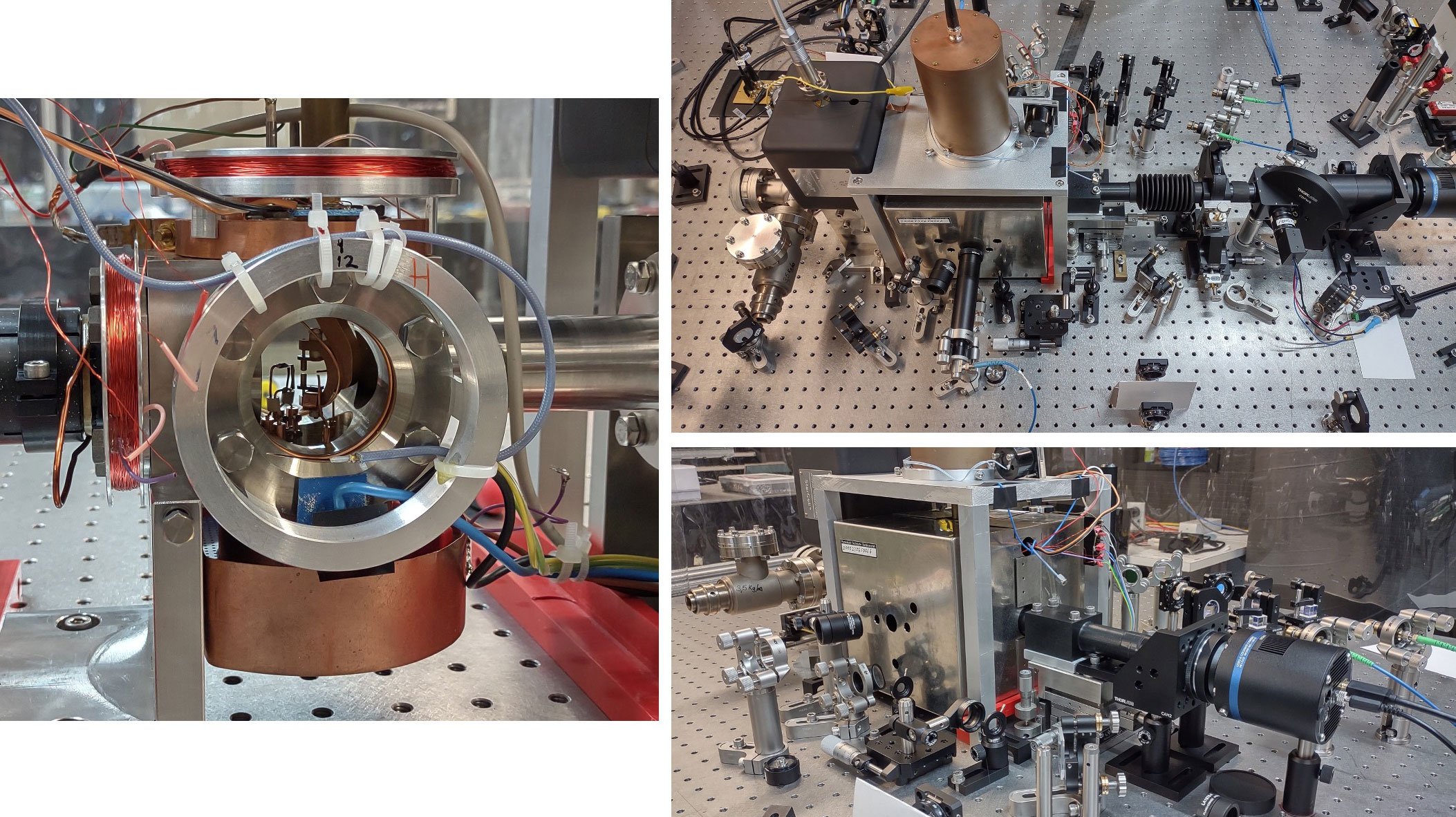
Scientists have now developed a theoretical method to detect the quantum effects of these different flows of time using advanced atomic clocks. Published in Physical Review Letters, the research shows how trapped-ion clocks could reveal a previously unobserved connection between quantum mechanics and relativity. The proposed approach uses existing experimental technology and could bring researchers closer to testing how time behaves in the quantum world.
How Quantum Physics Changes Our Understanding of Time
According to Einstein’s theory of relativity, time passes at different rates depending on an object’s speed and the strength of gravity. Atomic clocks are sensitive enough to detect these differences across height changes of just a few millimeters. They measure time using precise atomic frequencies and are essential to technologies such as GPS.
Quantum mechanics introduces another possibility. An atomic clock’s motion can exist in a superposition of different states, potentially exposing it to multiple rates of time simultaneously. Under these conditions, the clock’s motion becomes entangled with its internal energy, producing changes in its quantum properties that researchers believe can be measured.
A New Way to Detect Quantum Time
“It’s the precision that led us to develop our theoretical model. We found that the atomic clock’s motion becomes “entangled” with its internal energy. The signature of this entanglement is that the clock itself loses some of its quantum properties, which can be detected using modern techniques,” explains Associate Professor Joshua Foo of Kyushu University’s Institute for Advanced Studies, one of the study’s lead authors.
The international research team, led by scientists at Kyushu University and working with collaborators in the United States, Canada, and Sweden, also developed a theoretical approach for precisely controlling the motion of trapped ions. This could substantially increase the detectability of the quantum effect.
“We introduced a new technique for controlling the atomic clock’s motion, improving its sensitivity to this effect by 100 to 1000 times.”
Toward Experimental Tests of Quantum Time
The next challenge is to translate the theoretical framework into an experiment that can reliably detect the predicted quantum signature while accounting for disturbances and uncertainties in real laboratory conditions. If successful, the approach could establish atomic clocks as tools for investigating the quantum behavior of time and potentially improve future clock technology.
“Naturally, bringing our theoretical model to reality is the big next step, and developing a detailed experiment that accounts for real-world unpredictability will give us further insight into our model,” concludes Foo. “We are also interested in exploring whether atomic clocks could eventually be used to probe the quantum realm of gravity, the other fundamental question in physics.”
Reference: “Quantum Signatures of Proper Time in Optical Ion Clocks” by Gabriel Sorci, Joshua Foo, Dietrich Leibfried, Christian Sanner and Igor Pikovski, 20 April 2026, Physical Review Letters.
DOI: 10.1103/qhj9-pc2b
Funding: National Science Foundation, National Aeronautics and Space Administration, Alfred P. Sloan Foundation, Gordon and Betty Moore Foundation, John Templeton Foundation, Simons Foundation, Banting Postdoctoral Fellowship, Novartis Science Scholarship
Never miss a breakthrough: Join the SciTechDaily newsletter.
Follow us on Google and Google News.