
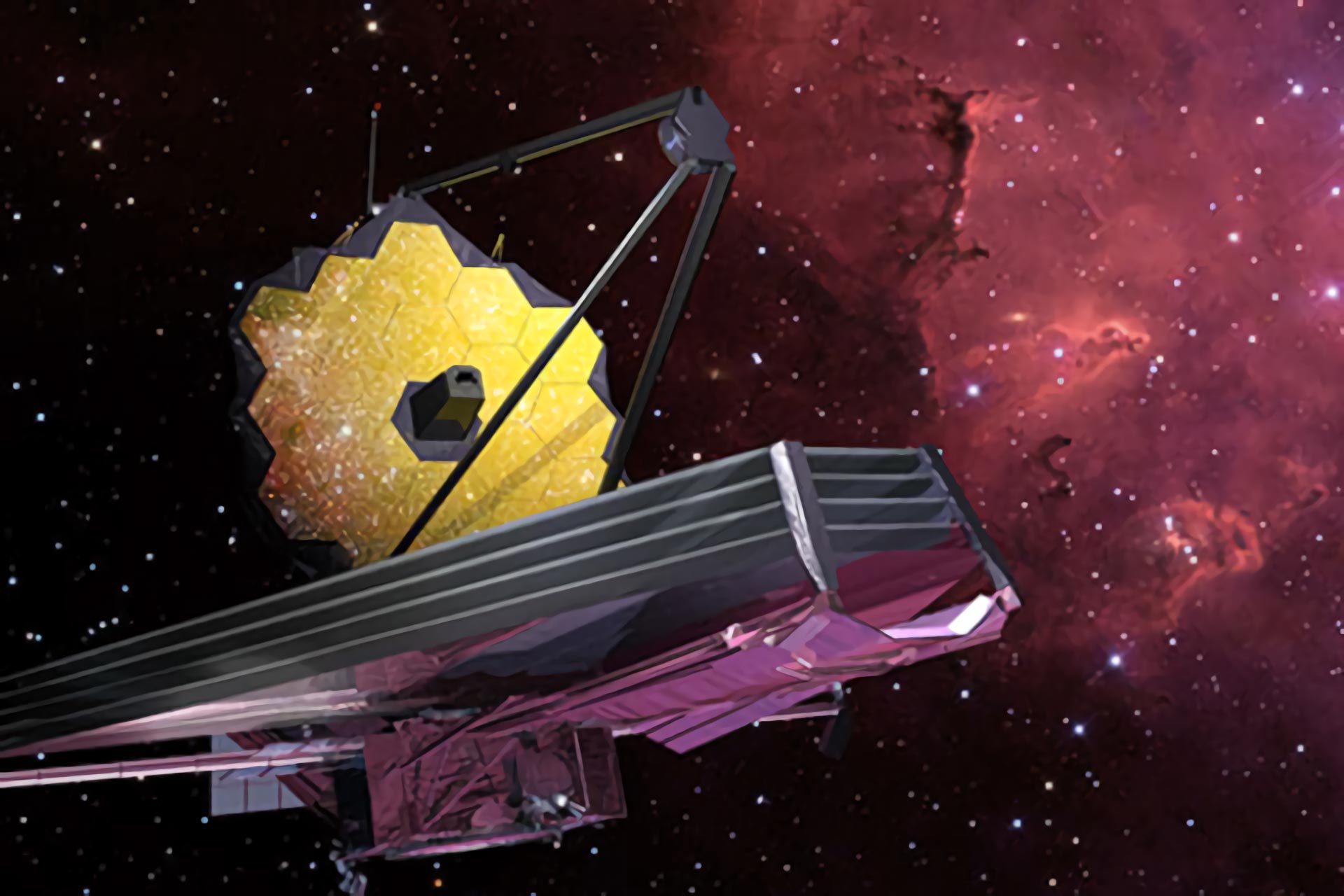
Finding planets like Earth may depend on better ways to read telescope images, after a new technique uncovered a giant world already captured by JWST.
A giant planet was hiding in observations taken by NASA’s James Webb Space Telescope (JWST), even though astronomers already knew it existed. The telescope had captured its faint light, but the overwhelming glow of its host star made the planet impossible to distinguish using conventional image-processing techniques.
This is one of the biggest challenges in photographing planets beyond our solar system. Stars are extraordinarily bright compared with the worlds orbiting them, and even JWST, which can observe galaxies billions of years in the past, struggles to separate a planet’s faint signal from its star’s glare.
Researchers led by Northwestern University developed a new computational technique that helped overcome this problem. By accounting for tiny imperfections in the telescope, they improved its sensitivity to faint planets by 2 to 15 times and recovered a giant planet that had remained hidden in two-year-old observations. Their findings were published in the journal Nature.
“Planets are a million times fainter than their stars,” said Northwestern’s Rodrigo Ferrer-Chavez, who led the study. “So, to image exoplanets, we need to remove that glare. That is a very tricky problem because even the tiniest changes in the telescope can affect how that glare appears. Slight shifts or tilts — even on the scale of just a few nanometers — can change the pattern of light. Our method models how light travels through the telescope and accounts for those tiny changes, allowing us to remove the glare much more precisely.”
Ferrer-Chavez is a Ph.D. student in astronomy at Northwestern’s Weinberg College of Arts and Sciences and a member of Jason Wang’s research group. Wang, an assistant professor of physics and astronomy at Weinberg, co-authored the study. Both researchers belong to Northwestern’s Center for Interdisciplinary Exploration and Research in Astrophysics (CIERA).
Starlight still leaks past planet-hunting instruments
Astronomers have long relied on specialized instruments called coronagraphs to block starlight when searching for planets. Even relatively bright young giant planets can be 100,000 times fainter than their stars, making this step essential. However, some light still escapes around the coronagraph, creating patterns of glare that can conceal nearby objects.
“For the past 20 years, astronomers have tackled this problem by observing a different star and using its image as a reference,” Wang said. “Then, they subtract that reference image from the original observation to remove the unwanted glare to reveal faint planets that otherwise might be hidden.”
The difficulty is that a telescope never remains perfectly still. Minute changes in its mirrors and other components can alter how starlight spreads across an image. Even a slight mismatch between the reference photograph and the original observation can leave enough residual glare to hide a planet.
“We try to make telescopes extremely stable, but there are extreme engineering challenges that we haven’t quite solved yet,” Wang said. “There are known causes of instability and unknown causes. Small thermal changes could cause a mirror to expand or contract by a picometer. Telescopes like JWST have cryocoolers to keep the instrument super cold. Those coolers have little motors that can cause the mirrors to vibrate. So, there are issues like those but also issues that we still don’t understand as we learn how to build these complex telescopes.”
A digital twin reconstructs unwanted starlight
To address these limitations, the Northwestern researchers developed Physics-based Learning for Imaging Planets (FLIP). Instead of relying entirely on reference photographs, the technique creates a digital twin of the telescope, a computer model that recreates how starlight travels through its mirrors and reaches its detectors.
The team used powerful computational tools to adjust millions of parameters in the model, accounting for subtle movements, optical distortions, and other imperfections. By repeatedly refining the simulation until it closely matched the real observations, FLIP could reproduce the unwanted starlight more accurately and subtract it from the image.
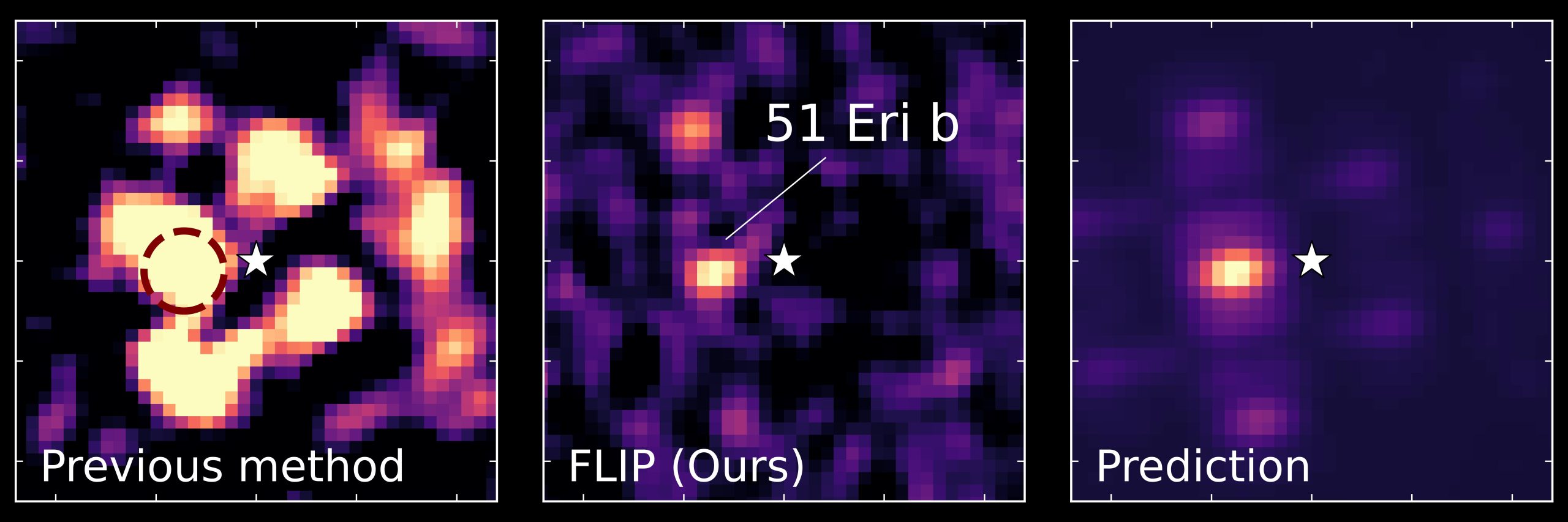
This visualization demonstrates the image processing method, called FLIP, as it subtracts starlight from a James Webb Space Telescope (JWST) observation of star 51 Eridani A (51 Eri) in the F430M filter. Starlight subtraction proceeds with the iteration number shown in the lower left, eventually revealing the faint planet 51 Eri b at its expected location. Credit: Rodrigo Ferrer-Chavez
Although the approach used optimization techniques commonly associated with machine learning, it relied on the known physics of the telescope rather than artificial intelligence to recognize planets.
“We used the same computational tools that researchers use to train AI models, but we did not actually use AI,” Wang said. “Because we already know the physics, we don’t need AI to understand what’s happening.”
A giant planet emerges from glare
The researchers tested FLIP using existing JWST observations of three stars. Two, HIP 65426 and 51 Eridani, had known planets, while the third, TYC 5899, had no known planetary companions. The technique consistently outperformed conventional image processing, particularly when examining light from extremely faint objects.
One of the clearest demonstrations involved 51 Eridani b, a giant planet previously discovered using ground-based telescopes. Although astronomers knew the planet existed, it had remained hidden in JWST observations at an infrared wavelength of 4.3 microns.
That wavelength is especially valuable because carbon dioxide strongly absorbs infrared light there, potentially allowing astronomers to investigate a planet’s atmospheric composition. However, carbon dioxide absorption in 51 Eridani b’s atmosphere made its already faint signal even harder to detect.
When Ferrer-Chavez applied FLIP to the same observations, the planet emerged from the glare.
“We showed that we can actually recover a planet that people previously couldn’t see,” Wang said. “This is real data in a real scenario. It was science left on the table because we didn’t have the right tools to analyze the data in the most optimal way.”
The result suggested that valuable information about distant planets could already be present in existing telescope observations, waiting for better processing methods to reveal it. More precise removal of starlight could also help astronomers study planets at different wavelengths, potentially uncovering new details about their atmospheres.
Earth-like worlds pose a steeper challenge
The approach could have implications for future space missions as well. NASA’s proposed Habitable Worlds Observatory aims to directly photograph Earth-like planets orbiting distant sun-like stars. Detecting such small, faint worlds may require optical stability at the picometer scale, equivalent to trillionths of a meter. That would mean keeping the telescope roughly 100 to 1,000 times more stable than JWST.
Rather than relying entirely on engineering to achieve that precision, methods like FLIP could potentially compensate for some of the tiny imperfections that interfere with observations. For now, the researchers hoped their technique would help astronomers recover previously hidden planets and expand the range of worlds they could study.
“We know of no planets around other stars that are like those in our own solar system,” Ferrer-Chavez said. “It’s not that they don’t exist. It’s that we cannot see them. Every time we improve our techniques, we discover new types of planets. By finding more planets, we can better understand how planetary systems form and evolve, and ultimately how typical our own solar system truly is.”
Reference: “Imaging exoplanets below the telescope stability limit” by Rodrigo Ferrer-Chavez, Jason J. Wang, Katherine L. Bouman, William T. Freeman, Laurent Pueyo, Brandon Y. Feng and Marshall D. Perrin, 4 November 2026, Nature.
DOI: 10.1038/s41586-026-11213-z
Supported by the Space Telescope Science Institute (award number JWST-AR-07942), the Sloan Foundation (award number FG-2025-24976) and the National Science Foundation (award number PHY-2525568).
Never miss a breakthrough: Join the SciTechDaily newsletter.
Follow us on Google and Google News.