

Evidence of a rare particle decay fits physics’ best theory, giving scientists a new way to test whether our understanding of matter leaves something out.
After more than 40 years of searching, physicists have found the first evidence of a particle decay predicted to occur only about once in every 10 billion beauty particles. The signal, recorded by the upgraded LHCb experiment at CERN’s Large Hadron Collider (LHC), offers a way to look for undiscovered particles through the influence they might have on that exceptionally unlikely event.
Inside the protons and neutrons at an atom’s center are smaller building blocks called up and down quarks. Beauty quarks are heavier members of the same family, produced in huge numbers when particles collide at the LHC, and they exist for only around one and a half trillionths of a second before decaying. LHCb studies particles containing these short-lived quarks. In the decay at the center of the new result, known as Bd to mu mu, one such particle transforms into two muons, particles similar to electrons but heavier.
With a statistical significance of 3.2 sigma, the signal is strong enough to qualify as evidence of the decay, although more data will be needed to reach the five-sigma threshold required to claim a discovery in particle physics.
Professor Chris Parkes, head of the Department of Physics and Astronomy at the University of Manchester, said, “This decay is remarkably unlikely, the chance of it happening is roughly like going on a romantic date and, on your very first try, finding the one perfect match for you among everyone on Earth.”
Rare decays could reveal hidden particles
An undiscovered particle could change the chances of a beauty particle decaying in a particular way, giving physicists a means of detecting its influence even if they cannot observe it directly at the LHC. The rarer a decay is, the more sensitive it can be to such effects. Researchers can therefore look for discrepancies between the measured decay rate and the predictions of the Standard Model, their best current theory of fundamental particles and their interactions. The new measurement matches those predictions, and greater precision could help reveal where the theory might eventually begin to break down.
By pursuing these increasingly precise measurements, physicists hope to probe what they call the “Zeptoverse,” an unexplored world at distances of a zeptometer, or a billionth of a trillionth of a meter, where unknown particles and forces may be hiding.
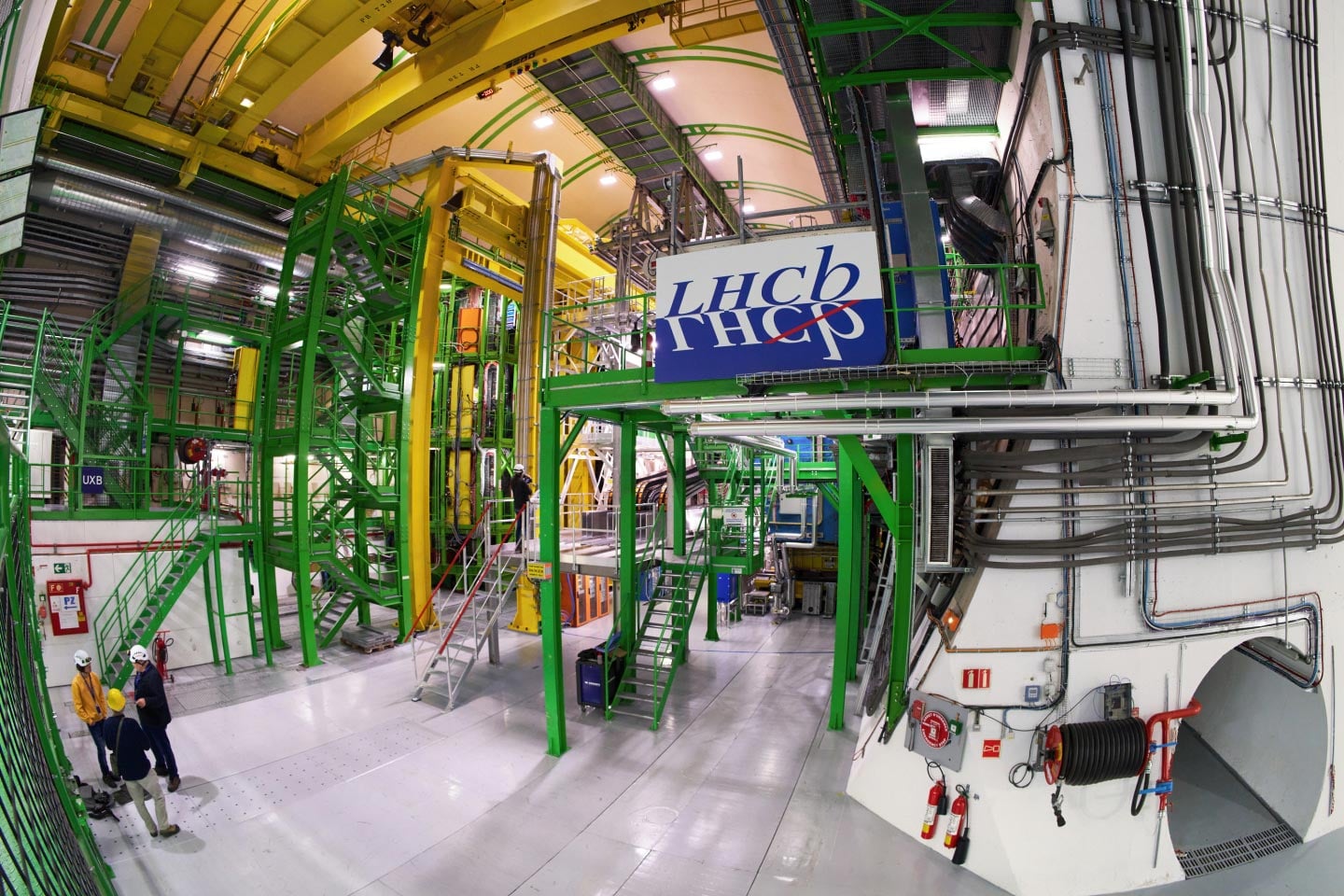
Professor Conor Fitzpatrick of the University of Manchester, deputy physics coordinator of the international LHCb collaboration, said, “There has been a more than forty year long search by physicists worldwide to observe this decay. It is a golden channel to observe the effects of new physics from beyond our current knowledge.
“The results from this experiment are expanding our understanding of nature at its most fundamental level. We are excited to have finally seen this elusive signal and looking forward to the future discoveries that will come from our data.”
Pinpointing where beauty particles decay
Just five millimeters, or about 0.2 inches, from the LHC beams sits the Vertex Locator, a silicon pixel detector that tracks the paths of particles emerging from collisions with extreme precision. This major UK-built component is part of the upgraded LHCb experiment. University of Manchester researchers played key roles in the experiment and its upgrade, including developing detector technology that helped make the measurement possible.
Dr. Stefano De Capua, who led construction of the detectors at the University of Manchester, said, “We worked with nearly 90 UK companies to construct this detector and trained the next generation of scientists and engineers on the novel technologies we are using. It is these detectors that we use to locate where the beauty meson was produced and pinpoint where it decayed into two muons.”
Parkes led the international LHCb collaboration through construction of the upgrade and led its approval of the new result. Made a Fellow of the Royal Society earlier this year for his work on LHCb, he said, “The upgraded LHCb was a major undertaking – a fifteen-year design and construction project from a 1900 international member collaboration.
“The UK made the largest nation contribution to the project, pioneering new technologies that have made today’s result possible, where we probe nature at a new scale. But this is also just the start, we are planning the construction of an experiment that will exploit the capabilities of the next-generation High Luminosity LHC, probing physics at an even smaller scale.”
By collecting data at up to five times its previous rate, the upgraded experiment is expected to build a much larger dataset into the early 2030s. A further planned upgrade could increase that rate by another factor of ten, enabling more precise measurements of these decays and increasing sensitivity to undiscovered particles at even shorter distances.
Professor Brian Cox, a particle physicist at the University of Manchester who was not involved in the experiment, said, “This is an important result and a beautiful example of how science advances. We upgrade our instruments and we see nature in greater detail. Occasionally we see something we don’t understand, and then progress is made. We cannot know whether this progress will be incremental or genuinely world-changing – that’s science! LHCb is a major scientific success.”
The experiment is funded by the Science and Technology Facilities Council as part of UK Research and Innovation.
Never miss a breakthrough: Join the SciTechDaily newsletter.
Follow us on Google and Google News.