
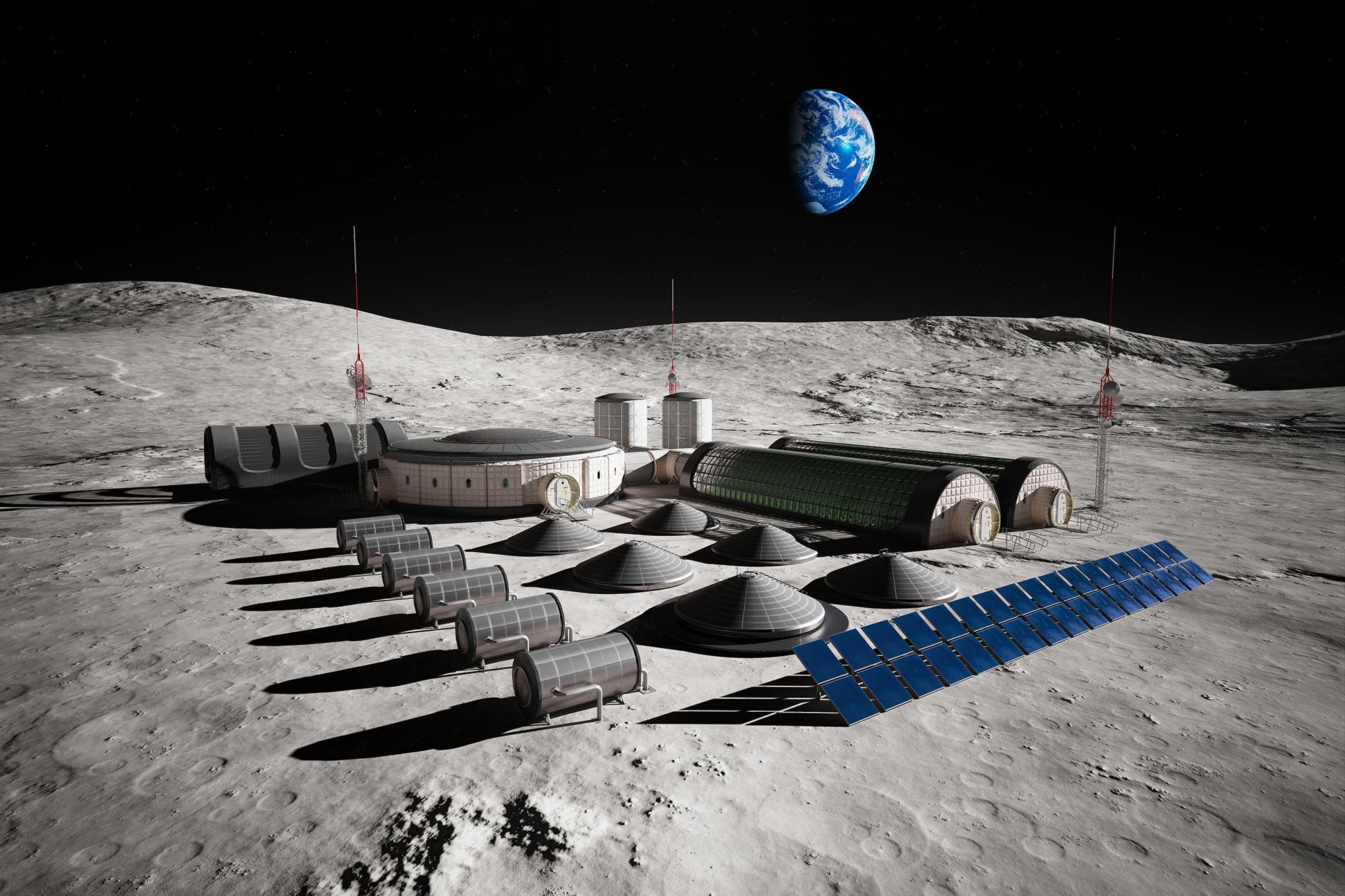
Building on the Moon could require fewer supplies from Earth, as scientists have found a way to fuse simulated lunar dust into interlocking bricks without added materials.
Building a future home on the Moon might someday resemble assembling a giant LEGO set. Instead of plastic pieces, astronauts could use interlocking bricks made from lunar dust, creating structures from materials already available on the Moon’s surface.
Researchers at the University of Arkansas have taken an early step toward that possibility by demonstrating that simulated lunar dust can be 3D-printed into LEGO-like building blocks without adding other materials. The approach could reduce the construction supplies NASA would need to transport from Earth as it works toward establishing permanent settlements on the Moon.
The key ingredient is lunar regolith, the loose, dusty material covering the Moon’s surface. Unlike soil on Earth, regolith contains no organic matter. It consists of jagged particles formed over billions of years as asteroids, micrometeorites, and other space debris struck the Moon.
For their experiments, the researchers used Lunar Highlands Regolith Simulant (LHS-1), a commercially available material designed to imitate samples collected during the Apollo missions in the 1960s and early 1970s.
The study, published in the journal NPJ Advanced Manufacturing, was led by first author Cole McCallum, then an undergraduate at the University of Arkansas, and senior author Wan Shou, an assistant professor of mechanical engineering.
Lunar dust bonds without added ingredients
To create the bricks, the team used a 3D-printing technique called laser powder bed fusion. The process begins by spreading a thin layer of powder across a flat surface. A concentrated light source, such as a laser, heats selected portions of the powder, causing the particles to bond together through a process known as sintering. The printing bed then lowers, allowing another layer of powder to be added. Repeating these steps gradually builds a three-dimensional object.
Other researchers have successfully printed objects using lunar regolith mixed with binding agents. However, those additional ingredients would have to be transported from Earth, increasing the amount of material needed for construction on the Moon.
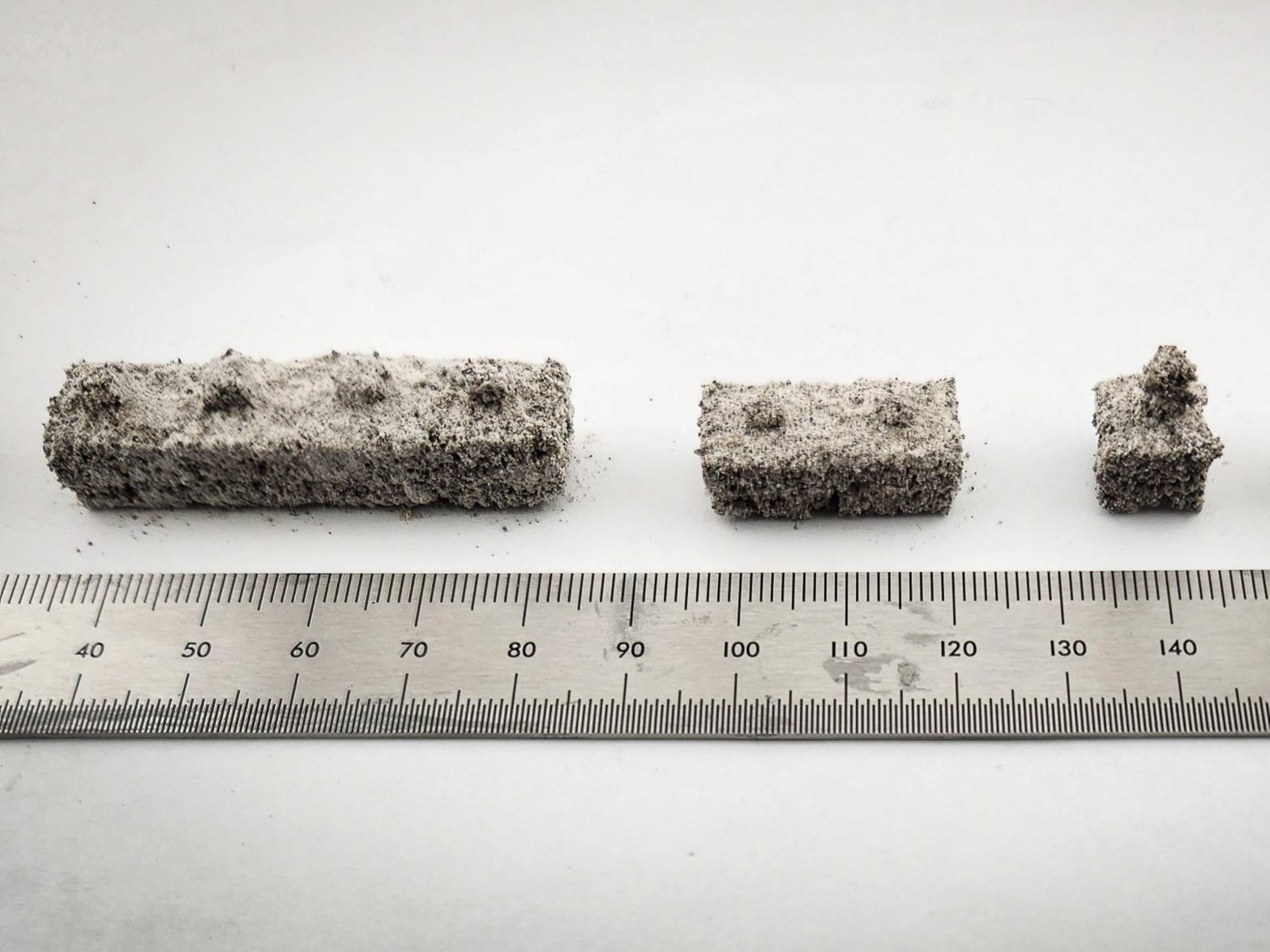
The Arkansas team demonstrated for the first time that simulated lunar regolith could be sintered directly into reconfigurable construction blocks without a binder, using a relatively low-power light source.
“There’s nothing else it’s binding to. The regolith powder is binding to itself,” McCallum said.
The researchers produced blocks measuring a few centimeters across, including pieces shaped like crosses and the letter H. These shapes could fit together much like LEGO bricks, allowing individual pieces to be assembled into larger structures.
Lunar bricks still face a strength problem
Although the researchers successfully created interlocking blocks, the material is not yet strong enough for all the demands of lunar construction. Bricks made entirely from simulated regolith were more porous and structurally weaker than objects printed with binding agents.
“These structures we’re making can be self-supported,” McCallum said. “But I would be hesitant to say our process could be used for something that’s supporting other loads at this moment yet.”
The team must also determine how the printing process would behave under actual lunar conditions. According to Shou, further experiments are needed to understand its performance in microgravity and vacuum environments, while improvements to the bricks’ mechanical properties will be necessary before they become practical construction materials.
Shou remains optimistic that the approach could eventually offer an efficient way to manufacture components and structures for permanent settlements on the Moon.
From lunar bricks to aerospace engineering
For McCallum, the project also marked an important early step in his scientific career. A native of Little Rock, Arkansas, he joined Shou’s laboratory early in his undergraduate studies, encouraged by his professor’s commitment to involving students in research.
“He had this really strong belief that undergrads should get involved more with research,” McCallum said.
McCallum graduated in May with degrees in mechanical engineering and physics. He was subsequently awarded an inaugural Lafayette Fellowship, a program established to celebrate the 250th anniversary of the United States. Only 30 fellows were selected from more than 3,400 applicants to pursue master’s degrees in France.
He is now studying aerospace engineering in Toulouse at the Institut Supérieur de l’Aéronautique et de l’Espace (ISAE-SUPAERO), one of France’s leading aerospace engineering schools.
Although his academic focus has shifted away from the additive manufacturing research he conducted in Shou’s laboratory, McCallum credits the experience with teaching him how to navigate the challenges of scientific investigation.
“It helps you refine and overcome all the problems you have as a researcher. There are a lot of mistakes that I made the first time through,” he said. “It was really nice to have a head start on everyone else and make those mistakes early.”
Reference: “Additive manufacturing of lunar regolith for reconfigurable building blocks toward lunar habitation” by Cole McCallum, Youwen Liang, Nahid Tushar, Ben Xu, Bo Zhao, Hao Zeng and Wan Shou, 29 August 2026, npj Advanced Manufacturing.
DOI: 10.1038/s44334-026-00111-x
This work was supported by the Honors College Undergraduate Research Grant to C.M. and the Startup Package from the University of Arkansas to W.S.
Never miss a breakthrough: Join the SciTechDaily newsletter.
Follow us on Google and Google News.