
Close Menu
    Facebook X (Twitter) Instagram
    SciTechDaily
    • Biology
    • Chemistry
    • Earth
    • Health
    • Physics
    • Science
    • Space
    • Technology
    Facebook X (Twitter) Pinterest YouTube RSS
    SciTechDaily
    Home»Space»New Moon Map Created to Help Guide Future Lunar Exploration Missions
    Space

    New Moon Map Created to Help Guide Future Lunar Exploration Missions

    By University of ArkansasMay 5, 2021No Comments3 Mins Read
    Facebook Twitter Pinterest Telegram LinkedIn WhatsApp Email Reddit
    Share
    Facebook Twitter LinkedIn Pinterest Telegram Email Reddit
    Lunar Basin Map
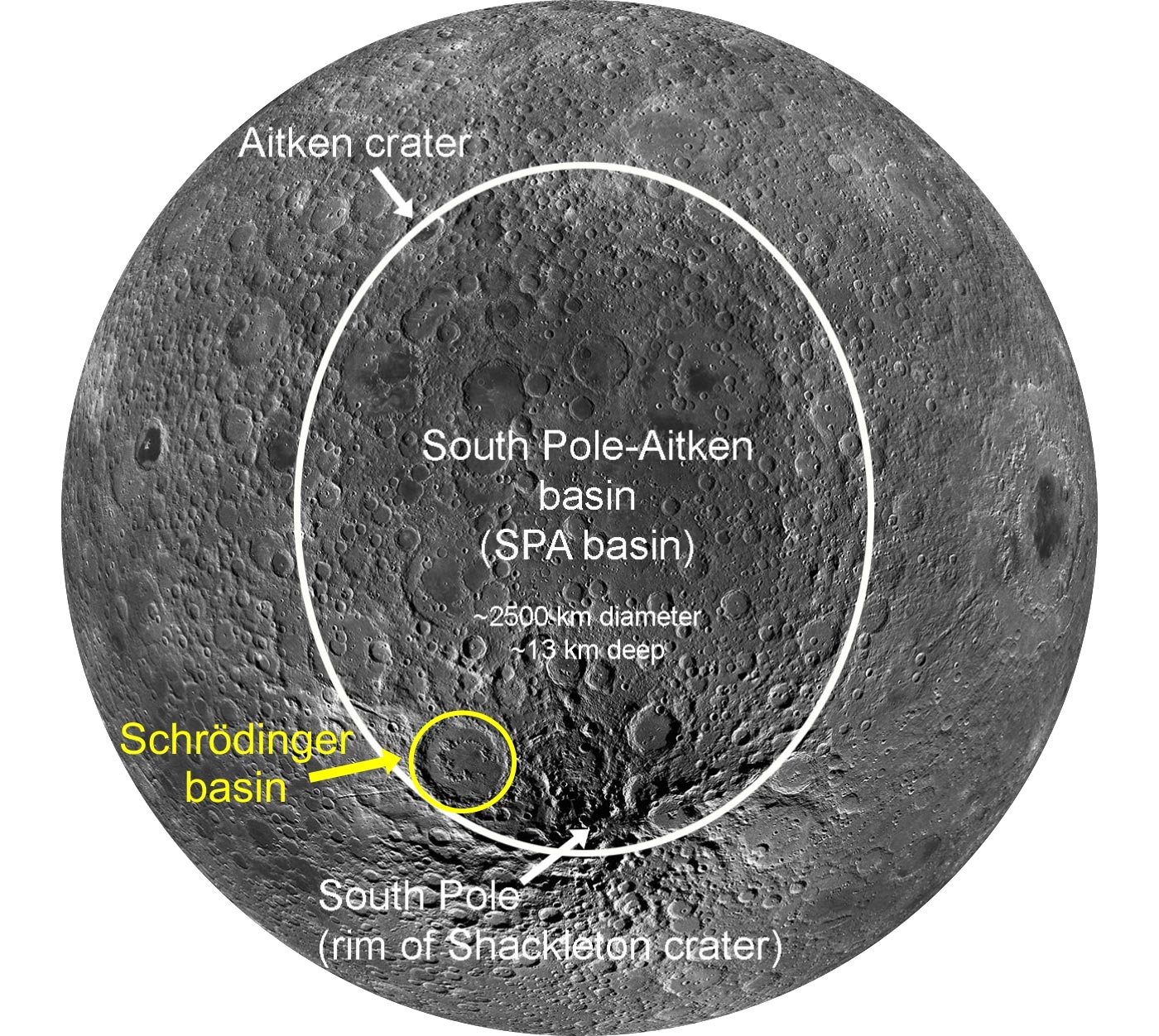
    View of the southern, midlatitude far side of the moon showing the SPA basin outlined in white and the Schrödinger basin outlined in yellow (modified from LPI Lunar South Pole Atlas). Credit: Ellen Czaplinski

    A new map of the moon’s Schrödinger basin identifies high-priority sampling zones and guides future rover exploration.

    The map, along with proposed paths for robotic rovers, provides new details on a scientifically important region of the moon’s south pole.

    A new map including rover paths of the Schrödinger basin, a geologically important area of the moon, could guide future exploration missions. The map was created by a team of interns at the Lunar and Planetary Institute, including Ellen Czaplinski, a U of A graduate student researcher at the Arkansas Center for Planetary Sciences and first author of a paper that was recently published in The Planetary Science Journal.

    Schrödinger Basin’s Geological Importance

    The researchers identified significant geologic features of the Schrödinger basin, located near the lunar south pole. Schrödinger is the second-youngest impact basin on the moon and includes diverse crustal features and rock types that are important to understanding the moon’s geological history.

    “When the Schrödinger basin was formed, some of these lithologies (the general physical characteristics of the rocks) may have been uplifted from very deep below the lunar surface,” Czaplinski said. “Therefore, investigating these rocks up close is extremely important for answering high-priority science goals.”

    In 2007, the National Research Council outlined scientific objectives and goals of future lunar missions, including exploration of the South Pole-Aitken basin, the oldest and deepest impact basin on the moon. Because the Schrödinger basin is located within the South Pole-Aitken basin, it presents a unique opportunity to study rocks that possibly originated deep below the surface, Czaplinski said.

    “Many of these rock types are exposed at the surface in multi-kilometer long exposures of rock outcrops in Schrödinger’s ‘peak ring,’ an inner ring of uplifted rocks that formed with the basin. Sampling these rocks within the peak ring provides high scientific potential for further understanding the context of Schrödinger’s lithologies.”

    Along with the map, researchers created three potential paths for robotic rovers to travel through the Schrödinger basin to collect high-priority rock samples.

    Reference: “Human-assisted Sample Return Mission at the Schrödinger Basin, Lunar Far Side, Using a New Geologic Map and Rover Traverses” by E. C. Czaplinski, E. M. Harrington, S. K. Bell, G. D. Tolometti, B. E. Farrant, V. T. Bickel, C. I. Honniball, S. N. Martinez, A. Rogaski, H. M. Sargeant and D. A. Kring, 12 March 2021, The Planetary Science Journal.
    DOI: 10.3847/PSJ/abdb34

    The students’ study at the Lunar and Planetary Institute was supported by NASA’s Solar System Exploration Research Virtual Institute.

    Never miss a breakthrough: Join the SciTechDaily newsletter.
    Follow us on Google and Google News.

    Moon Popular University of Arkansas
    Share. Facebook Twitter Pinterest LinkedIn Email Reddit

    Related Articles

    Blue Ghost Lunar Lander Just Made History: Epic Descent, Cosmic Navigation & Stunning Sunrise

    Touchdown! Blue Ghost Lands on the Moon, Ushering in a New Era of Exploration

    Blue Ghost Is About to Land on the Moon in a Record-Breaking Mission

    Discovering Hidden Water Reservoirs on the Moon

    Moon on the Move: Surprising New Ridges Reveal Recent Activity

    Could This Asteroid Be a Lost Chunk of the Moon?

    Don’t Miss: Mars and the Wolf Moon Align in Epic Sky Spectacle

    Mars Ablaze: Witness Retrograde, Opposition, and a Cosmic Dance With the Moon

    Did Earth’s Gravity Give the Moon a Volcanic Makeover?

    Leave A Reply Cancel Reply

    • Facebook
    • Twitter
    • Pinterest
    • YouTube

    Don't Miss a Discovery

    Subscribe for the Latest in Science & Tech!

    Trending News

    Once-in-a-Century Impact: NASA Just Found a Massive New Crater on the Moon

    Anak Krakatau Just Blasted Ash 50,000 Feet Into the Sky

    NASA’s Chandra Reveals Galaxies Being Torn Apart, Blasted by Black Holes, and Reborn in Stars

    Ozempic’s Active Ingredient Shows Surprising Anti-Aging Effects

    Scientists Discover Canada’s First Dinosaur Tracks From a Rarely Documented Cretaceous Age

    Astronomers Just Caught a Giant Planet in the Act of Forming

    Two Dead Stars Are Racing Around Each Other Every 6.2 Minutes

    Natural Compound May Help Protect the Brain and Heart From Excess Salt

    Follow SciTechDaily
    • Facebook
    • Twitter
    • YouTube
    • Pinterest
    • Newsletter
    • RSS
    SciTech News
    • Biology News
    • Chemistry News
    • Earth News
    • Health News
    • Physics News
    • Science News
    • Space News
    • Technology News
    Recent Posts
    • Losing the Same Weight Didn’t Produce the Same Health Benefits
    • Feeling Lonely Could Take Nearly 6 Years From Your Healthy Lifespan
    • Hidden Artery Plaque Found in 1 in 13 Adults Before Age 30
    • Can Species Evolve Fast Enough To Survive Climate Change?
    • Scientists Solve a Decades-Old Stick Insect Mystery
    Copyright © 1998 - 2026 SciTechDaily. All Rights Reserved.
    • Science News
    • About
    • Contact
    • Editorial Board
    • Privacy Policy
    • Terms of Use

    Type above and press Enter to search. Press Esc to cancel.