
New nutrient profiling system, most comprehensive and science-based to date, clears up confusion to benefit consumers, policymakers.
A scientific team at the Friedman School of Nutrition Science and Policy at Tufts has developed a new tool to help consumers, food companies, restaurants, and cafeterias choose and produce healthier foods and officials to make sound public nutrition policy.
Food Compass is a new nutrient profiling system, developed over three years, that incorporates cutting-edge science on how different characteristics of foods positively or negatively impact health. Important novel features of the system, reported on October 14, 2021, in Nature Food, include:
- Equally considering healthful vs. harmful factors in foods (many existing systems focus on harmful factors);
- Incorporating cutting-edge science on nutrients, food ingredients, processing characteristics, phytochemicals, and additives (existing systems focus largely on just a few nutrients); and
- Objectively scoring all foods, beverages, and even mixed dishes and meals using one consistent score (existing systems subjectively group and score foods differently).
“Once you get beyond ‘eat your veggies, avoid soda,’ the public is pretty confused about how to identify healthier choices in the grocery store, cafeteria, and restaurant,” said the study’s lead and corresponding author, Dariush Mozaffarian, dean of the Friedman School. “Consumers, policy makers, and even industry are looking for simple tools to guide everyone toward healthier choices.”
Cutting-Edge Science Behind the Scoring
The new Food Compass system was developed and then tested using a detailed national database of 8,032 foods and beverages consumed by Americans. It scores 54 different characteristics across nine domains representing different health-relevant aspects of foods, drinks, and mixed meals, providing one of the most comprehensive nutrient profiling systems in the world. The characteristics and domains were selected based on nutritional attributes linked to major chronic diseases such as obesity, diabetes, cardiovascular problems, and cancer, as well as to risk of undernutrition, especially for mothers, young children, and the elderly.
Food Compass was designed so that additional attributes and scoring could evolve based on future evidence in such areas as gastrointestinal health, immune function, brain health, bone health, and physical and mental performance; as well as considerations of sustainability.
Potential uses of Food Compass include:
- Encouraging the food industry to develop healthier foods and reformulate the ingredients in popular processed foods and snacks;
- Providing food purchasing incentives for employees through worksite wellness, health care, and nutrition assistance programs;
- Supplying the science for local and national policies such as package labeling, taxation, warning labels, and restrictions on marketing to children;
- Enabling restaurants and school, business, and hospital cafeterias to present healthier food options;
- Informing agricultural trade policy; and
- Guiding institutional and individual investors on environmental, social, and corporate governance (ESG) investment decisions.
Scoring Foods Across the Spectrum
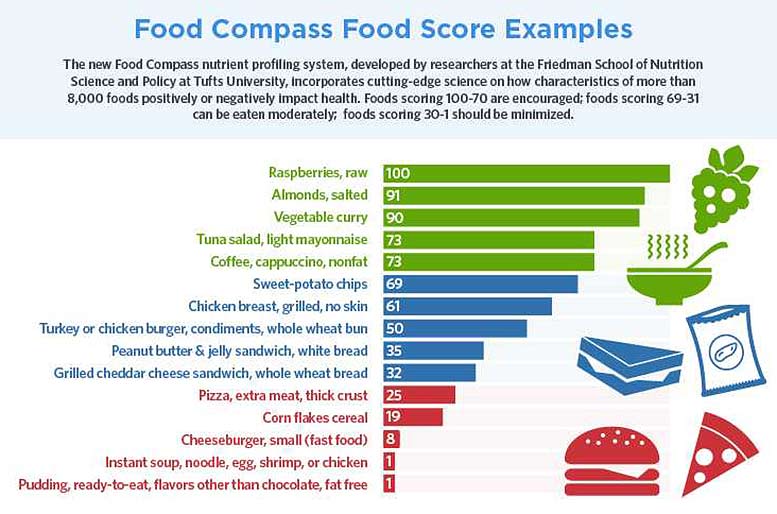
Each food, beverage, or mixed dish receives a final Food Compass score ranging from 1 (least healthy) to 100 (most healthy). The researchers identified 70 or more as a reasonable score for foods or beverages that should be encouraged. Foods and beverages scoring 31-69 should be consumed in moderation. Anything scoring 30 or lower should be consumed minimally.
Across major food categories, the average Food Compass score was 43.2.
- The lowest scoring category was snacks and sweet desserts (average score 16.4).
- The highest scoring categories were vegetables (average score 69.1), fruits (average score 73.9, with nearly all raw fruits receiving a score of 100), and legumes, nuts, and seeds (average score 78.6).
- Among beverages, the average score ranged from 27.6 for sugar-sweetened sodas and energy drinks to 67 for 100% fruit or vegetable juices.
- Starchy vegetables scored an average of 43.2.
- The average score for beef was 24.9; for poultry, 42.67; and for seafood, 67.0.
Food Compass is the first major nutrient profiling system to use consistent scoring across diverse food groups, which is especially important for mixed dishes. For example, in the case of pizza, many other systems have separate scoring algorithms for the wheat, meat, and cheese, but not the finished product itself. Consistent scoring of diverse items can also be helpful in assessing and comparing combinations of food and beverages that could be sold and consumed together, such as an entire shopping basket, a person’s daily diet pattern, or a portfolio of foods sold by a particular company.
Toward Healthier Choices and Policies
“With its publicly available scoring algorithm, Food Compass can provide a nuanced approach to promoting healthy food choices–helping guide consumer behavior, nutrition policy, scientific research, food industry practices, and socially based investment decisions,” said last author Renata Micha, who did this work as a faculty member at the Friedman School and is now at the University of Thessaly.
Additional authors are Naglaa H. El-Abbadi, Meghan O’Hearn, Josh Marino, William A. Masters, Paul Jacques, Peilin Shi, and Jeffrey B. Blumberg of the Friedman School.
The study is part of the Food-PRICE (Policy Review and Intervention Cost-Effectiveness) project, a National Institutes of Health-funded research collaboration working to identify cost-effective nutrition strategies that can have the greatest impact on improving health outcomes in the United States. This work was supported by Danone and the National Heart, Lung, and Blood Institute of the National Institutes of Health under award numbers R01HL130735 and R01HL115189. The content is solely the responsibility of the authors and does not necessarily represent the official views of the National Institutes of Health. Please see the study for conflicts of interest.
Reference: “Food Compass is a nutrient profiling system using expanded characteristics for assessing healthfulness of foods” by Dariush Mozaffarian, Naglaa H. El-Abbadi, Meghan O’Hearn, Josh Erndt-Marino, William A. Masters, Paul Jacques, Peilin Shi, Jeffrey B. Blumberg and Renata Micha, 14 October 2021, Nature Food.
DOI: 10.1038/s43016-021-00381-y
Never miss a breakthrough: Join the SciTechDaily newsletter.
Follow us on Google and Google News.
8 Comments
Anything that says Tina is healthy, when it’s widely known it’s one of the most toxic fishes in the ocean… Loses all credibility.
And you wonder why America is dying from heart disease, diabetes, obesity.
I thought the same about tuna as said in the previous comment. Maybe you consider it is easy to find tuna without heavy metals, but it is not the case for most people.
Vegetables are healthier than fruit, there is no question about it. If you are using flawed date claiming fat is bad, you are going to get flawed results. This type of study is too generic and does not actually encompass the multifaceted aspects of a healthy lifestyle/diet.
egg – 1
???
This information is bogus! They created an algorithm where they assign the value of importance to the various items. Clearly they dont value fructose sugar in high concentration like in fruit juice, where they’ve stripped out the fiber, as damaging and contributor to developing diabetes. They were evaluating ‘processed foods’ but mention them in whole state, i.e. raspberries and red meat, but left off eggs. They would likely score them quite low then everyone would know this is false data. Another attempt to fool the american consumer to protect the wealthy food industry. Dont believe it!
That must be vegan tuna or at least have chlorella or veggies
I seriously question this “study”. B/L S/L chicken breast grilled scores only a 61 while tuna salad with mayo and capuccino score a 73??
That makes absolutely no sense.
Also, fruit juices should never score a 100 as they can send blood sugars through the roof. Fresh fruit is good, but most juices are not.