
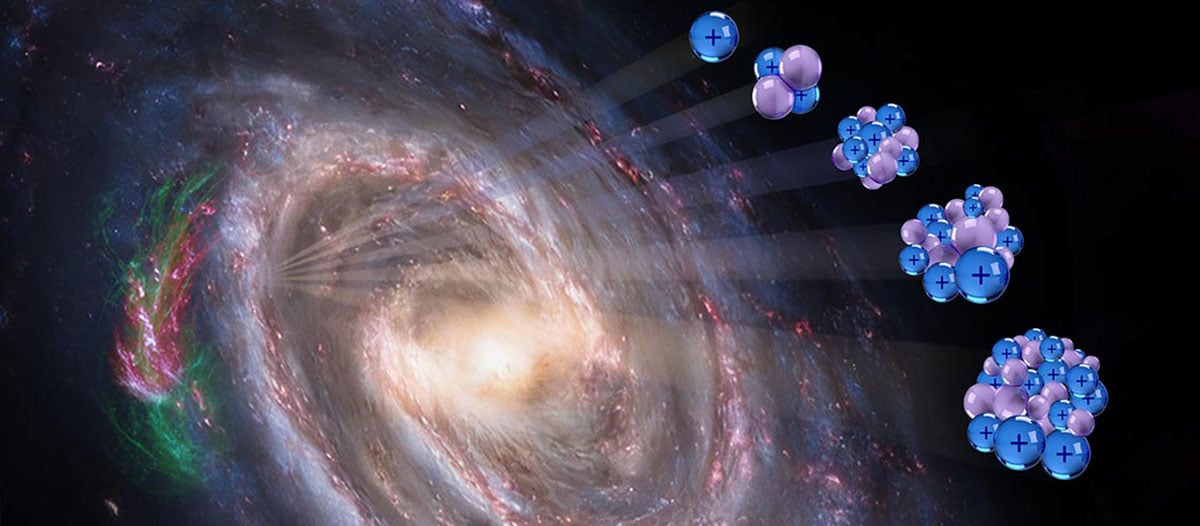
A long-standing cosmic mystery is beginning to yield new clues as researchers uncover a strikingly consistent pattern in the behavior of high-energy particles traveling across the universe.
More than 100 years after their discovery, cosmic rays continue to puzzle scientists. These extremely energetic particles travel across the universe from distant and powerful sources. The DAMPE (Dark Matter Particle Explorer) space telescope is working to better understand them, including whether dark matter plays a role in how they form.
This international project, which includes the University of Geneva (UNIGE), has now uncovered an important new clue. Researchers have identified a shared feature among these particles, and the findings were published in Nature.
The Mystery of Cosmic Rays
Cosmic rays are the highest-energy particles ever detected, far exceeding anything produced by human-made accelerators on Earth. Their origins remain uncertain, though scientists suspect they are created in extreme environments such as supernova explosions, jets from black holes, or pulsars.
Launched in December 2015, the DAMPE space telescope was designed to investigate these questions. The mission includes major contributions from the astrophysics group at UNIGE’s Department of Nuclear and Particle Physics (DPNC). By analyzing highly precise data, researchers discovered a consistent pattern in the energy distribution of primary cosmic ray nuclei, from protons to iron.
“Cosmic rays are primarily composed of protons, but also of helium, carbon, oxygen, and iron nuclei,” explains Andrii Tykhonov, associate professor at the DPNC in the Faculty of Science at UNIGE, and co-author of the study. “These particles are also categorized according to their energy: low, up to a few billion electron-volts; intermediate, from a few billion to several hundred billion electron-volts; and high, from 1,000 billion electron-volts and beyond.”
The team found that the number of particles drops off more sharply after a certain energy level. This effect, known as “spectral softening,” reflects a steeper decline than the gradual decrease normally seen as energy increases.
Implications for Cosmic Ray Physics
This shift occurs at a rigidity of about 15 TV (teraelectron-volts) (about 15 trillion electron-volts). Rigidity describes how much a particle’s path is influenced by magnetic fields.
Finding the same pattern at this rigidity across different types of nuclei supports models where both the acceleration and movement of cosmic rays depend on rigidity. Competing ideas that focus on energy per nucleon (energy divided by the number of nucleons in the particle) are strongly challenged by the data, with a confidence level of 99.999%.
Researchers at UNIGE played a key role in this work. They developed advanced artificial intelligence methods to reconstruct particle events and contributed to precise measurements of proton and helium fluxes, along with carbon analysis. The team also led the development of a major DAMPE instrument, the Silicon-Tungsten Tracker (STK), which allows scientists to accurately trace particle paths and measure their charge.
These findings bring scientists closer to understanding where cosmic rays come from and how they travel through the galaxy. The results place new limits on theories about particle acceleration in extreme astrophysical environments and improve models of how these particles move through interstellar space.
Reference: “Charge-dependent spectral softenings of primary cosmic rays below the knee” by The DAMPE Collaboration, 29 April 2026, Nature.
DOI: 10.1038/s41586-026-10472-0
Never miss a breakthrough: Join the SciTechDaily newsletter.
Follow us on Google and Google News.