
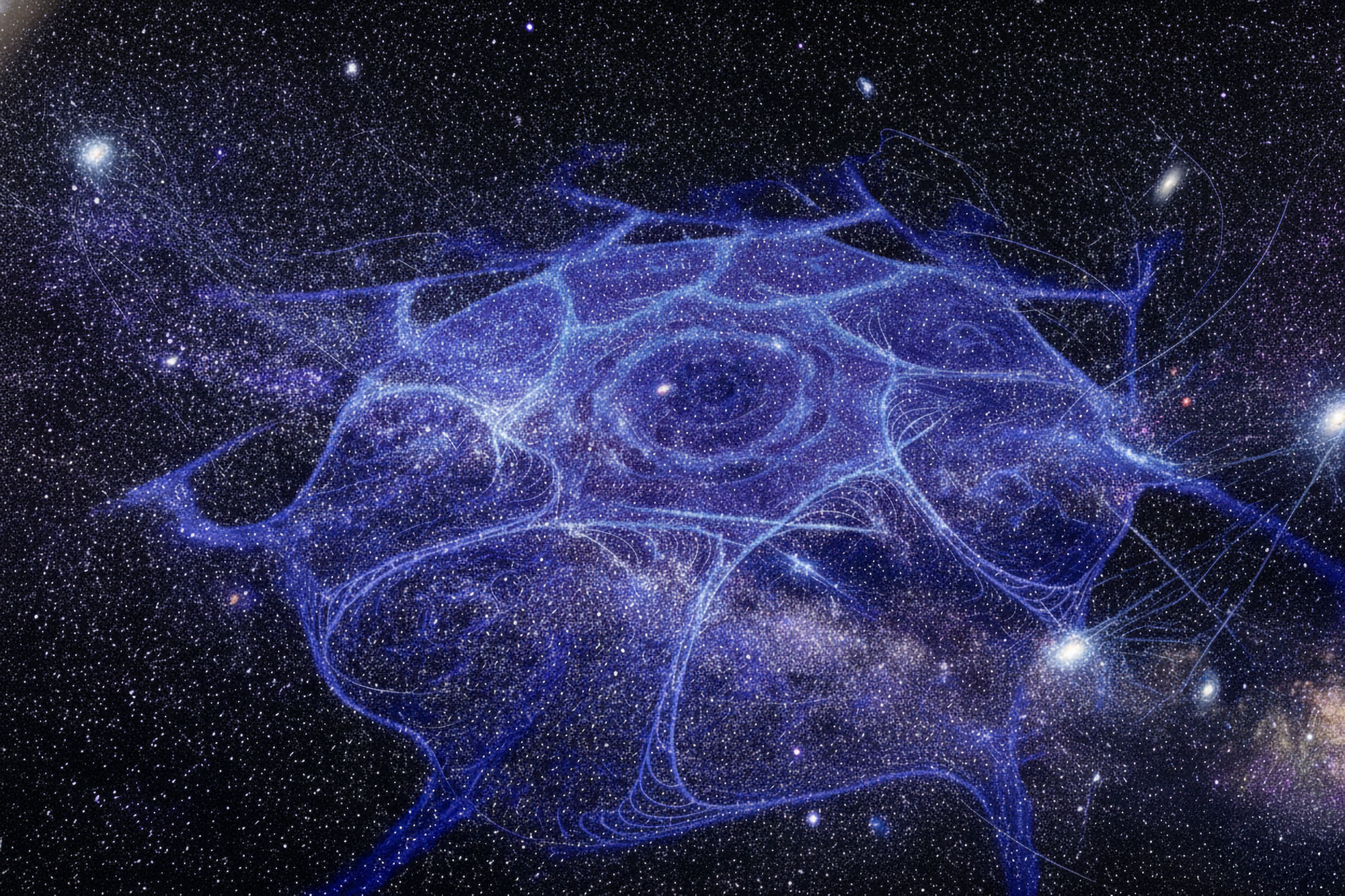
A team led by UNIGE has shown that the most mysterious component of our Universe follows the laws of classical physics, though some doubts still remain.
Does dark matter obey the same physical laws as the matter we can see? Scientists are still trying to answer this question about one of the Universe’s greatest mysteries. Dark matter, an invisible and theoretical form of matter that neither emits nor reflects light, continues to puzzle researchers.
A group that included scientists from the University of Geneva (UNIGE) set out to explore whether dark matter behaves like ordinary matter on the largest scales of the cosmos or if other, unknown forces might influence it.
The team’s results, published in Nature Communications, indicate that dark matter likely behaves in a similar way to regular matter. However, the study also leaves room for the existence of a still-undetected type of interaction. This research brings scientists a step closer to understanding the nature of this mysterious substance, which makes up about five times more of the Universe than ordinary matter.
The Forces That Govern the Universe
Ordinary matter is influenced by four known fundamental forces: gravity, electromagnetism, and the strong and weak nuclear forces that operate within atoms. The big question is whether dark matter, which cannot be seen or directly detected, is also shaped by these same forces or if it responds to an entirely new, unidentified one.
To explore this question, the researchers investigated how dark matter behaves on a cosmic scale. They focused on whether it moves through the Universe’s gravitational “wells” in the same way as ordinary matter. These wells form when massive celestial objects, such as stars and galaxies, warp the fabric of space, creating regions that draw matter inward.
Planets, stars, and galaxies move within these wells according to the well-established principles of physics, including Einstein’s theory of general relativity and Euler’s equations. The team set out to see if dark matter follows those same laws—or if something else is at work.
“To answer this question, we compared the velocities of galaxies across the Universe with the depth of gravitational wells,” explains Camille Bonvin, associate professor in the Department of Theoretical Physics at UNIGE’s Faculty of Science and co-author of the study. “If dark matter is not subject to a fifth force, then galaxies — which are mostly made of dark matter — will fall into these wells like ordinary matter, governed solely by gravity. On the other hand, if a fifth force acts on dark matter, it will influence the motion of galaxies, which would then fall into the wells differently. By comparing the depth of the wells with the galaxies’ velocities, we can therefore test for the presence of such a force.”
Euler’s equations still valid
Applying this approach to current cosmological data, the research team concluded that dark matter falls into gravitational wells in the same way as ordinary matter, thus obeying Euler’s equations.
“At this stage, however, these conclusions do not yet rule out the presence of an unknown force. But if such a fifth force exists, it cannot exceed 7% of the strength of gravity — otherwise it would already have appeared in our analyses,” says Nastassia Grimm first author of the study and former postdoctoral researcher at the Department of Theoretical Physics at UNIGE’s Faculty of Science who has recently joined the Institute of Cosmology and Gravitation at the University of Portsmouth.
These initial results mark a major step forward in characterizing dark matter. The next challenge will be to determine whether a fifth force governs it.
“Upcoming data from the newest experiments, such as LSST and DESI, will be sensitive to forces as weak as 2% of gravity. They should therefore allow us to learn even more about the behavior of dark matter, concludes Isaac Tutusaus, researcher at ICE-CSIC and IEEC and associate professor at IRAP, Midi-Pyrénées observatory, University of Toulouse, co-author of the study.
Reference: “Comparing the motion of dark matter and standard model particles on cosmological scales” by Nastassia Grimm, Camille Bonvin and Isaac Tutusaus, 3 November 2025, Nature Communications.
DOI: 10.1038/s41467-025-65100-8
Never miss a breakthrough: Join the SciTechDaily newsletter.
Follow us on Google and Google News.
5 Comments
Four ad-free, non-economic low budget videos demonstrating aspects of externally induced radiant pulsing angular lines of gravity force, no dark matter or fifth force required: https://odysee.com/@charlesgshaver:d?view=home
no
Dude, less is more.
The real test is whether you can break through trying to prove the first idea you were told (because it was wrong and the environment required for its relevance is unreal).
You’re going to have to see beyond what you’ve been thinking – and that will certainly be outside what everyone else has been wasting their time believing.
They’ve been trying to figure out what’s wrong with their theories using the same tools – that aren’t reflective of reality. In other words: They be wrong.
Solar system does not require dark matter. But Milkyway requires nearly 7 times it’s estimated mass to keep the stars together. This they argue is provided by dark matter.
In my view, gravity is directly proportional to square of the speed. The speed of solar system is 220 Km/s while the speed of Milkyway is 600 Km/s. So, the gravity of Milkyway is nearly 7 times stronger. So the available matter is enough to create the required force. No dark matter is required.