
Groundbreaking new research reveals that rotation curves of galaxies stay flat indefinitely far out, corroborating predictions of modified gravity theory as an alternative to dark matter.
This finding challenges the existing models of cosmology and suggests that either dark matter halos are vastly extended or our understanding of gravitational theory needs a fundamental reassessment.
Breakthrough in Cosmology
In a breakthrough discovery that challenges the conventional understanding of cosmology, scientists at Case Western Reserve University have unearthed new evidence that could reshape our perception of the cosmos.
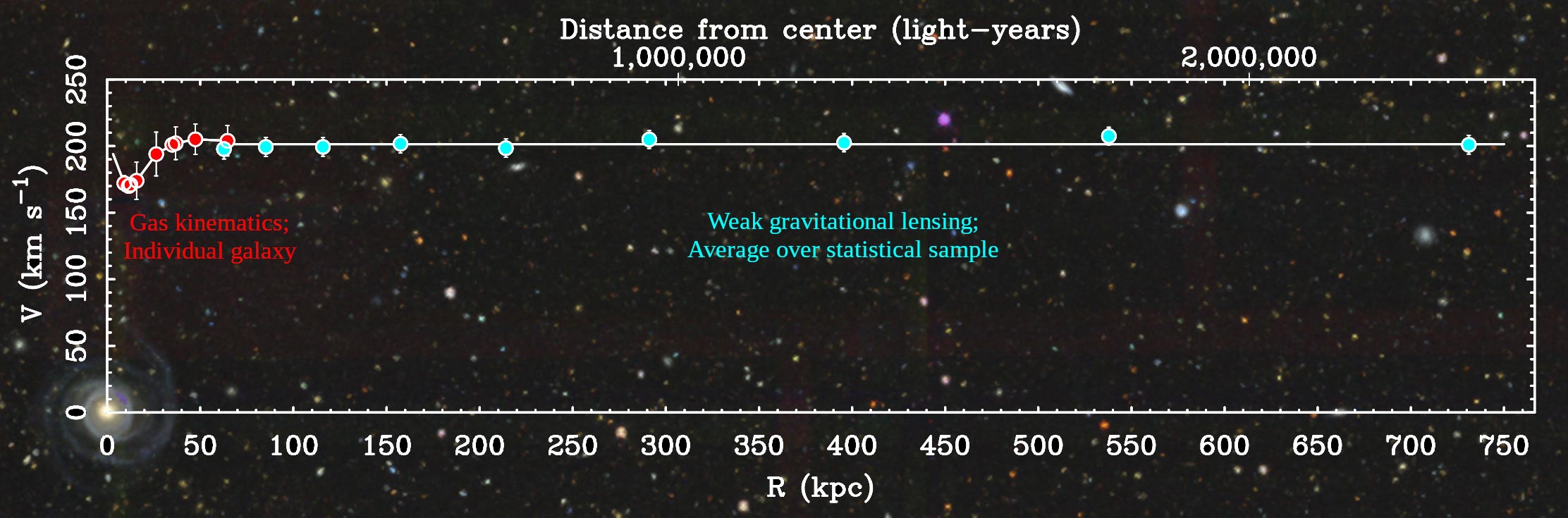
Tobias Mistele, a post-doctoral scholar in the Department of Astronomy at Case Western Reserve’s College of Arts and Sciences, pioneered a revolutionary technique using “gravitational lensing” to delve into the enigmatic realm of dark matter. He discovered that the rotation curves of galaxies remain flat for millions of light years with no end in sight.
Scientists have previously believed that the rotation curves of galaxies must decline the farther out you peer into space.
Challenging Traditional Cosmic Models
Traditionally, the behavior of stars within galaxies has puzzled astronomers. According to Newtonian gravity, stars on the outer edges should be slower due to diminished gravitational pull. This was not observed, leading to the inference of dark matter. But even dark matter halos should come to an end, so rotation curves should not remain flat indefinitely.
Mistele’s analysis defies this expectation, providing a startling revelation: the influence of what we call dark matter extends far beyond previous estimates, stretching at least a million light-years from the galactic center.

Such a long-range effect may indicate that dark matter—as we understand it—might not exist at all.
“This finding challenges existing models,” he said, “suggesting there exist either vastly extended dark matter halos or that we need to fundamentally reevaluate our understanding of gravitational theory.”
Revolutionary Implications for Astrophysics
Stacy McGaugh, professor and director of the Department of Astronomy in the College of Arts and Sciences, said Mistele’s findings, slated for publication in the Astrophysical Journal Letters, push traditional boundaries.
“The implications of this discovery are profound,” McGaugh said. “It not only could redefine our understanding of dark matter, but also beckons us to explore alternative theories of gravity, challenging the very fabric of modern astrophysics.”
Turning Einstein’s Theory on Its Head
The primary technique Mistele used in his research, gravitational lensing, is a phenomenon predicted by Einstein’s theory of general relativity. Essentially, it occurs when a massive object, like a galaxy cluster or even a single massive star, bends the path of light coming from a distant source. This bending of light happens because the mass of the object warps the fabric of spacetime around it. This bending of light by galaxies persists over much larger scales than expected.

As part of the research, Mistele plotted out what’s called Tully–Fisher relation on a chart to highlight the empirical relationship between the visible mass of a galaxy and its rotation speed.
“We knew this relationship existed,” Mistele said. “But it wasn’t obvious that the relationship would hold the farther you go out. How far does this behavior persist? That’s the question, because it can’t persist forever.”
Mistele said his discovery underscores the necessity for further exploration and collaboration within the scientific community—and the possible analysis of other data.
Reevaluating Dark Matter Theories
McGaugh noted the Herculean—yet, so far, unsuccessful—efforts in the international particle physics community to detect and identify dark matter particles.
“Either dark matter halos are much bigger than we expected, or the whole paradigm is wrong,” McGaugh said. “The theory that predicted this behavior in advance is the modified gravity theory MOND hypothesized by Moti Milgrom as an alternative to dark matter in 1983. So, the obvious and inevitably controversial interpretation of this result is that dark matter is a chimera; perhaps the evidence for it is pointing to some new theory of gravity beyond what Einstein taught us.”
Reference: “Indefinitely Flat Circular Velocities and the Baryonic Tully-Fisher Relation from Weak Lensing” by Tobias Mistele, Stacy McGaugh, Federico Lelli, James Schombert and Pengfei Li, Accepted, Astrophysical Journal Letters.
arXiv:2406.09685
Never miss a breakthrough: Join the SciTechDaily newsletter.
Follow us on Google and Google News.
19 Comments
Turns out the gravity field is filled with scarecrows pretending to do global “media outreach” aimed at children.
Favorite anti-gravitational prejudice of rainbow warriors – different masses can fall together, and an equation where mass converts to energy the same regardless of altitude (regardless of gravity) is genius, therefor different components of white light must religiously fall at different rates under gravity, especially to make up for the lightest fastest matter approaching only half the gravitational bending shown by light.
“If the speed of light changed then thing like the spectral lines of atoms would also change”
Saw this from someone in a group of global Einsteins residing on a fashion science website for gamers pretending to be good programmers. Wish it could be translated into something globally definite so the supposed global logic could be checked, but who knows… Redshift be darned, this is supposed to be proof “c” is constant everywhere, so straight time can continue being bent, and bent lines can continue being straight, and no it’s not a plan to depress normal brains.
I mean why is it I can easily imagine it will never get downrated by the usual global gang of invisible contra-verbal kangaroos? What are expansion-redshifted lines supposed to do, crowd together? … spead apart? … mainstain constant spacing as lower frequencies abruptly disappear? Something better?
These are people who believe some things are moving away so fast that time is passing five times slower for them when out in public, so it’s clearly not too hard for gamers to confuse a gravitational frequency shift with an expansionary (or velocity-based, as if there’s a difference) frequency shift. I mean when you like to slow down time wherever things are falling faster you should maybe get a clue it’s cartoon super-physicist time.
It’s not a comment on SR, which is cartoon cosmology, but on GR that pretends to be better than that.
I’m just going to leave it at making “c” an illusorily-constant variable instead of adopting the mainstream science candor suggesting time and free will are the illusions, or the “bent illusions” if you prefer.
Blue-shifted moonlight shows things falling slower on the moon. And please, no, let’s not bend things the other way to slow time down to “fix” it, either.
Even more concisely – dilate/compress photons instead of dilating/compressing time in order to not pretend bent things have to be considered straight.
Hold your inner-child conceptual nose if you have to but try to immerse yourself in the idea that light always carries the cosmological distortion, never time, without drowning in it. Like, you never know until you give it a decent try.
And the resident idiot babbles on, pretending to be smart…
Great, you’re still kicking your ass by proxy here. More braindead jackass projection from the only MOND fan with the nerve to invoke Dunning-Kruger.
TheHack, if only you knew any of the people in this article, they’d tell you they want nothing to do with you. The way you defend Einstein worship in the standard obnoxious way, namely as if he’s your uncle with a generational inheritance you want part of…
I know who you remind me of … it’s that senator with no big problem rear-ending people on the interstate!
Make a note – poster needs its own APE-PAC advisor.
Consider that the plane of a galaxy acts like a wheel, where gravity is concentrated linearly across the plane, which maintains its disk structure as it rotates because of the gravitational concentration that exists radially between the stars along the diameter of the plane. That might explain the supposed inconsistency that caused cosmologists to formulate the idea of dark matter. Most likely, gravity concentrated along the plane keeps everything synchronous and gravitationally “bound” together. Angular momentum maintains the rotational speed and revolution of the disk while radially concentrated gravity maintains cohesion of the stars making up the disk.
…”gravity is concentrated linearly across the plane, which maintains its disk structure as it rotates because of the gravitational concentration that exists radially between the stars …”
Well of course the gravity between adjacent things crowded together into a disk is going to be the strongest gravity, compared to gravity off-disk … the question is whether this sort of flat neighbor-to-neighbor gravity enhancement could produce an *unexpectedly strong* coupling not predictable by an inverse-square rule that doesn’t care about directions. Something maybe having to do with unexpected cooling-associated mechanisms that align neighborhood spin planes, something maybe having to do with favoring retroreflections of coupling energy, you know what I mean?
“… gravity concentrated along the plane keeps everything synchronous and gravitationally “bound” together… ”
Of course gravity “binds” masses together in space, making large systems such as galaxies, but not usually like space is e.g. selectively moving in part like a solid disk. By “synchronous” you’re possibly suggesting to me that entanglement is involved.
I can’t argue with non-Newtonian concentration of binding energy in e.g. disk galaxies, but curious if you’d take the idea as far as I do and claim temperature-based (spin de-randomizing-based) retro-reflective gravitational carrier flow affecting nucleon bindings even between distant neighboring atoms.
I was thinking that rainbows are formed using solids and liquid boundaries with optically-active regions necessarily existing close to the scale of single wavelengths. Gravitational light-bending should duplicate this, at least in the minds of true absolute rainbow experts. No gravity rainbow, ergo constant light speed. That what goes for true “genius” inspiration any more. But anyway, I took the LSAT only once, did not get a perfect score, probably didn’t practice enough.
SR has particle collider operators and e.g. muon lifetime experts in agreement, but the question I ask myself is – what if all the measurable relativistic time effects are indistinguishable from relativistic mass gain effects, and both time and mass effects cannot be simply compounded together thus only invoking one effect is possible?
When you have a “wide” binary identifiable in a short period, you probably have a pair that visibly crosses and un-crosses itself in said short period. In that case, you probably have a pair that may be practically grazing each other while both spin in complementary ways at high speed.
Seems my non-Newtonian point would be that “wide” binaries are “cherry picks.”
“grazing each other”
Seems possible experts are treating the dark planetary and pro-planetary matter systematically spinning around stars as if it was random clouds of matter. Microlensing doesn’t seem to offer a lot of promise for measuring dark system spins.