
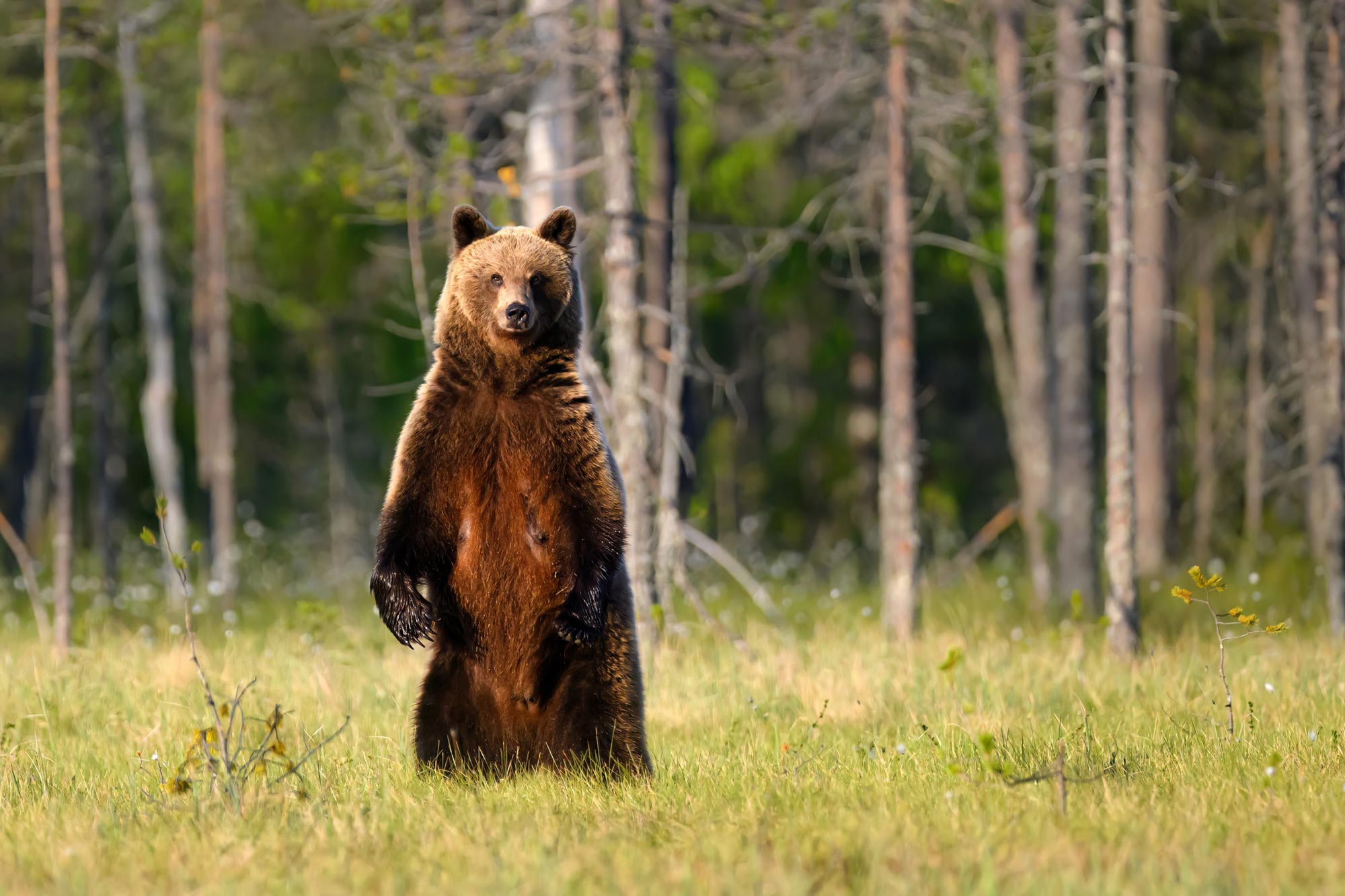
New research shows that wildlife reacts differently to human presence than to human-made landscapes.
For centuries, people have transformed landscapes, forcing wildlife to adjust to a rapidly changing world. New research suggests that animals are not only responding to altered habitats, but also to the direct presence of humans.
Researchers from UC Santa Barbara, the Smithsonian’s National Zoo and Conservation Biology Institute, and Yale University combined GPS tracking data from 37 animal species with cellphone location information collected across the United States. Their study, published in Science, found that animals respond to human activity in very different ways depending on the species and the condition of the surrounding habitat. The results point to the need for more tailored conservation and wildlife management strategies.
“Humans have complicated effects on wildlife — from our physical presence to how we reshape habitats — but we can’t understand our full impact without information on both,” said co-lead author Ruth Oliver, an assistant professor in UCSB’s Bren School of Environmental Science & Management.
The COVID-19 pandemic created an unusual opportunity to examine these effects separately. As lockdowns changed how people moved through their communities, researchers were able to compare the influence of human presence with the effects of long-term landscape changes.
The team analyzed weekly GPS records from 4,581 mammals and birds across the continental United States during the same periods in 2019 and 2020. Measuring human activity required a more direct approach than researchers typically have available.
Reliable public data on human movement are limited. As a result, studies of human-wildlife interactions often rely on indirect indicators such as urban development, agriculture, or pandemic restrictions. Because these measures do not directly track where people are, the researchers turned to anonymized cellphone geolocation data at the neighborhood level. According to the authors, this is the first study to use this type of information to examine how human presence affects animal movement.
“The cell phone data we used was made available to researchers during the pandemic to help reveal the impacts of COVID-19 shutdowns,” said co-lead author Scott Yanco, a research ecologist at the Smithsonian’s National Zoo. “Typically, private companies hold onto these, which made this a rare opportunity for us to quantify how human presence impacts wildlife, and to demonstrate that there is more to consider than just land modification to create robust conservation plans.”
Untangling Human Impacts on Wildlife
The researchers examined how human activity influenced both the area used by individual animals and their environmental niches, which describe how species interact with habitats and available resources. Their analysis showed that, for most species, the effects of habitat modification cannot be fully understood without also accounting for human presence.
Overall, 57% of the species studied were affected by a combination of human presence and landscape changes. Human activity was linked to shifts in occupied area or environmental niche size for 67% of mammal species and 68% of bird species.
In many cases, the effects of human presence and habitat modification were closely connected. About 67% of mammal species and 41% of bird species reduced the areas they used when both factors increased. These responses were often strongest in less developed settings, such as national parks, where animals appeared more sensitive to people than in heavily urbanized environments.
Species responses were far from uniform. Wolves were unusual in that they expanded their ranges in response to human presence, potentially reflecting a tendency to spread farther apart and avoid people.
White-tailed deer and sandhill cranes reacted in opposite ways. Deer expanded their environmental niches as landscapes became more modified but contracted them when human presence increased. Sandhill cranes showed the reverse pattern.
“These findings highlight the critical importance of species-based conservation,” Oliver said. “Every species has different habitat requirements, has its own particular behavioral tendencies and faces unique threats. Effective conservation requires that we understand the particular challenges that each species faces.”
Lessons From the “Anthropause”
The study is part of the COVID-19 Bio-Logging Initiative, a global collaboration established to investigate wildlife responses to pandemic lockdowns, a period researchers called the “anthropause.”
Earlier studies from the initiative documented widespread behavioral changes among mammals, major shifts in marine traffic, and the value of tracking human movement when studying wildlife responses during the Anthropocene (the time period when human activities have had an environmental impact on the Earth). The effort brought together 600 partners and collected about 1 billion location records from roughly 13,000 animals.
The new findings demonstrate how combining animal GPS data with mobile device location information can provide a more detailed understanding of human impacts on wildlife. The approach allows scientists to separate the effects of infrastructure and habitat alteration from the effects of people themselves.
Oliver’s team is now investigating how human-driven changes to landscapes and climate influence wildlife mortality.
“Our current study shows that animals change how they use space and resources, but we don’t know if these changes are helping them adapt or are a sign of stress,” she pointed out. “Our group is now digging into that question by asking whether animals that change their behavior in response to human pressures are at greater or lower risk of dying.”
The pandemic offered researchers a rare chance to study human influences on wildlife in ways that were previously impossible. As a result, conservation policies developed before this period lacked many of the insights now emerging about how animals respond to people.
“Our results give me some optimism that we can achieve wildlife-coexistence through more nuanced policies that more smartly consider where and when we need to give animals space,” Oliver said.
Reference: “Interacting effects of human presence and landscape modification on birds and mammals” by Ruth Y. Oliver, Scott W. Yanco, Diego Ellis-Soto, Brett R. Jesmer, Juliet Cohen, Song Gao, Robert Patchett, Tal Avgar, Keith Bildstein, Nicholas W. Bakner, David Barber, Kristin Barker, Joseph G. Barnes, Guillaume Bastille-Rousseau, Jerrold L. Belant, John F. Benson, Joël Bêty, Dean E. BeyerJr., David Bird, Nathaniel Bowersock, Andy J. Boyce, Ben S. Carlson, Michael L. Casazza, Michael J. Chamberlain, Michael J. Cherry, Bret A. Collier, Alyson Courtemanch, Sarah C. Davidson, Darren DeBloois, Vickie DeNicola, Christopher R. DeSorbo, Robert C. Dowler, Daniel Dupont, L. Mark Elbroch, John Elliott, Betsy A. Evans, W. Mark Ford, David Hancock, Molly Hardesty-Moore, Jason E. Hawley, Mackenzie R. Jeffress, Scott Jennings, Matthew J. Kauffman, Roland Kays, Marcella J. Kelly, Bryan M. Kluever, Myles Lamont, Scott LaPoint, Tayler N. LaSharr, Josee Lefebvre, Pierre Legagneux, Matthias-Claudio Loretto, David Lumpkin, Lindsay A. Martinez, John M. Marzluff, Douglas McCauley, Fiona McDuie, Tony W. Mong, Kevin L. Monteith, Thomas Mueller, Levi Newediuk, Anna C. Ortega, Federico Ossi, Cory Overton, J. Clint Perkins, Tyler R. Petroelje, Laura Prugh, Kimberly A. Sager-Fradkin, Michael Seer, Avery L. Shawler, Shannon Skalos, Rachel A. Smiley, Julia Sommerfeld, Daniel R. Stahler, John A. Stephenson, Richard D. Stevens, Nathan J. Svoboda, Jean-Francois Therrien, Philippe J. Thomas, Meredith VanAcker, Eric Vander Wal, Dan E. Varland, Tana L. Verzuh, Brittany L. Wagler, Nils Warnock, Stephen L. Webb, Christopher K. Williams, Christopher C. Wilmers, David W. Wolfson, Julie K. Young, Christian Rutz and Walter Jetz, 21 May 2026, Science.
DOI: 10.1126/science.adq3396
Never miss a breakthrough: Join the SciTechDaily newsletter.
Follow us on Google and Google News.
1 Comment
thanks for this