
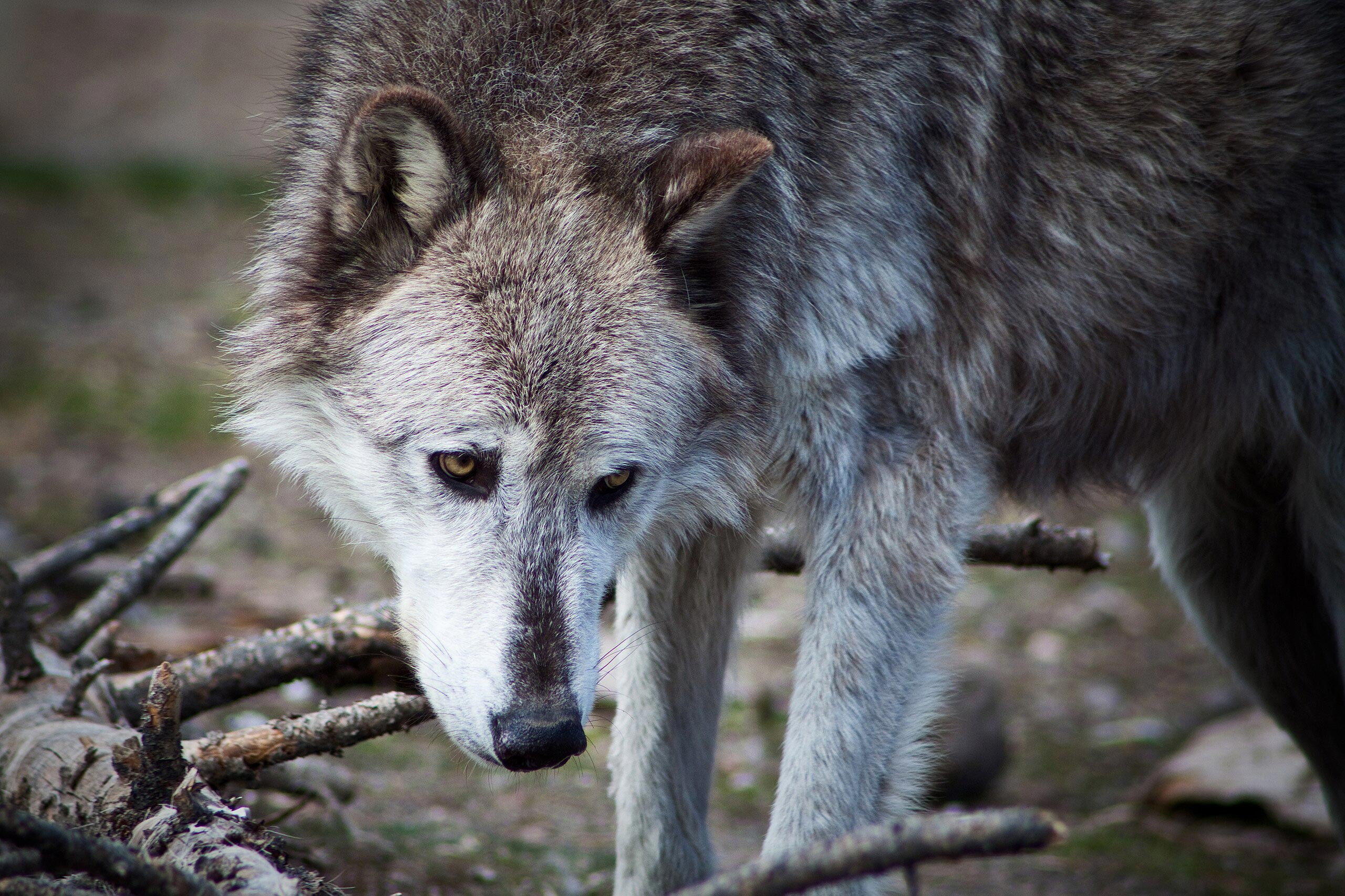
A new peer-reviewed study reports that claims of a “world-leading” trophic cascade in Yellowstone National Park are not supported, citing problems with the methods used in earlier research.
A newly published peer-reviewed analysis questions one of the most widely publicized claims about wolves in Yellowstone.
In a detailed comment appearing in Global Ecology and Conservation, scientists from Utah State University and Colorado State University argue that a 2025 study by Ripple et al. exaggerated the ecological impact of wolf recovery in Yellowstone National Park.
“Ripple et al. argued that carnivore recovery produced one of the world’s strongest trophic cascades,” said Dr. Daniel MacNulty, lead author and wildlife ecologist at Utah State University. “But our re-analysis shows their conclusion is invalid because it relies on circular reasoning and violations of basic modeling assumptions.”
Ripple et al. based their conclusion on a 1,500 percent increase in willow crown volume, calculated from plant height data using a regression model that defines and predicts volume from the same variable. “Because height was used both to compute and to predict volume,” MacNulty explained, “the relationship is circular—mathematically guaranteed to look strong even if no biological change occurred.”
Methodological issues amplify effects
The authors pointed to several additional problems:
- The height-to-volume model was used on willows that had been heavily browsed and had irregular shapes, which broke key model assumptions and made growth appear larger than it was.
- Many of the willow plots compared between 2001 and 2020 did not match, mixing real ecological change with differences caused by sampling bias.
- Comparisons with trophic cascades elsewhere assumed ecological equilibrium, an assumption that does not fit Yellowstone’s still recovering, non-equilibrium system.
- The use of selective photographs and the exclusion of important influences, such as human hunting, further weakened attempts to draw clear cause and effect conclusions.
Evidence points to modest responses
“Once these problems are accounted for, there is no evidence that predator recovery caused a large or system-wide increase in willow growth,” said Dr. David Cooper, co-author and emeritus senior research scientist at Colorado State University. “The data instead support a more modest and spatially variable response influenced by hydrology, browsing, and local site conditions.”
The authors emphasize that their critique does not diminish the ecological significance of large carnivores but underscores the need for rigorous methods when evaluating complex food-web interactions.
“Our goal is to clarify the evidence, not downplay the role of predators,” MacNulty said. “Predator effects in Yellowstone are real, but context-dependent—and strong claims require strong evidence.”
The study reconciles conflicting interpretations of the same dataset. Ripple et al. (2025) concluded that carnivore recovery produced a strong trophic cascade, whereas Hobbs et al. (2024), who collected the data through two decades of field experimentation, found only weak cascade effects.
Reference: “Flawed analysis invalidates claim of a strong Yellowstone trophic cascade after wolf reintroduction: A comment on Ripple et al. (2025)” by Daniel R. MacNulty, David Cooper, Michael Procko and T.J. Clark-Wolf, 13 October 2025, Global Ecology and Conservation.
DOI: 10.1016/j.gecco.2025.e03899
Never miss a breakthrough: Join the SciTechDaily newsletter.
Follow us on Google and Google News.
4 Comments
Climate activist releases flawed report. Surprising everyone I’m sure. Full of exaggeration and failed methodology. All honest mistakes no doubt…
Seriously? Yellowstone has gotten better since the wolves came back. Who would believe it hasn’t? People that hate wolves?
Seriously? Who would believe that it has? People who love wolves?
Wolves have helped willow grow n balance of nature n the ecosystem!