
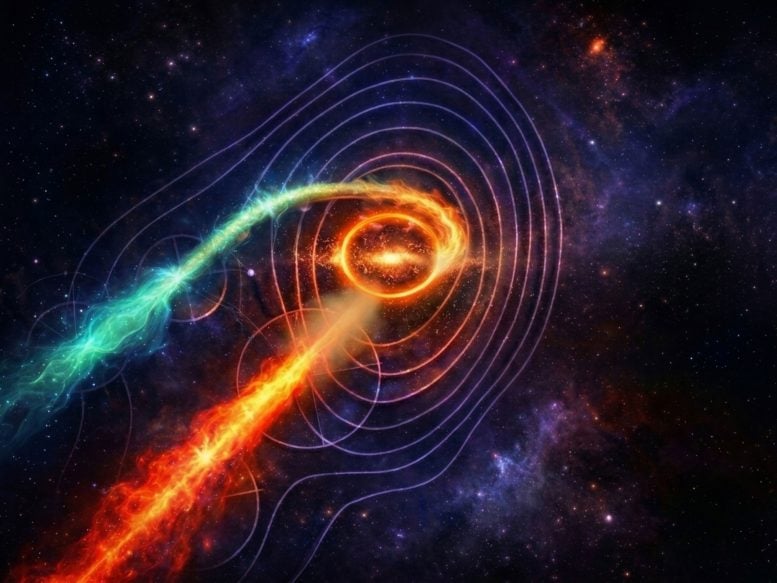
Researchers discovered a closely orbiting pair of supermassive black holes in Markarian 501 by tracking two jets of particles. The binary system could merge within 100 years and may produce detectable gravitational waves.
Current evidence indicates that nearly every large galaxy contains a supermassive black hole at its center, with a mass ranging from millions to billions of times that of the Sun. Exactly how these objects grow so large remains a major unanswered question. Accumulating (accreting) gas from their surroundings alone would be too slow, suggesting that mergers with other massive black holes play a crucial role in their growth.
Galaxy collisions are common throughout the Universe, making it likely that the supermassive black holes at their centers also eventually merge. Before combining into a single object, the two black holes are expected to orbit one another while gradually moving closer together.
Yet scientists have struggled to model the final stages of this process accurately. Despite the frequency of galaxy mergers over cosmic timescales, no close pair of supermassive black holes had been definitively identified. A new study of the galaxy Markarian 501 (Mrk 501) in the constellation Hercules has now provided compelling evidence.
An international team led by Silke Britzen of the Max Planck Institute for Radio Astronomy (MPIfR) in Bonn discovered direct signs of a supermassive black hole pair at the center of Mrk 501. The findings have been published in the Monthly Notices of the Royal Astronomical Society.
Twin Jets Reveal a Hidden Black Hole Pair
The supermassive black hole at the center of Mrk 501 produces a powerful jet of particles that travels through space at nearly the speed of light. To investigate the region, researchers examined high-resolution observations spanning multiple radio frequencies. The data were collected over approximately 23 years across dozens of observing sessions. Instead of finding only one jet, the team identified a second jet as well.
The observations provide the first direct image of this type of system in a galactic center and offer strong evidence for a second supermassive black hole. “We searched for it for so long, and then it came as a complete surprise that we could not only see a second jet but even track its movement,” said Silke Britzen.
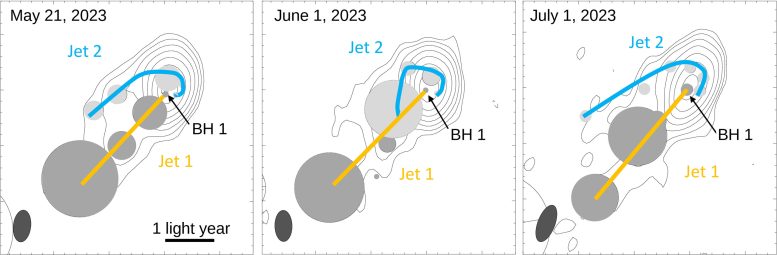
The first jet is directed toward Earth, making it appear exceptionally bright and allowing astronomers to study it for many years. The second jet points in a different direction, which made it much harder to detect. Within just a few weeks, researchers recorded major changes. The second jet emerges from behind the larger black hole and moves counterclockwise around it in a repeating pattern.
“Evaluating the data felt like being on a ship. The entire jet system is in motion. A system of two black holes can explain this: The orbital plane sways”, explained Silke Britzen.
During one observation in June 2022, radiation from the system followed such a distorted path that it appeared as a ring, known as an Einstein ring. The most likely explanation is that the system was perfectly aligned with Earth. The black hole in the foreground then acted as a gravitational lens, bending the light from the second jet behind it.
Evidence for a Rapidly Orbiting Black Hole Binary
By studying long-term changes and repeating brightness patterns in the jets, the researchers concluded that the two black holes orbit one another every 121 days. Their separation is roughly 250 to 540 times the Earth-Sun distance (about 23.2 to 50.2 billion miles, or 37.4 to 80.8 billion kilometers), remarkably small for objects with masses ranging from 100 million to 1 billion Suns. Depending on their true masses, the pair could draw together quickly enough to merge in as little as 100 years.
Because Mrk 501 is so distant from Earth, even the most advanced instruments cannot directly resolve the two black holes as separate objects. The Event Horizon Telescope (EHT), which captured the first black hole images in 2019 and 2022, also lacks the necessary resolution. As a result, astronomers will not be able to directly observe the pair’s shrinking orbit.
Even so, researchers expect to detect signs of the decreasing separation through gravitational waves. The system should generate extremely low-frequency gravitational waves that could be observed using pulsar timing arrays (PTAs).
Supermassive black hole binaries (SMBHBs) are already considered the leading explanation for the gravitational wave background detected in 2023 by the European Pulsar Timing Array and other collaborations. Mrk 501 has now emerged as one of the strongest candidates for linking PTA measurements to a specific supermassive black hole binary.
“If gravitational waves are detected, we may even see their frequency steadily rise as the two giants spiral toward collision, offering a rare chance to watch a supermassive black hole merger unfold,” said co-author Héctor Olivares.
Reference: “Detection of a second jet within the nuclear core of Mrk 501” by S Britzen, H Olivares, Gopal-Krishna, F Jaron, I N Pashchenko, E Kun, F K Schinzel, J Becerra González, D Paneque and N R MacDonald, 27 March 2026, Monthly Notices of the Royal Astronomical Society.
DOI: 10.1093/mnras/stag291
Never miss a breakthrough: Join the SciTechDaily newsletter.
Follow us on Google and Google News.
1 Comment
Well observed data for the galaxy Markarian 501 has been obtained;but,due to limited power for resolution of the Event Horizon Telescope(EHT),picture of shrinking orbit of supermassive black hole binary system can not be obtained directly.Hence,through detection of gravitational wave by Pulsar Timing Array method or watching reasonable change in the data collected for a decade or so,merger event can be confirmed,contrast to a stable orbit case.