
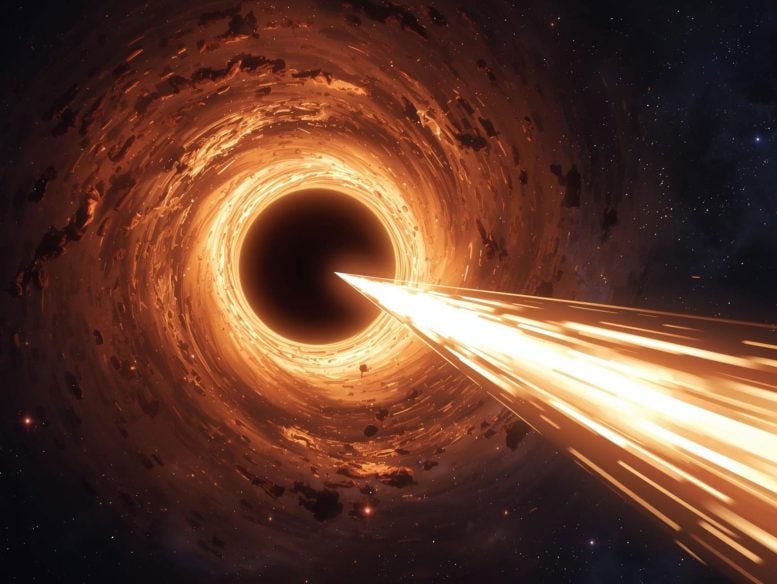
A black hole in a relatively nearby galaxy has abruptly switched on a powerful cosmic beacon, and years later, it is still blazing.
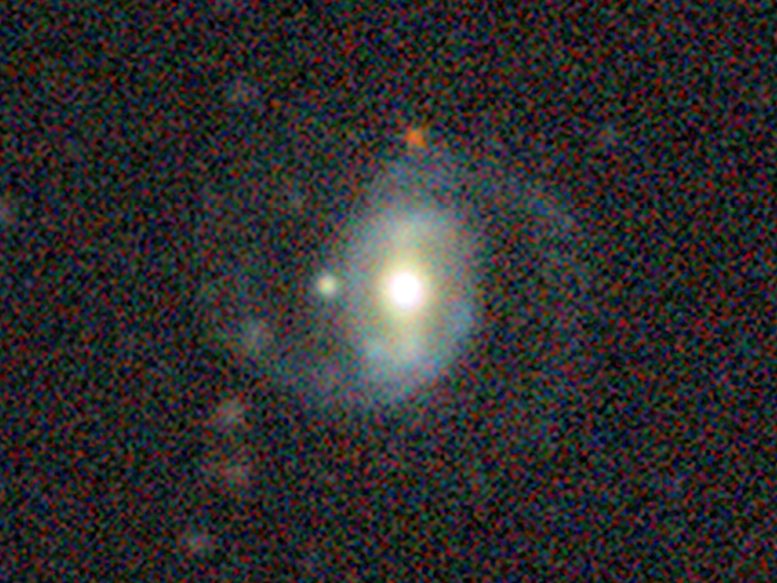
Astronomers have discovered a galaxy whose central black hole has remained extraordinarily bright in radio waves for more than eight years after its emission suddenly increased by more than 20 times. Located about 1.8 billion light-years from Earth in the constellation Leo, the spiral galaxy SDSS J110546.07+145202.4 may represent the first known example of an entirely new class of active galaxy.
Radio transients usually appear when an extreme event causes a source to brighten and then fade over days, weeks, or months. This galaxy instead entered a sustained radio-bright state unlike anything previously observed around a rapidly growing black hole of its size.
“We are dealing with the prototype of a new class of galaxies that undergo rapid changes in radio emission,” said co-author Phil Edwards from CSIRO, Australia’s national science agency.
The object is classified as a narrow-line Seyfert 1 galaxy, a type of active galaxy generally associated with comparatively low-mass black holes that are rapidly consuming material. Researchers describe it as the first known long-duration radio “changing-look” galaxy of this kind because its radio properties underwent a dramatic transformation and stayed that way.
How a Growing Black Hole Powers Radio Jets
An international team led by Stefanie Komossa of the Max Planck Institute for Radio Astronomy (MPIfR) investigated the outburst using new observations and archival measurements covering the electromagnetic spectrum from radio waves to X-rays. The results were published in The Astrophysical Journal.
Although black holes emit no light directly, matter falling toward them can become extraordinarily bright. Gas and dust spiral into a rapidly rotating accretion disk, where friction and compression heat the material. Magnetic fields can also redirect some of the incoming matter into narrow jets that race away from the black hole at nearly the speed of light.
The team suspects that an increased flow of matter into this black hole triggered such a jet. That jet appears to be responsible for radio emission roughly ten quadrillion (1016) times as intense as the Sun’s.
“Luminous radio radiation from rapidly growing, lightweight black holes is rare to begin with. Their transition into a long-lasting, radio-bright state has never been observed before,” said lead author Stefanie Komossa.
A Mystery That Defies Explanation
Observations indicate that the galaxy changed from a relatively quiet radio source into an extremely radio-loud one. Earlier research found no comparable surge in visible or infrared light, making the radio transformation even more unusual. The behavior also appears difficult to explain as a star being torn apart by the black hole or as the more familiar variability seen in blazars, whose jets point almost directly toward Earth.
“Follow-up observations with numerous telescopes, including the 100-meter (328-foot) radio telescope in Effelsberg, CSIRO’s Australia Telescope Compact Array, and satellites in space, confirm the source’s unique properties,” said co-author Alexander Kraus.
Astronomers still do not know what suddenly increased the black hole’s food supply or why its jet has remained active for so long. The black hole may have encountered a fresh reservoir of gas, or conditions in its accretion disk may have changed in a way that allowed a powerful jet to form. Continued monitoring will be needed to distinguish between those possibilities.
A Window Into the Early Universe
The discovery is particularly valuable because the black hole resembles rapidly growing black holes thought to have been common when the universe was young. Those ancient objects are so distant that examining their immediate surroundings is extremely difficult. SDSS J110546.07+145202.4 offers astronomers a much closer laboratory for studying how a growing black hole can launch and sustain a jet.
“Such high-energy events can provide astronomers with a wealth of insights. By observing these jets and outbursts, we can study the physical processes in some of the most extreme environments in the Universe,” said co-author Kovi Rose from the University of Sydney’s Sydney Institute for Astronomy.
Future observations with the Very Long Baseline Array (VLBA) could resolve the structure of the jet and reveal how it changes. By combining signals collected by radio antennas spread across large distances, the array can effectively act like a much larger telescope, allowing astronomers to examine compact structures near the center of the galaxy.
The upcoming Square Kilometre Array (SKA) observatories could also uncover more objects undergoing similar transformations. Finding a larger population would show whether this galaxy is an extraordinary exception or the first detected member of a previously hidden class.
“With sensitive facilities like the incoming SKA telescopes, we’ll be able to identify similar radio transients in future sky surveys. This is crucial for filling the gaps in our understanding of the early Universe,” said Komossa.
Reference: “SDSS J110546.07+145202.4: The First Long-duration Radio Changing-look NLS1 Galaxy” by S. Komossa, D. Grupe, A. Kraus, P.G. Edwards, E. F. Kerrison, K. Rose, R. Soria, T. An, M.J. Hardcastle, K.É. Gabányi, S. Panda, D.W. Xu, J. Wang, S. Frey and A. Mezősi, 13 May 2026, The Astrophysical Journal.
DOI: 10.3847/1538-4357/ae610f
Never miss a breakthrough: Join the SciTechDaily newsletter.
Follow us on Google and Google News.
4 Comments
When you hear about a “jet of energy” shooting out of a black hole, it’s easy to think of it as a blast of wind or a loud acoustic pressure wave (like friction causing sound). But the reality of what that jet is made of—both in mainstream science and on my Torsion Hill universal framework V24 workbench—is much more physical. “The jet isn’t just matter being thrown away by a messy eater. It is the universe’s pressure-relief valve. When a black hole compresses space too tightly, the excess rotational tension is forced outward in a clean, laminar ‘glass tube’ of pure grid-energy, which condenses into matter as it travels.
This is why that ‘laminar flow’ visual is so powerful. The jet is a perfectly smooth channel where the background fabric of the universe is undergoing torsional uncoiling at maximum speed.” Believe when I say I have tested this theory extensively using relativity as the base platform and science should take advantage of all it offers , Torsion Hill universal unified theory .
I thought matter could never be created
What if……
What if that radio brightness was a civilization sending a ‘hi how are you’ message?
Probably not, but what if?
8 years? About the time AI went mainstream…just a coincidence, no doubt