
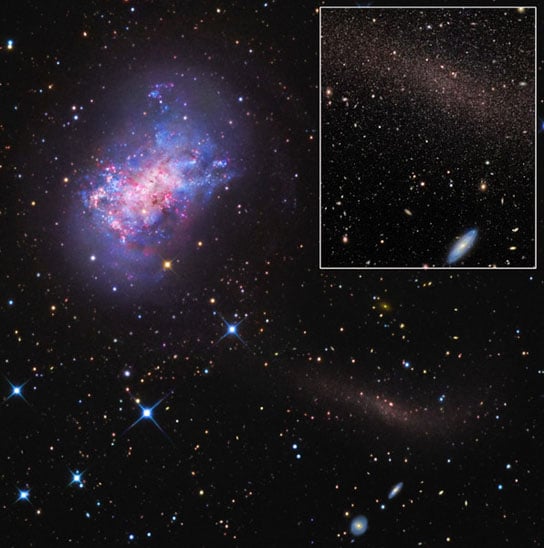
A research team from Max Planck Institute for Astronomy and another team lead by Michael Rich of UCLA and the Polaris Observer Association has identified the first example of a galaxy merger between very small galaxies. By examining the forms of distortion, they found evidence that a small companion of the dwarf galaxy NGC 4449 is in the process of being swallowed up.
From small to large – this motto also applies in space. Tiny galaxies can merge into formidable Milky Way systems. But how do dwarf galaxies grow? Apparently, in a similar manner – through cosmic cannibalism. Two research groups including MPIA researchers David Martínez-Delgado and Michelle Collins from the Max Planck Institute for Astronomy in Heidelberg have found a mini galaxy that is just in the process of devouring another.
In the widely accepted hierarchical model of galaxy evolution, much of galactic growth involves acts of cannibalism and large-scale mergers: pre-existing, smaller galaxies successively coalesce into larger pieces until large galaxies, the size of the Milky Way or even bigger, form. But before galaxies and their stars can merge, stars have to form in the first place.
This is thought to happen by gas gathering to form denser regions under the influence of its own gravity; once a critical density is reached, stars are born. Conceivably, the smallest galaxies, so-called dwarf galaxies, might form in this way directly, without the need for mergers. And indeed, until now, no such mergers had been observed.
Now, two independent groups of researchers, one led by David Martínez-Delgado of the Max Planck Institute for Astronomy (MPIA), the other by Michael Rich of University of California, Los Angeles (UCLA) and the Polaris Observer Association, have identified the first confirmed example for a galaxy merger between very small galaxies. They found convincing evidence that a small companion of the dwarf galaxy NGC 4449 in the constellation Canis Venatici, first identified in 2007, is indeed another, smaller dwarf galaxy in the process of being disrupted by its larger neighbor – prior to being swallowed up.
The researchers examined, among other things, the form of the distortion; they analyzed star types and searched for structures mapping the orbit of the galaxy on the menu.
Martínez-Delgado says: “The models predict that dwarfs should eat dwarfs. But this is the first clear example of such a feast that has been actually observed: We’ve found a key piece of the puzzle of galaxy evolution. Also, the fact that NGC 4449 is quite close to us shows that processes like this are still happening. They need to be taken into account if we want to describe our cosmic neighborhood.”
MPIA’s Michelle Collins, who worked with Michael Rich on analyzing the dwarf galaxy’s shape, adds: “Knowing what a half-digested dwarf galaxy looks like should help us find additional examples of dwarfs eating dwarfs. Finding a fair number of examples should put our models of the first stages of galactic growth on a firm footing – or show what we’re missing.”
Mass estimates for the distorted dwarf suggest that it contains significant amounts of Dark Matter, which does not emit light and only interacts with ordinary, atomic matter via gravity. If so, then this pairing could be a rare glimpse of a “stealth merger” – a galaxy’s merger with a low-brightness object that is difficult to observe directly, yet, due to its high mass, can have a major influence on the receiving galaxy’s shape, size and dynamics.
Both groups’ examinations of the smaller dwarf galaxy’s basic properties was performed with modest-scale instruments in cooperation with amateur astronomers: Rich used the Saturn Lodge 0.7m telescope on the grounds of the Polaris Observatory Association for observations May-June 2011, while Martínez-Delgado, a researcher with a Humboldt fellowship at the Max Planck Institute for Astronomy in Heidelberg, used Jay GaBany’s 0.5 m telescope at Black Bird Observatory for observations between April 2010 and January 2011. Martínez-Delgado et al. followed up with detailed observations using the SUBARU telescope on Hawaii in January 2011, obtaining images in which the smaller galaxy’s haze is resolved into separate stars.
Never miss a breakthrough: Join the SciTechDaily newsletter.
Follow us on Google and Google News.