
Close Menu
    Facebook X (Twitter) Instagram
    SciTechDaily
    • Biology
    • Chemistry
    • Earth
    • Health
    • Physics
    • Science
    • Space
    • Technology
    Facebook X (Twitter) Pinterest YouTube RSS
    SciTechDaily
    Home»Physics»‘Collapsing’ Iron Superconductor Capable of Operating at 47 Degrees Kelvin
    Physics

    ‘Collapsing’ Iron Superconductor Capable of Operating at 47 Degrees Kelvin

    By National Institute of Standards and TechnologyFebruary 8, 2012No Comments3 Mins Read
    Facebook Twitter Pinterest Telegram LinkedIn WhatsApp Email Reddit
    Share
    Facebook Twitter LinkedIn Pinterest Telegram Email Reddit
    crystals are able to superconduct and collapse
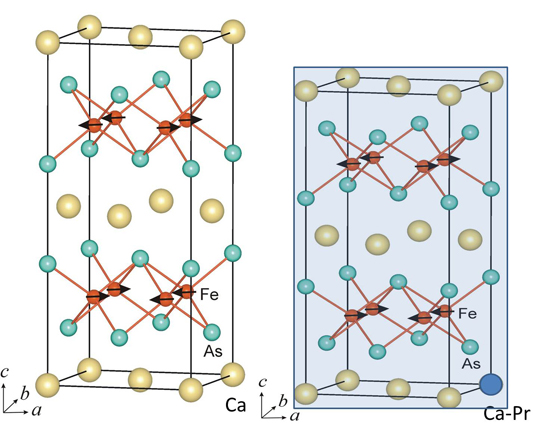
    When calcium atoms (yellow spheres) in these iron-based crystals (left) are replaced on some occasions with praseodymium (blue sphere in the right image), the crystals are able to superconduct at up to 47K – but the crystals can also collapse, shrinking by about 10 percent in size. Adding a sufficient amount of praseodymium is necessary to avoid the collapse, which compromises the materials usability in electronics applications. Credit: National Institute of Standards and Technology

    A team of researchers from the National Institute of Standards and Technology and the University of Maryland discovered an iron-based superconductor capable of operating at 47 degrees Kelvin. While the discovery marks the highest threshold temperature yet for a 1:2:2 superconductor, this crystal structure also exhibited a collapse in size.

    A team from the National Institute of Standards and Technology (NIST) and the University of Maryland has found an iron-based superconductor that operates at the highest known temperature for a material in its class. The discovery inches iron-based superconductors—valued for their ease of manufacturability and other properties—closer to being useful in many practical applications.

    Iron-based superconductors, which were discovered only about four years ago, are a hot research topic, in part because they are more amenable to commercial applications than copper-based superconductors, which are more difficult to make and are frequently brittle. Of the four broad classes of iron-based superconductors, the 1:2:2 class—so named because their crystals are built around a hub of one atom of calcium, two of iron and two of arsenic—is particularly promising because these superconductors’ properties can be custom-tailored by substituting other atoms for these basic elements.

    Magnets made with low-temperature superconductors have already found use in hospital MRI machines, but less expensive MRI machines and other applications, such as superconducting cables for resistance-free power transmission over long distances, become closer to reality the more choices manufacturers have among superconductors.

    Working at the NIST Center for Neutron Research (NCNR) and the University of Maryland, the team found that a particular type of 1:2:2 superconductor possesses some unexpected properties. Of perhaps greatest value to manufacturers is that its threshold temperature of superconductivity is 47 degrees Kelvin (-226 degrees Celsius or -375 Fahrenheit), the highest yet for the 1:2:2 class, whose previous record was 38K.

    But the crystal also has a highly curious property: It can superconduct at this record temperature when a smaller atom is substituted for the crystal’s original calcium in some of its hubs, and when this substitution is performed, the overall crystal actually shrinks by about 10 percent, a dramatic size change. “It’s almost like what would happen if you cut off a few inches from the bottom of your chair’s legs,” says the NCNR’s Jeff Lynn. “The crystal just collapses. The change is quite visible in neutron scans.”

    This effect is likely one that manufacturers will want to avoid. But Lynn says the group’s research has determined how to make the substitution while eluding the collapsed state altogether, so that as it is cooled, the potential mechanical instabilities associated with the collapse are sidestepped. “This understanding should enable manufacturers to use the superconductor in electronic devices,” he says.

    Reference: “Structural collapse and superconductivity in rare-earth-doped CaFe2As2” by S.R. Saha, N.P. Butch, T. Drye, J. Magill, S. Ziemak, K. Kirshenbaum, P.Y. Zavalij, J.W. Lynn and J. Paglione, 13 January 2012. Physical Review B.
    DOI: 10.1103/PhysRevB.85.024525

    Never miss a breakthrough: Join the SciTechDaily newsletter.
    Follow us on Google and Google News.

    Crystals NIST NIST Center for Neutron Research Superconductor University of Maryland
    Share. Facebook Twitter Pinterest LinkedIn Email Reddit

    Related Articles

    Scientists Just Found a Mind-Bending Way to Control Electrons

    New Magnetic Phase in Iron-Based Superconductors Discovered

    Experimental Strontium Atomic Clock Sets New Records

    New Insights Into How Superconducting Materials Interact With Magnetic Ones

    Experimental Evidence Shows Iron-Based Superconductors Exhibit S-Wave Symmetry

    Ion Crystal Set to Power Quantum Simulator

    Iron-Based Crystal Superconductor Breaks High-Temperature Record

    NIST Researches the Use of Switching Mechanisms in Advanced Computer Memory Device

    JILA Scientists Create the World’s First Extreme Ultraviolet (EUV) Frequency Comb

    Leave A Reply Cancel Reply

    • Facebook
    • Twitter
    • Pinterest
    • YouTube

    Don't Miss a Discovery

    Subscribe for the Latest in Science & Tech!

    Trending News

    Monster Storms on Jupiter Unleash Lightning Beyond Anything on Earth

    Scientists Create “Liquid Gears” That Spin Without Touching

    The Simple Habit That Could Help Prevent Cancer

    Millions Take These IBS Drugs, But a New Study Finds Serious Risks

    Scientists Unlock Hidden Secrets of 2,300-Year-Old Mummies Using Cutting-Edge CT Scanner

    Bread Might Be Making You Gain Weight Even Without Eating More Calories

    Scientists Discover Massive Magma Reservoir Beneath Tuscany

    Europe’s Most Active Volcano Just Got Stranger – Here’s Why Scientists Are Rethinking It

    Follow SciTechDaily
    • Facebook
    • Twitter
    • YouTube
    • Pinterest
    • Newsletter
    • RSS
    SciTech News
    • Biology News
    • Chemistry News
    • Earth News
    • Health News
    • Physics News
    • Science News
    • Space News
    • Technology News
    Recent Posts
    • Scientists Discover a New Meteor Shower From a Mysterious Crumbling Asteroid
    • This Simple Fruit Wash Could Make Produce Safer and Last Days Longer
    • These Tiny Robots 50x Smaller Than a Hair Can Hunt and Move Bacteria
    • Simple Blood Test May Predict Alzheimer’s Years Before Brain Scans Show Signs
    • Scientists Say Adding This Unusual Seafood to Your Diet Could Reverse Signs of Aging
    Copyright © 1998 - 2026 SciTechDaily. All Rights Reserved.
    • Science News
    • About
    • Contact
    • Editorial Board
    • Privacy Policy
    • Terms of Use

    Type above and press Enter to search. Press Esc to cancel.