
Close Menu
    Facebook X (Twitter) Instagram
    SciTechDaily
    • Biology
    • Chemistry
    • Earth
    • Health
    • Physics
    • Science
    • Space
    • Technology
    Facebook X (Twitter) Pinterest YouTube RSS
    SciTechDaily
    Home»Physics»NIST Researches the Use of Switching Mechanisms in Advanced Computer Memory Device
    Physics

    NIST Researches the Use of Switching Mechanisms in Advanced Computer Memory Device

    By National Institute of Standards and TechnologyFebruary 22, 2012No Comments4 Mins Read
    Facebook Twitter Pinterest Telegram LinkedIn WhatsApp Email Reddit
    Share
    Facebook Twitter LinkedIn Pinterest Telegram Email Reddit
    Switching Mechanism Computer Memory Device
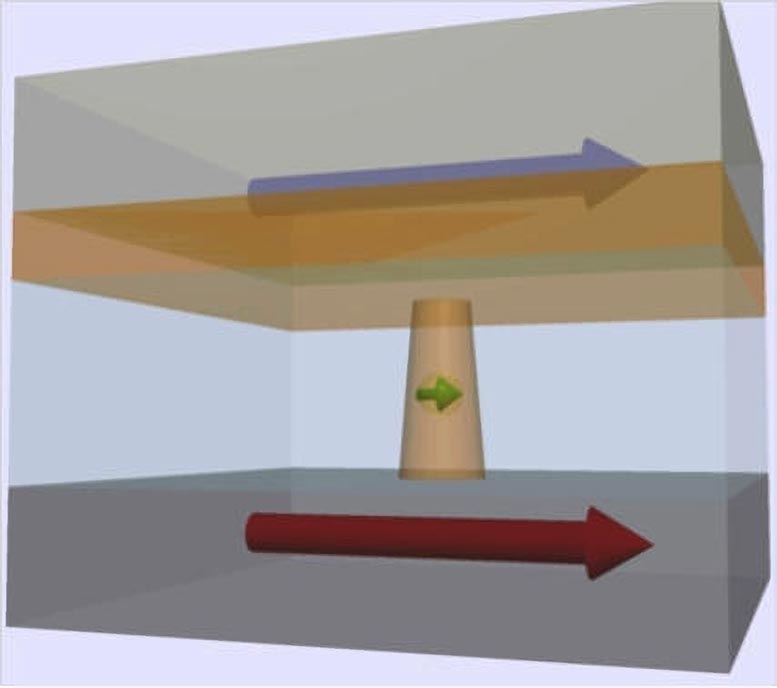
    When two electrodes (top and bottom layers) whose magnetic orientation is the same (indicated by arrows) are separated by thin layers of copper (orange) and tantalum oxide (blue), a filament of copper forms through the oxide when there is a potential difference of 1 to 1.5 volts across the electrodes. When the filament forms, current can flow easily between the two electrodes. The findings help solve the mystery of why the layered structure can form electronic switches that maintain their on/off state when the power is off. Credit: NIST

    Using ferromagnetic metals for the electrodes, a team of researchers from the National Institute of Standards and Technology built a layered switching device to better study the behaviors of switching mechanisms. They discovered that when an electric field is applied between the ferromagnetic electrodes, it causes the formation of tiny copper filaments and believe this research may help lead to the use of “spintronics” in layered structures.

    Sometimes knowing that a new technology works is not enough. You also must know why it works to get marketplace acceptance. New information from the National Institute of Standards and Technology (NIST)* about how layered switching devices for novel computer memory systems work, for example, may now allow these structures to come to market sooner, helping bring about faster, lower-powered computers.

    Switches based on transition-metal oxides have great potential as memory devices that retain their information even when the power is turned off. One type is made by stacking four different materials: a layer of copper and one of a metal oxide sandwiched between two metal layers that act as electrodes. Such systems can act as an on/off switch when a voltage is applied between the electrodes, but just why they behave as they do is a matter of debate.

    Types of nonvolatile memory already exist—thumb drives make use of it—but they do not yet perform well enough to function as the working memory of a computer’s central processor. If metal oxides can be perfected for this use, they could enable computers that boot up in seconds and use far less energy.

    To study the switching mechanism, the NIST research team built its own version, but with a twist: They used ferromagnetic metals for the electrodes instead of the nonmagnetic metals typically used. They found that when an electric field is applied between the ferromagnetic electrodes, it causes the formation of tiny copper filaments that stretch through the metal-oxide layer. The filaments, about 16 nm long, are created or annihilated depending on the direction of the applied voltage through the electrodes, making or breaking the switch connection.

    “The presence of such filaments is the only explanation that makes any sense as to why our structures make such good switches,” says Curt Richter of NIST’s Semiconductor Electronics Division.

    One key to the team’s discovery was their use of the physics of “spin”—a quantum property of electrons that has two possible values, either up or down. From the top electrode, the team sent a current made of electrons that had a polarized spin state, and they found that their spin state had not changed by the time the electrons reached the bottom.

    “Only if a filament made of high-quality copper formed would the spins maintain their state,” Richter says. “This finding was an end in itself, but it also suggests the layered structure could have applications in ‘spintronics’ where electron spin is used to carry and process information.”

    Reference: “Spin transport in memristive devices” by Hyuk-Jae Jang, Oleg A. Kirillov, Oana D. Jurchescu and Curt A. Richter, 26 January 2012, Applied Physics Letters.
    DOI: 10.1063/1.3679114

    Never miss a breakthrough: Join the SciTechDaily newsletter.
    Follow us on Google and Google News.

    Electrons Filaments Layered Structures NIST Spintronics Switching Mechanisms
    Share. Facebook Twitter Pinterest LinkedIn Email Reddit

    Related Articles

    Spintronics Breakthrough – Scientists Confirm a Previously Undetected Physics Phenomenon

    Nuclear Clock Accurate to 19 Decimal Places

    First Real-Time Image of Two Atoms Vibrating in a Molecule

    Nucleons in a Dense Nucleus Exceed 25 Percent of the Speed of Light

    Researchers Discover Electrical Switch for Magnetic Current

    Researching the Properties of Relativistic Electron Vortex Beams

    Researchers Create Electron Vortex Beams Inside Electron Microscopes

    ‘Collapsing’ Iron Superconductor Capable of Operating at 47 Degrees Kelvin

    JILA Scientists Create the World’s First Extreme Ultraviolet (EUV) Frequency Comb

    Leave A Reply Cancel Reply

    • Facebook
    • Twitter
    • Pinterest
    • YouTube

    Don't Miss a Discovery

    Subscribe for the Latest in Science & Tech!

    Trending News

    One of the Universe’s Largest Stars May Be Getting Ready To Explode

    Scientists Discover Enzyme That Could Supercharge Ozempic-Like Weight Loss Drugs

    Popular Sweetener Linked to DNA Damage – “It’s Something You Should Not Be Eating”

    Ancient “Rock” Microbes May Reveal How Complex Life Began

    Researchers Capture Quantum Interference in One of Nature’s Rarest Atoms

    “A Plague Is Upon Us”: The Mass Death That Changed an Ancient City Forever

    Scientists Discover Game-Changing New Way To Treat High Cholesterol

    This Small Change to Your Exercise Routine Could Be the Secret to Living Longer

    Follow SciTechDaily
    • Facebook
    • Twitter
    • YouTube
    • Pinterest
    • Newsletter
    • RSS
    SciTech News
    • Biology News
    • Chemistry News
    • Earth News
    • Health News
    • Physics News
    • Science News
    • Space News
    • Technology News
    Recent Posts
    • Revolutionary Imaging Technique Unlocks Secrets of Matter at Extreme Speeds
    • Where Does Mass Come From? Scientists Find Evidence of a New Exotic Nuclear State
    • Quantum Breakthrough: Unhackable Keys Sent Over 120 km Using Quantum Dots
    • Researchers Discover Unknown Beetle Species Just Steps From Their Lab
    • Jellyfish Caught Feasting on Exploding Sea Worms for the First Time
    Copyright © 1998 - 2026 SciTechDaily. All Rights Reserved.
    • Science News
    • About
    • Contact
    • Editorial Board
    • Privacy Policy
    • Terms of Use

    Type above and press Enter to search. Press Esc to cancel.