
Close Menu
    Facebook X (Twitter) Instagram
    SciTechDaily
    • Biology
    • Chemistry
    • Earth
    • Health
    • Physics
    • Science
    • Space
    • Technology
    Facebook X (Twitter) Pinterest YouTube RSS
    SciTechDaily
    Home»Physics»Experimental Evidence Shows Iron-Based Superconductors Exhibit S-Wave Symmetry
    Physics

    Experimental Evidence Shows Iron-Based Superconductors Exhibit S-Wave Symmetry

    By SLAC National Accelerator LaboratoryMay 18, 2012No Comments3 Mins Read
    Facebook Twitter Pinterest Telegram LinkedIn WhatsApp Email Reddit
    Share
    Facebook Twitter LinkedIn Pinterest Telegram Email Reddit
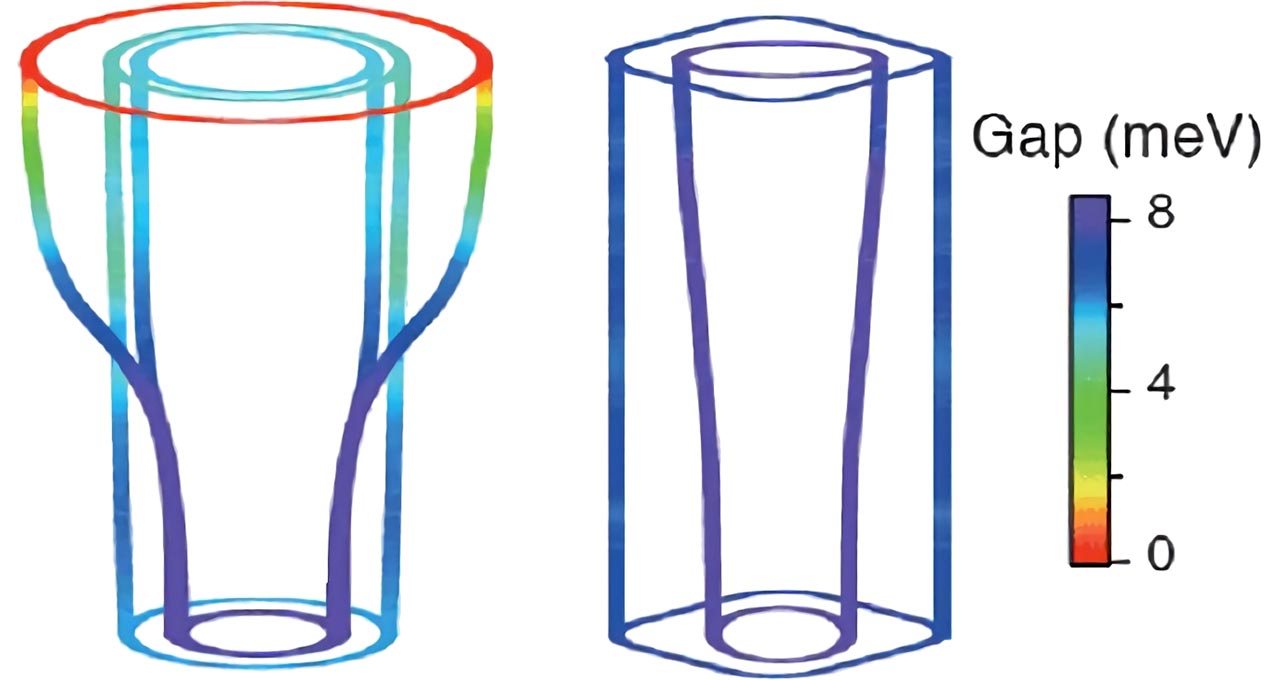
    Superconducting Gap Distribution
    False-color plots of the superconducting gap distribution of BaFe2(As0.7P0.3)2. The image on the left shows the superconducting energy gap approaching zero (indicated by color), but at a circular horizontal line-node. This immediately rules out the d-wave pairing symmetry, which would give four vertical line nodes in the diagonal directions. Credit: D.L. Feng, et al.

    While using an instrument to measure the detailed superconducting gap structure of the ferropnictide superconductor BaFe2(As0.7P0.3)2, physicists discovered experimental evidence that iron-based superconductors fall into the regime of s-wave pairing symmetry.

    Condensed-matter physicists the world over are in hot pursuit of a comprehensive understanding of high-temperature superconductivity, not just for its technological benefits but for the clues it holds to strongly correlated electron systems.

    One important avenue of investigation is pairing symmetry. It’s a property of Cooper pairs, the bound electron pairs that are a hallmark of all superconductors, whether high-temperature or conventional. The paired electrons act as if they were a single particle, and the energy required to break Cooper pairs is measured by the superconducting gap. The symmetry of the superconducting gap, known as the pairing symmetry, is an important characteristic of Cooper pairs that is intimately related to the mechanism of superconductivity.

    In conventional superconductors, the Cooper pairs have s-wave pairing symmetry, which takes the shape of a sphere. In contrast, Cooper pairs in the cuprate family of high-temperature superconductors exhibit d-wave pairing symmetry, which looks a bit like a four-leaf clover. The leaves, or lobes, are areas where the superconducting gap is finite. At the points where two leaves join, known as nodes, the superconducting gap goes to zero.

    However, iron-based superconductors do not fall nicely into either of these two categories. Some members of this group exhibit characteristics of superconducting gaps with s-wave pairing symmetry, while others show signatures of nodes where the gap becomes zero, as with d-wave pairing symmetry.

    The key to resolving this discrepancy remained unknown until recently, when a team of scientists from Fudan University used an instrument at the Stanford Synchrotron Radiation Lightsource’s Beam Line 5-4 to measure the detailed superconducting gap structure of the ferropnictide superconductor BaFe2(As0.7P0.3)2. They discovered a signature that could not have originated from a d-wave pairing – a striking difference from the cuprate family.

    This finding, the first measurement of its kind, provides solid experimental evidence that iron-based superconductors fall into the regime of s-wave pairing symmetry seen in conventional superconductors, and suggests that both nodal and nodeless gaps could arise from the same mechanism. This could lead to a unified theoretical framework for both phenomena, making the research an important step toward unveiling the mechanism of iron-based superconductivity.

    Reference: “Nodal superconducting-gap structure in ferropnictide superconductor BaFe2(As0.7P0.3)2” by Y. Zhang, Z. R. Ye, Q. Q. Ge, F. Chen, Juan Jiang, M. Xu, B. P. Xie and D. L. Feng, 4 March 2012, Nature Physics.
    DOI: 10.1038/nphys2248

    Never miss a breakthrough: Join the SciTechDaily newsletter.
    Follow us on Google and Google News.

    Condensed Matter SLAC National Accelerator Laboratory Superconductor
    Share. Facebook Twitter Pinterest LinkedIn Email Reddit

    Related Articles

    Superconductors’ Secret: Old Physics Law Stands the Test of Time in Quantum Material Conundrum

    New Possibilities Discovered for Room-Temperature Superconductivity

    After 15 Years of Research, Scientists Reveal the Fourth Signature of the Superconducting Transitions

    Triggering Room-Temperature Superconductivity With a Flash of Light

    After 20 Years of Trying, Scientists Succeed in Doping a 1D Atomic Chain of Cuprates

    Skyrmions – Tiny Magnetic Whirlpools – Have a Lot in Common With High-Temperature Superconductors

    High-Temperature Superconductor Study Reveals “Strange Metal” May Be “Densely Entangled Matter”

    Iron-Based Crystal Superconductor Breaks High-Temperature Record

    Scientists Use Ultra-Short Pulses of Terahertz Laser Light to Manipulate Magnetism

    Leave A Reply Cancel Reply

    • Facebook
    • Twitter
    • Pinterest
    • YouTube

    Don't Miss a Discovery

    Subscribe for the Latest in Science & Tech!

    Trending News

    Artificial Sweeteners May Harm Future Generations, Study Suggests

    Splashdown! NASA Artemis II Returns From Record-Breaking Moon Mission

    What If Consciousness Exists Beyond Your Brain

    Scientists Finally Crack the 100-Million-Year Evolutionary Mystery of Squid and Cuttlefish

    Beyond “Safe Levels”: Study Challenges What We Know About Pesticides and Cancer

    Researchers Have Found a Dietary Compound That Increases Longevity

    Scientists Baffled by Bizarre “Living Fossil” From 275 Million Years Ago

    Your IQ at 23 Could Predict Your Wealth at 27, Study Finds

    Follow SciTechDaily
    • Facebook
    • Twitter
    • YouTube
    • Pinterest
    • Newsletter
    • RSS
    SciTech News
    • Biology News
    • Chemistry News
    • Earth News
    • Health News
    • Physics News
    • Science News
    • Space News
    • Technology News
    Recent Posts
    • What if Dark Matter Has Two Forms? Bold New Hypothesis Could Explain a Cosmic Mystery
    • Researchers Expose Hidden Chemistry of “Ore-Forming” Elements in Biology
    • Geologists Reveal the Americas Collided Earlier Than We Thought
    • 20x Difference: Study Reveals True Source of Airborne Microplastics
    • Scientists Uncover Hidden Force Powering Yellowstone’s Supervolcano
    Copyright © 1998 - 2026 SciTechDaily. All Rights Reserved.
    • Science News
    • About
    • Contact
    • Editorial Board
    • Privacy Policy
    • Terms of Use

    Type above and press Enter to search. Press Esc to cancel.