
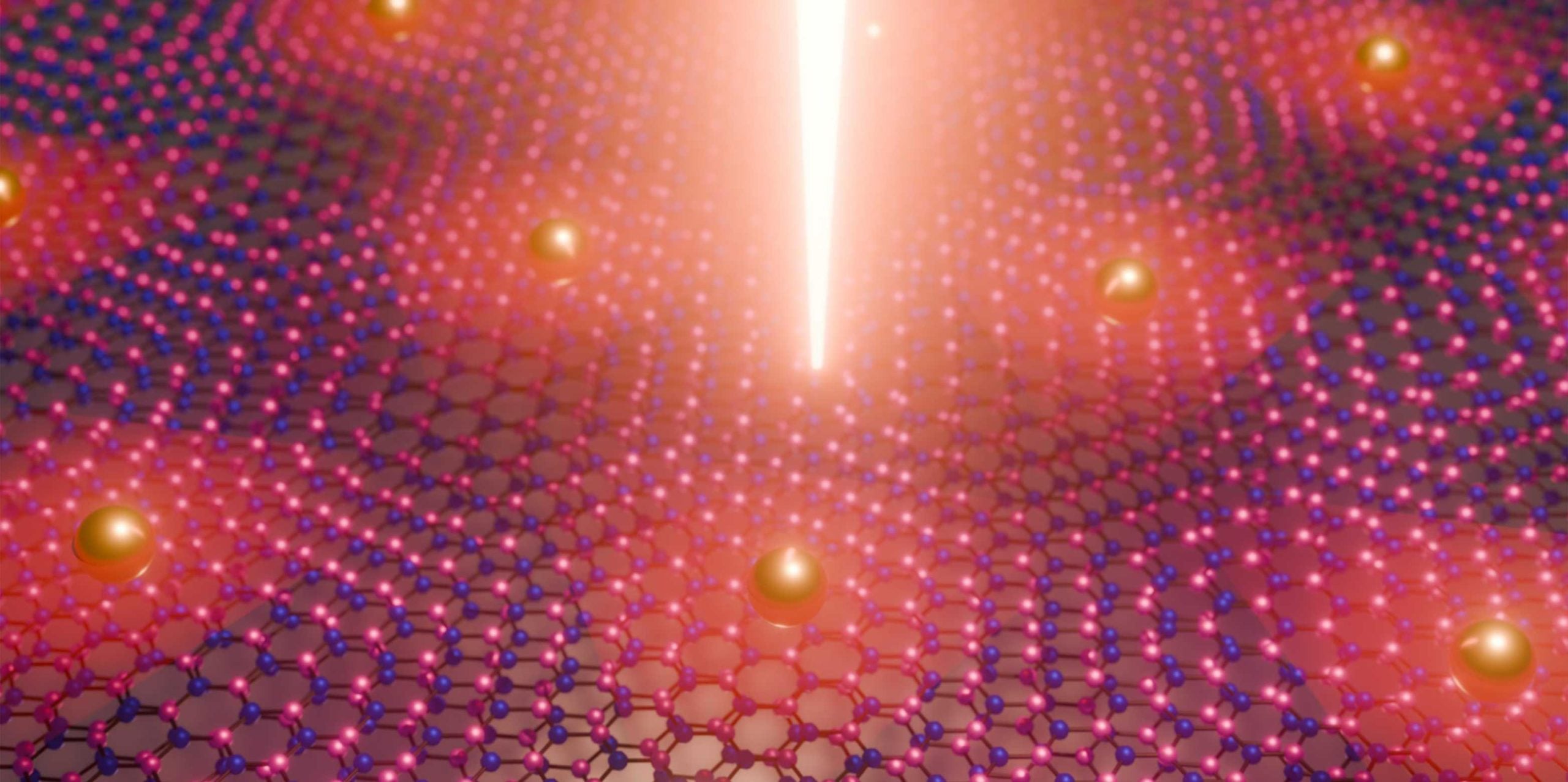
Researchers at ETH Zurich have developed a new technique to better understand how electrons interact within materials. By using a moiré material, created by twisting ultra-thin atomic layers, they generated an artificial crystal lattice in a nearby semiconductor, allowing for more precise studies of electron behavior.
- Scientists have devised a method to create artificial crystal lattices with a large lattice constant in semiconductor materials.
- The increased lattice constant reduces the electrons’ motional energy, making their interactions more prominent.
- This technique will help researchers study electron interactions across different materials.
- A better understanding of these interactions could explain how certain insulators transition into superconductors when extra electrons are introduced.
Unveiling Electron Interactions
Physicists have long devised creative methods to study how electrons interact within materials. These interactions are crucial because they drive important phenomena like superconductivity. However, in most materials, electron interactions are extremely weak, making them difficult to observe. One common approach to amplifying these interactions involves reducing the electrons’ motional energy. Scientists achieve this by artificially creating a crystal lattice with a large lattice constant — meaning the distance between lattice sites is increased. While the interaction energy remains small, it becomes relatively more significant, making interaction effects easier to detect.
Traditionally, researchers have used moiré materials for this purpose. These materials, created by stacking and slightly twisting two atom-thin layers, form a superlattice that influences electron behavior. However, moiré materials also alter other physical properties, complicating studies of electron interactions.
A research team led by Ataç Imamoğlu at the Institute for Quantum Electronics at ETH Zurich has now developed a novel method to overcome this challenge. Instead of directly studying electrons within moiré materials, they use these materials to generate a spatially periodic electric field at a distance, affecting only the electrons in a separate semiconductor layer.
This new technique, recently published in Physical Review X, allows scientists to isolate and study electron interactions with greater precision, opening new possibilities for research in different materials.

Twisted Crystal Lattices
Moiré materials are produced by individually removing two layers of a material, each only one atom thick, twisting them slightly with respect to each other and then putting them back together. Since the crystal lattices of the two layers are no longer exactly on top of each other, a kind of beating effect occurs: just as two sound waves with slightly different frequencies lead to a slow periodic increase and decrease in the sound volume, in the twisted crystal lattices a “superlattice” with a much larger lattice constant arises, in which the electrons can move.
“In our new method we also produce a moiré material, but we use it in a completely different way,” says Natasha Kiper, a PhD student in Imamoğlu’s group. Kiper and her colleagues use two layers of hexagonal boron nitride (an artificially synthesized solid that is almost as hard as diamond) that are twisted by less than 2 degrees with respect to each other.
This twisting leads to a periodic electric field that also acts at a distance beyond the material. Below the twisted boron nitride, the researchers place an atomic layer of the semiconductor molybdenum diselenide. The electric field acts on the electrons inside the molybdenum diselenide and thus creates an artificial crystal lattice.
Detection Using Excitons
“The big advantage here is that the electric field only acts on the electrons in the molybdenum diselenide but not on the neutral excitons,” says Kiper. The researchers need those excitons to study the electrons. Excitons are created when an electron in a material is excited by light of a specific frequency. As a consequence, the electron climbs to a higher energy level and leaves behind a defect, also called a hole, in the lower energy level. The negatively charged electron and the positively charged hole then attract each other and pair up to become an electrically neutral exciton.
From the light frequency at which excitons are excited, the researchers were able to draw conclusions about the behavior of the electrons. By applying an electric voltage, they varied the number of electrons in the semiconductor. From the exciton excitation frequency they could then, for instance, prove that when one third or two thirds of the lattice sites were filled with electrons, they arranged themselves in a regular pattern.
When the number of electrons was increased further, such that more than one electron occupied a lattice site, the interactions between the electrons led to a clearly visible change in the states of the electrons. Such insights into the effects of strong interactions help physicists to understand, for instance, how certain electrical insulators can become superconductors by adding excess electrons to them.
Expanding to New Materials and Phenomena
“Our new method is exciting also because it is highly controllable and can, in principle, be applied to many other materials,” says Imamoğlu. By adding additional layers of material, the strength of the electric field can be varied. Moreover, in the future it will be possible to study processes in which the electrons move between two layers.
In addition to their spin, which indicates in which direction the “compass needle” of an electron is oriented, the electron would also acquire a pseudo-spin pointing up or down depending on the layer in which it finds itself.
“We could use this to study exotic physical processes such as so-called chiral spin liquids, which up to now have never been observed experimentally,” says Imamoğlu.
Reference: “Confined Trions and Mott-Wigner States in a Purely Electrostatic Moiré Potential” by Natasha Kiper, Haydn S. Adlong, Arthur Christianen, Martin Kroner, Kenji Watanabe, Takashi Taniguchi and Atac İmamoğlu, 5 March 2025, Physical Review X.
DOI: 10.1103/PhysRevX.15.011049
Never miss a breakthrough: Join the SciTechDaily newsletter.
Follow us on Google and Google News.