
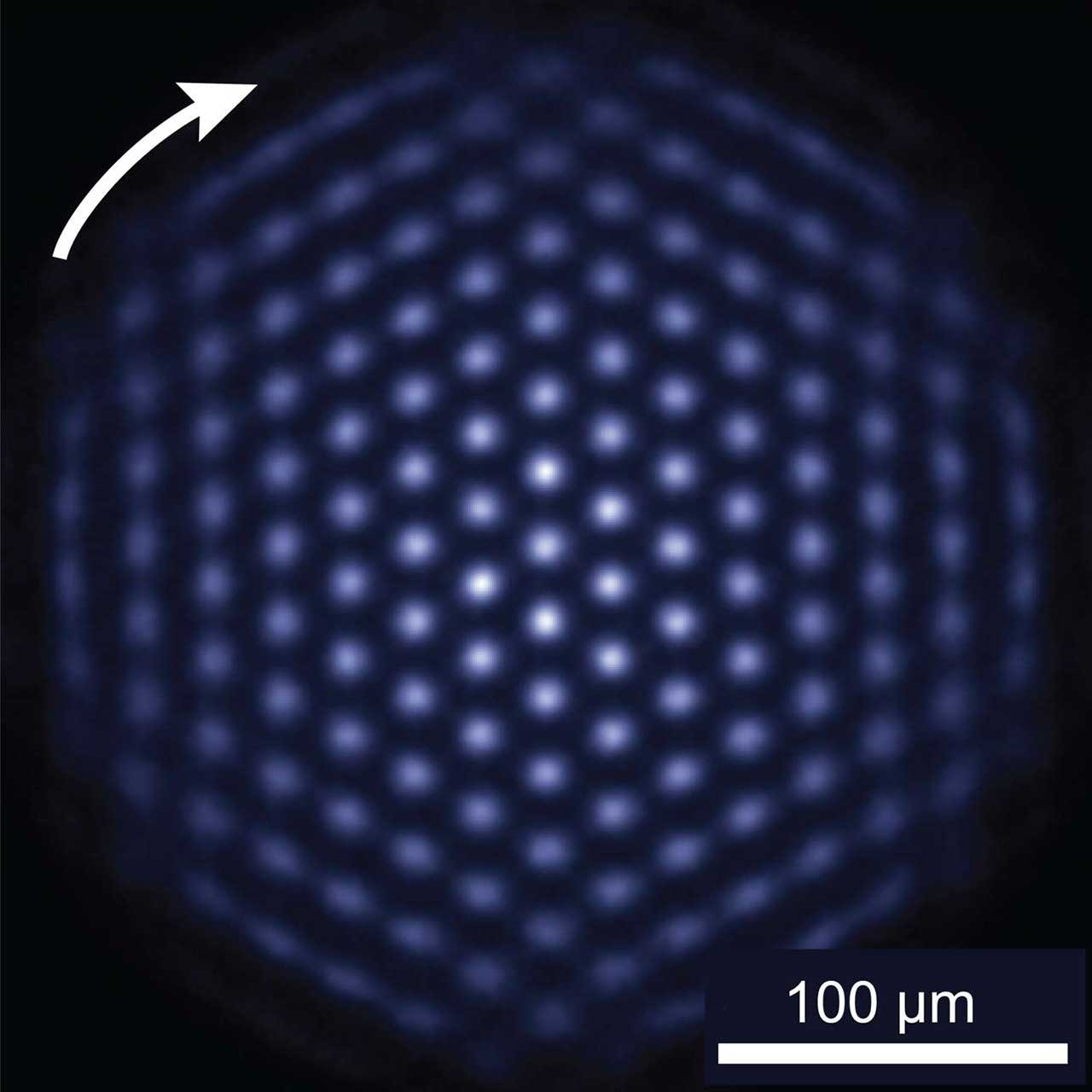
Quantum computers are getting closer to reality as scientists created the ion crystal that will allow this quantum simulator to perform calculations that eclipse the current maximum capacity of any known computer by an astonishing 10 to the power of 80.
The ion-crystal used is poised to create one of the most powerful computers ever developed, with the results published in the journal Nature on April 25, 2012.
“Computing technology has taken a huge leap forward using a crystal with just 300 atoms suspended in space,” said Dr. Biercuk, from the University’s School of Physics and ARC Center of Excellence for Engineered Quantum Systems.
“The system we have developed has the potential to perform calculations that would require a supercomputer larger than the size of the known universe — and it does it all in a diameter of less than a millimeter,” said Dr. Biercuk.
“The projected performance of this new experimental quantum simulator eclipses the current maximum capacity of any known computer by an astonishing 10 to the power of 80. That is 1 followed by 80 zeros, in other words, 80 orders of magnitude, a truly mind-boggling scale.”
The work smashes previous records in terms of the number of elements working together in a quantum simulator, and therefore the complexity of the problems that can be addressed.
The team Dr. Biercuk worked with, including scientists from the US National Institute of Standards and Technology, Georgetown University in Washington, North Carolina State University and the Council for Scientific and Industrial Research in South Africa, has produced a specialized kind of quantum computer known as a ‘quantum simulator’.
Ever since Nobel Prize winner Richard Feynman highlighted the potential of quantum computing in the 1980s, scientists have been attempting to build quantum computers capable of solving some of the largest and most complex problems. Special-purpose quantum simulators have tremendous potential to solve a variety of challenging problems in materials science, chemistry, and biology, with much greater efficiency than conventional computers.
The research team’s revolutionary crystal exceeds all previous experimental attempts in providing ‘programmability’ and the critical threshold of qubits (a unit measuring quantum information) needed for the simulator to exceed the capability of most supercomputers.
“Many properties of natural materials governed by the laws of quantum mechanics are very difficult to model using conventional computers. The key concept in quantum simulation is building a quantum system to provide insights into the behavior of other naturally occurring physical systems.”
Much like studying a scale model of an airplane wing in a wind tunnel to simulate the behavior of a full-scale aircraft, tremendous insights about difficult and complex quantum systems can be gleaned using a quantum ‘scale model’.
“By engineering precisely controlled interactions and then studying the output of the system, we are effectively running a ‘program’ for the simulation,” said Dr Biercuk.
“In our case, we are studying the interactions of spins in the field of quantum magnetism — a key problem that underlies new discoveries in materials science for energy, biology, and medicine,” said Dr. Biercuk.
“For instance, we hope to study the spin interactions predicted by models for high-temperature superconductivity — a physical phenomenon that has yet to be explained, but has the potential to revolutionize power distribution and high-speed transport.”
The experimental device provides exceptional new capabilities which allow the researchers to engineer interactions that mimic those found in natural materials.
Remarkably they can even realize interactions that are not known to be found in nature, engineering totally new forms of quantum matter.
Reference: “Engineered two-dimensional Ising interactions in a trapped-ion quantum simulator with hundreds of spins” by Joseph W. Britton, Brian C. Sawyer, Adam C. Keith, C.-C. Joseph Wang, James K. Freericks, Hermann Uys, Michael J. Biercuk and John J. Bollinger, 25 April 2012, Nature.
DOI: 10.1038/nature10981
Never miss a breakthrough: Join the SciTechDaily newsletter.
Follow us on Google and Google News.
1 Comment
I have my credit card ready to buy one. Probably 10,000 years away, though.