
Close Menu
    Facebook X (Twitter) Instagram
    SciTechDaily
    • Biology
    • Chemistry
    • Earth
    • Health
    • Physics
    • Science
    • Space
    • Technology
    Facebook X (Twitter) Pinterest YouTube RSS
    SciTechDaily
    Home»Science»Changing Landscapes, Changing Diets: Fossilized Teeth Reveal Dietary Shifts in Ancient Herbivores and Hominins
    Science

    Changing Landscapes, Changing Diets: Fossilized Teeth Reveal Dietary Shifts in Ancient Herbivores and Hominins

    By SciTechDailyAugust 27, 2020No Comments3 Mins Read
    Facebook Twitter Pinterest Telegram LinkedIn WhatsApp Email Reddit
    Share
    Facebook Twitter LinkedIn Pinterest Telegram Email Reddit
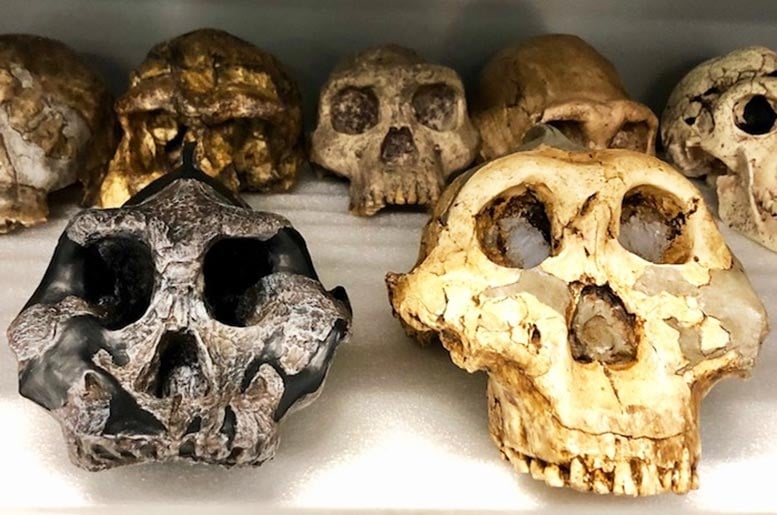
    Two Key Specimens: Paranthropus Aethiopicus and P. Boisei
    Casts of two key specimens: Paranthropus aethiopicus (left) and P. boisei (right). Credit: Zeresenay Alemseged

    A new study published this week in the journal Proceedings of the National Academy of Sciences documents dietary shifts in herbivores that lived between 1-3 million years ago in Ethiopia’s Lower Omo Valley. The research team, led by Enquye Negash, a postdoctoral researcher in the George Washington University Center for the Advanced Study of Human Paleobiology, examined stable isotopes in the fossilized teeth of herbivores such as antelopes and pigs and found a shift away from C3-derived foods, characteristic of woody vegetation, to C4-derived foods, representative of grasses and sedges. The shift happened at two distinct time periods, approximately 2.7 million years ago and 2 million years ago, when the environment of the Lower Omo Valley was transitioning to open savanna.

    The study, “Dietary trends in herbivores from the Shungura Formation, southwestern Ethiopia,” served as a comparative framework to an associated hominin diet study, also published this week, of which Negash was a co-author. The associated study, “Isotopic evidence for the timing of the dietary shift towards C4 foods in eastern African Paranthropus,” examined carbon isotope data from the fossilized tooth enamel of Paranthropus boisei, a nonancestral hominin relative. Led by Jonathan Wynn, now a program director in the National Science Foundation’s division of Earth sciences, the research team behind that paper found a profound shift toward the consumption of C4-derived foods approximately 2.37 million years ago, which preceded a morphological shift of P. boisei’s skull and jaw. Given the direct evidence provided by the abundant, well-dated fossilized teeth and their chemical composition, the new findings suggest behavioral dietary changes can precede apparent morphological adaptations to new foods.

    From the Researchers:

    “Major dietary shifts that are observed in our study reflect the response of the herbivores to major ecological and environmental changes during this time. This allowed us to better understand the environmental context of similar dietary changes in hominins.”

    – Enquye Negash

    “Although we’re interested in how the diets of our immediate and distant ancestors evolved to produce our modern human diet, it is very important to consider these hominins as a small part of an ecosystem that included other plant and animal species that responded to changing environments in an interconnected way.”
    – Jonathan Wynn

    References:

    “Dietary trends in herbivores from the Shungura Formation, southwestern Ethiopia” by Enquye W. Negash, Zeresenay Alemseged, René Bobe, Frederick Grine, Matt Sponheimer and Jonathan G. Wynn, 24 August 2020, Proceedings of the National Academy of Sciences.
    DOI: 10.1073/pnas.2006982117

    “Isotopic evidence for the timing of the dietary shift toward C4 foods in eastern African Paranthropus” by Jonathan G. Wynn, Zeresenay Alemseged, René Bobe, Frederick E. Grine, Enquye W. Negash and Matt Sponheimer, 24 August 2020, Proceedings of the National Academy of Sciences.
    DOI: 10.1073/pnas.2006221117

    This work was supported by National Science Foundation (NSF) award 1252157. Wynn was also supported by an NSF Independent Research and Development (IR/D) program.

    Never miss a breakthrough: Join the SciTechDaily newsletter.
    Follow us on Google and Google News.

    Anthropology Behavioral Science Evolution Paleontology
    Share. Facebook Twitter Pinterest LinkedIn Email Reddit

    Related Articles

    First Tales of the Earliest Domesticated Goats Revealed by 10,000-Year-Old DNA

    Nuclear DNA From Cave Sediments Helps Unlock Ancient Human History

    Modern Human-Like Brains Evolved Long After Earliest Humans First Dispersed From Africa

    Screams of “Joy” Are Often Mistaken for “Fear” When Heard Out of Context

    Earliest Homo Populations in Africa Had Primitive Ape-Like Brains – Just Half the Size of Today’s Humans

    Crystals Reveal Early Humans in the Kalahari 105,000 Years Ago Were As Innovative as Their Coastal Neighbors

    A New Clue to the Timeline of Human Evolution

    Earliest Interbreeding Between Ancient Human Populations Discovered – Evolutionary Puzzle Solved

    New Evidence Shows Humans Mastered Fire Earlier Than Thought

    Leave A Reply Cancel Reply

    • Facebook
    • Twitter
    • Pinterest
    • YouTube

    Don't Miss a Discovery

    Subscribe for the Latest in Science & Tech!

    Trending News

    Beyond Pain Relief: Scientists Discover a Protein That Could Stop Osteoarthritis in Its Tracks

    Scientists Discover Why Alcohol Prevents the Liver From Healing, Even After You Quit

    Scientists Stunned As Volcano Removes Methane From the Air

    Scientists Discover Signs Africa May Be Splitting Apart Beneath Zambia

    Common Blood Pressure Drug Supercharges Cancer Treatment in Surprising New Study

    540-Million-Year-Old Fossils Reveal a Huge Surprise About Early Life on Earth

    Scientists Reverse Stroke Damage Using Stem Cells in Breakthrough Study

    Eating One Egg a Day Could Cut Alzheimer’s Risk by 27%

    Follow SciTechDaily
    • Facebook
    • Twitter
    • YouTube
    • Pinterest
    • Newsletter
    • RSS
    SciTech News
    • Biology News
    • Chemistry News
    • Earth News
    • Health News
    • Physics News
    • Science News
    • Space News
    • Technology News
    Recent Posts
    • Scientists Uncover Hidden Biological Differences Between Men and Women’s Immune Systems
    • Scientists Challenge a Long-Held Belief About Why Human Childbirth Is So Difficult
    • Too Much Sleep May Age Your Body Faster, New Study Warns
    • Scientists Uncover Promising New Strategy To Stop Parkinson’s in Its Tracks
    • New Study Reveals How Vitamin D Could Calm Gut Inflammation
    Copyright © 1998 - 2026 SciTechDaily. All Rights Reserved.
    • Science News
    • About
    • Contact
    • Editorial Board
    • Privacy Policy
    • Terms of Use

    Type above and press Enter to search. Press Esc to cancel.