
The first study of its kind shows that ecosystems experience far more cumulative heat than standard measurements reveal.
A marine heatwave may have an official beginning and end, but the warm water affecting an ecosystem often does not. Like a pot that continues absorbing heat over time, coastal waters can remain unusually warm for weeks or months surrounding the event itself.
Research led by William & Mary’s VIMS & Batten School introduces a way to measure that broader exposure. Drawing on long-term temperature records from 20 U.S. estuaries, the study treats marine heatwaves (MHWs) as parts of larger warming episodes rather than isolated spikes.
Published in Communications Earth & Environment, the work classifies the warm periods that occur before and after MHWs and combines them into a measure of cumulative heat exposure. The framework is intended to better represent the temperature conditions marine organisms actually experience and improve assessments of ecological risk.
Warm periods extend beyond heatwaves
“We started to notice these warm-water anomalies on either side of marine heatwaves and realized that they’re actually embedded within larger periods of warm water,” explained lead author Ricardo Utzig Nardi M.S. ‘25, a research specialist working with coauthor Piero Mazzini, assistant professor at VIMS & the Batten School of Coastal & Marine Sciences. “It sounds obvious, but studies usually focus only on the marine heatwave window, and that’s not an accurate representation of real-world conditions.”
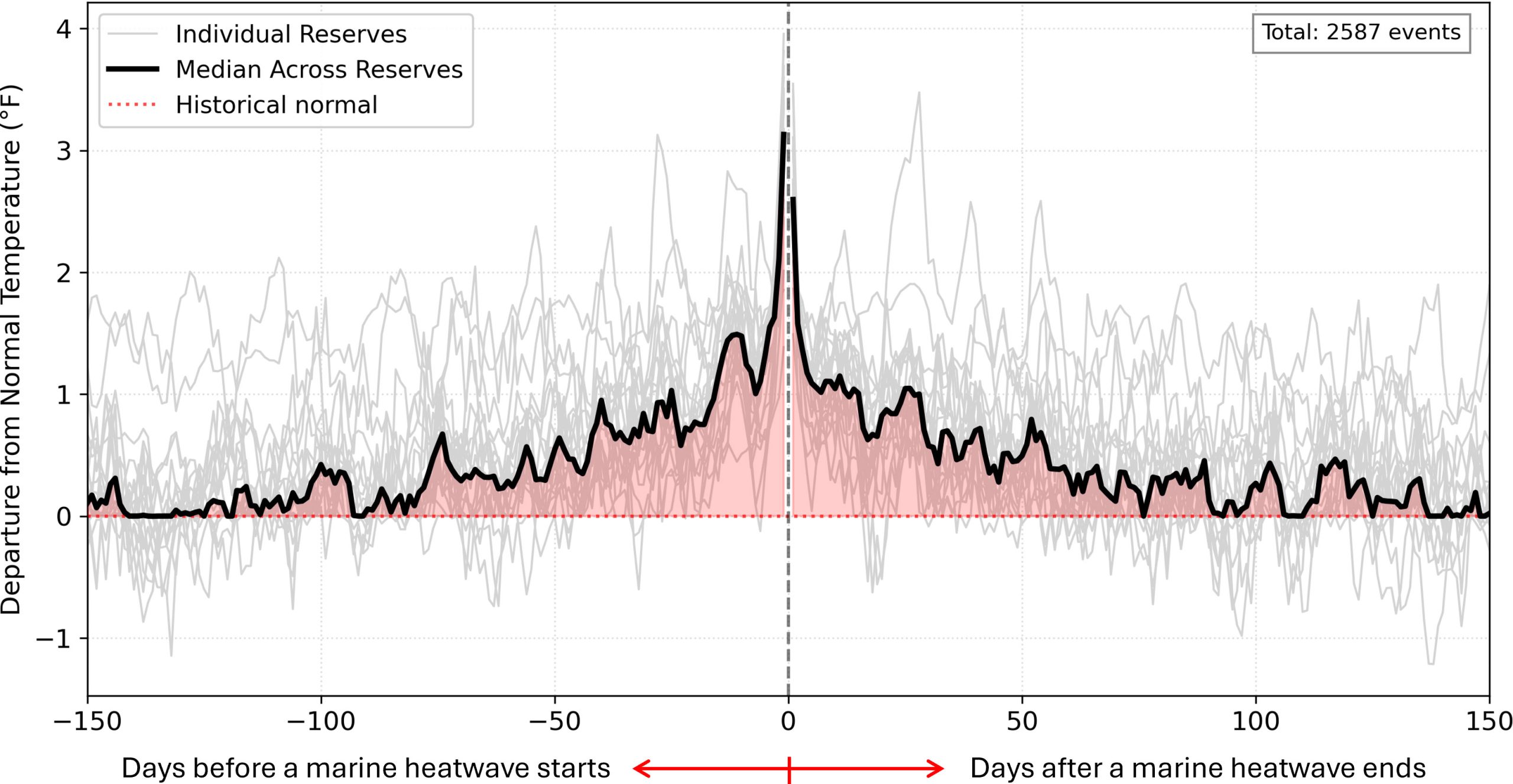
Nardi found that sustained warming frequently stretches across weeks or months, with the formally defined marine heatwave occurring somewhere within that longer interval. In many cases, the warm phases before and after the MHW contributed as much cumulative heat exposure as the heatwave itself, or even more.
“We can no longer look at marine heatwaves in isolation when assessing the impact of warming events on coastal and oceanic ecosystems,” said Mazzini. “We must acknowledge the larger framework in which they exist, and this research provides a way to do just that.”
Standard measures miss most heat exposure
The researchers examined more than 2,580 MHWs recorded over 20 years at 20 estuaries across the United States. Their analysis found that conventional assessments underestimate total heat exposure by more than 150% on average, a difference that could substantially change how scientists evaluate threats to ecosystem health.
“Consider spending time in the sun,” said Nardi, explaining the importance of cumulative heat exposure. “Your risk of sunburn depends on both sunlight intensity and how long you’re exposed to it. A few minutes may cause little harm, but hours of exposure can take a toll. It’s similar for marine organisms and warm water. Their biological responses depend not only on how warm the water becomes, but also on how long that warming persists. Prolonged, cumulative heat exposure, especially when combined with other stressors, can create conditions that some species may not be able to survive.”
The results indicate that the warm water anomalies occurring before and after a heatwave are largely independent of the MHW itself. That distinction challenges the usual practice of measuring heat stress only within the formally defined event and provides a framework for calculating full temperature exposure across coastal ecosystems.
Two patterns prolong ocean warming
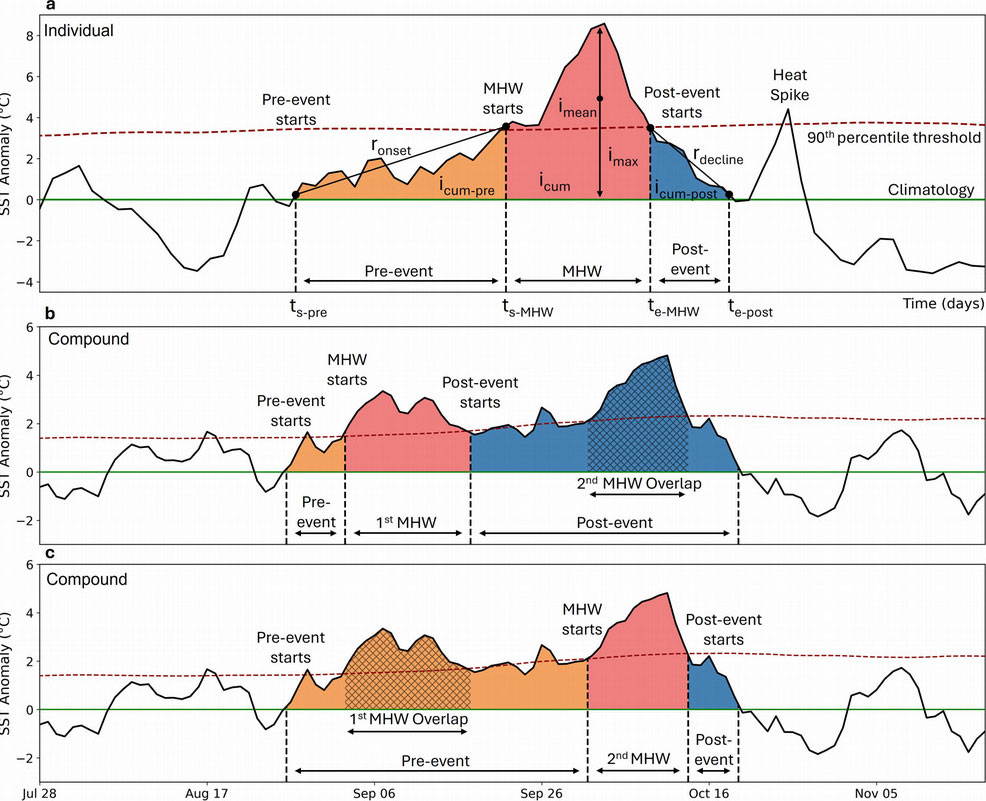
The analysis separated MHWs into two categories. About two-thirds were classified as “individual” events and occurred within approximately 60 days of elevated temperatures extending beyond the heatwave window.
The remaining one-third were “compound” events. These were associated with prolonged warming lasting approximately 90 days before and after the MHW and produced more than three times the cumulative heat exposure generated by the MHW alone.
“As you can see, these are remarkably long periods of thermal exposure,” explained Mazzini. “Many laboratory experiments simulate marine heatwaves by increasing temperatures for a few days or weeks in total. Our findings demonstrate that while these experiments hold value, they often fail to capture the prolonged thermal exposure organisms experience in nature. Our research provides a new framework for designing experiments that reflect natural marine heatwave conditions and quantify cumulative heat exposure, allowing scientists to better evaluate the biological impacts of marine heatwaves across ecosystems.”
The findings add to a series of MHW studies by faculty and researchers at VIMS & Batten School. Mazzini and Nathan Shunk, a third-year Ph.D. student, recently published research defining “vertical marine heatwaves” and creating a classification system for them in the Bay.
Last year, Nardi and Mazzini published another paper forecasting an increase in MHWs along the U.S. East Coast. That work also identified links between marine heatwaves and large-scale climate patterns, including El Niño and the Pacific Decadal Oscillation.
“This study is an example of outstanding science born from a simple question about temperature’s relationship to water quality conditions in estuaries,” said Mazzini. “It was made possible by NOAA’s National Estuarine Research Reserve System and its long-term, high-frequency temperature observations. Comprehensive monitoring programs like these allow us to ask bigger questions and uncover patterns that would otherwise remain hidden.”
Longer heat exposure raises ecological risks
The broader measure of warming could have practical value for coastal communities and natural resource managers. Long stretches of elevated water temperatures can intensify other environmental pressures, including low oxygen conditions and harmful algal blooms.
Together, those stressors may place additional strain on ecosystems ranging from seagrass beds to coral reefs. Accounting for the warm periods surrounding MHWs could help scientists design more realistic laboratory experiments, estimate ecosystem vulnerability more accurately, and provide better information for conservation and management decisions.
“This research has the potential to shift our understanding of the role warming waters play in ecosystem health by widening our focus beyond the heatwave window, so that we consider the full impact of temperature across time,” explained Nardi. “I’m excited to discover what we may have missed before with this new perspective.”
As marine heatwaves become more frequent and intense, measuring their full cumulative effects will be increasingly important for protecting coastal resources and helping communities prepare for future environmental change.
Reference: “Persistent warm water anomalies before and after marine heatwaves amplify heat exposure and associated risks” by Ricardo U. Nardi, Piero L. F. Mazzini, Ryan K. Walter and Jian Shen, 10 June 2026, Communications Earth & Environment.
DOI: 10.1038/s43247-026-03739-x
Never miss a breakthrough: Join the SciTechDaily newsletter.
Follow us on Google and Google News.
4 Comments
“Their analysis found that conventional assessments underestimate total heat exposure by more than 150% on average, a difference that COULD substantially change how scientists evaluate threats to ecosystem health.”
They are talking about warmth as though it were a cumulative toxin. They actually make a comparison to sunburn, without demonstrating if or how warmth does biological damage if the time is extended but within their toleration range. There is a good reason why fish don’t spawn in the Winter! Marine organisms have an optimum temperature range for functioning where they don’t have to expend energy warming or cooling their bodies, or travel to a location or depth that is within their optimum. Where is the evidence that sub-optimal temperatures have a cumulative effect when it is within their tolerance range? What is missing from their design data is evidence that temperatures within the tolerance range have a ‘Linear–No Threshold’ effect on the well being. They also don’t make a distinction between the stress created by low oxygen levels and just the effects of temperature. Sessile organisms can’t escape temperatures that exceed their temperature tolerance, but mobile organisms can. However, symbiotic organisms like corals have found other ways to survive heat waves. In fact, there are many organisms that include diurnal transitions in their depth.
I’m going to go out on a limb here and suggest that the range of temperature tolerance is governed by the average ambient conditions experienced when an organism first evolved. When those conditions change, which is what climate does, the organisms have the option of adapting to the changed climate before becoming extinct.
“This study is an example of outstanding science born from a simple question about temperature’s relationship to water quality conditions in estuaries,”
It seems that Nardi and I have different definitions for “outstanding science.” The statement “As marine heatwaves become more frequent and intense, …” implies the unstated assumption that MHWs WILL become more frequent and intense, without support for the assumptions.
It seems as if you are unaware that this a science press release, in which certain observations that are obvious to the layperson are not discussed in depth and citations are not traditionally provided. That is what the original paper is for, conveniently provided as a link. And there I’ll note the rather obvious citation to Nardi, R. U., Mazzini, P. L. F. & Walter, R. K. Climate change and variability drive
increasing exposure of marine heatwaves across US estuaries. Sci. Rep. 15, 7831 (2025).
https://doi.org/10.1038/s41598
Do they present ANY evidence that marine heat waves will become more frequent or severe? It is not the topic of the research and they don’t even present a citation that confirms that someone has researched the topic and presented a trustworthy prediction for the future.
Your point about this website being intended for fans of ‘science’ who are not necessarily experts in all, or any of the disciplines, is correct. Which is all the more reason for being critical about misinterpretations or leaving out information that is important to properly understanding the claims. As a former college professor I’m very sensitive to the fact that misinformation is hard to unlearn. Thus the importance of learning something right the first time. Not everyone will take the time or go to the trouble to read the original source material, particularly if they are laymen and nothing that they would be expected to know contradicts the claims made.
One of my additional concerns was that they did not present evidence that extended exposure to heat near the upper range of tolerance was harmful. That is, they imply that warm, pre- and post-MHW water is a threat to marine life. They say clearly, “While we discuss the mechanisms by which extended heat exposure MAY drive biological responses, we do not directly measure thermal stress;…” Indeed, the abstract of the linked paper focuses on the meteorological conditions, not the demonstrated biological impacts. They remark, “Such persistence of warm waters LIKELY interacts with other stressors, including algal bloom, degradation of submerged vegetation, hypoxia, and ACIDIFICATION, creating compound conditions that MAY intensify ecosystem impacts beyond what would be expected from short-term temperature changes during the MHW event. This conjecture suggests that focusing solely on the MHW event window MAY substantially underestimate total heat exposure, as well as the ecosystem’s response to potential compound stressors.” However, they give no information on what the measured impact of the thermal “stress” or “exposure” is, they only speculate that it may occur. Actually, so-called “acidification” has an inverse relationship to the temperature because carbon dioxide is less soluble in warm water than in cold water and it is the derived carbonic acid that is responsible for lowering the pH.
Fundamentally, the rationale for exploring estuary meteorological conditions was the poorly supported assumption that weather events that are not extreme will nevertheless have undesired impacts on the biota. If that assumption is not valid, then all their work was for naught.
It seems to me that one of the characteristics of life in general is that it is always pushing the boundaries of where it can survive. Being sensitive to not just temperature, but also the duration of exposure, would be a characteristic that would not select for expansion of habitat.
I’m still of the opinion that this does not qualify as “outstanding science.”