
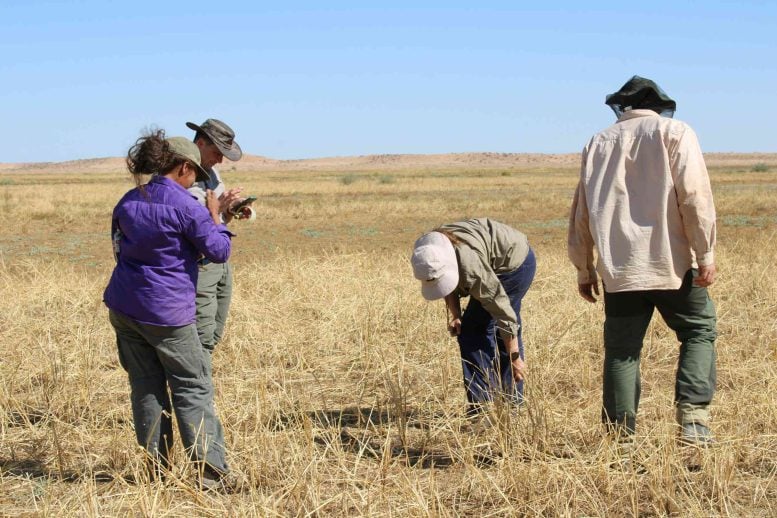
A native Australian millet may carry the genetic fingerprints of thousands of years of Aboriginal harvesting, storage, and plant management.
Seen from the air, Channel Country resembles a vibrant and vast tapestry, with a network of waterways crisscrossing the land. Spread across more than 280,000 square kilometers in outback Australia, it is one of the world’s last free-flowing desert river systems.
In the heart of Channel Country, in southwest Queensland, live the Mithaka people, whose ancestors over at least the past 3,000 years played a key role in the development of a transcontinental trade and exchange system. Plants were a central part of the economy of the Mithaka people, with at least 200 different species used for food, medicine, materials, and ceremonial purposes.
In a new paper published in Nature Communications, we reveal important new information about the genetic complexity of one particular food source from the region: channel millet (Echinochloa turneriana).
The traits we found are often associated with domestication.
Genomics Reveals Aboriginal Plant Management
How people managed and interacted with plants is an area that’s slowly starting to gain momentum in Australian archaeology.
Genomics has played a fundamental role in increasing understanding of relationships between people and plants in several regions of the world, including the Americas and Asia. It has the potential to shed light on how humans influenced vegetation communities in Australia, though much of the detailed research is yet to be done.
The few genetic studies undertaken in Australia, working with Aboriginal people on understanding their history of plant interactions, have revealed important new insights.
One outstanding example is the discovery that Aboriginal people in northeast New South Wales and southeast Queensland deliberately dispersed the black bean (Castanospermum australe), a valuable native food source.
A Landscape Built Around Native Foods
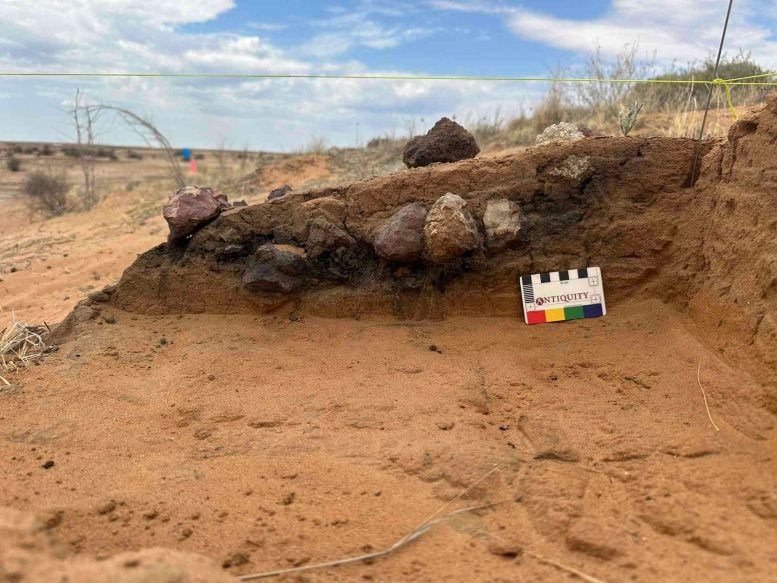
The Mithaka people have a rich archaeological record that highlights the deep importance of plants in everyday life. Our previous research has identified hundreds of grinding stone quarries used to process the seeds of native grasses, herbs, shrubs, and trees—evidence of sophisticated knowledge of local ecosystems and food resources.
Together, these sites form an interconnected cultural landscape of exceptional significance, recently recognized and added to the National Heritage List.
Our new study builds on this foundation.
Millet Fields Across the Floodplains
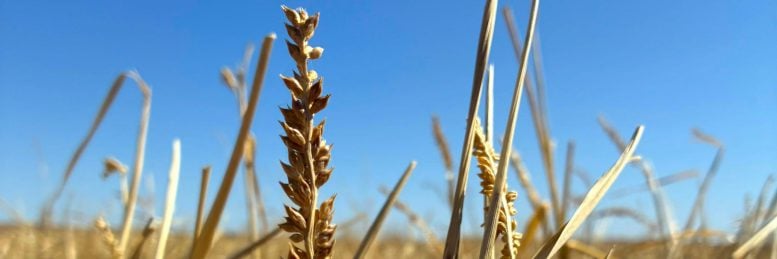
Channel millet grows more than a meter tall. A robust grass, it flourishes after flooding, forming extensive fields of waving brown seedheads. At such times in the past, it was an important food source for Aboriginal people.
The explorer Augustus Gregory came upon “fields of 1,000 acres of millet” on the Cooper Creek floodplain in 1884 and described people cutting the stalk halfway up. Early pastoralist and writer Alice Duncan-Kemp described the processing of “ugar” or “egar” (grass seeds resembling canary seeds) by Aboriginal women on the Diamantina River.
A Genome With 12 Chromosome Copies
We first sequenced the DNA in the channel millet. When we analyzed the genome, we found it to be highly complex. While humans and many plants have two copies of each chromosome (one from the father and one from the mother), this plant has 12 copies of each chromosome.
This is called polyploidy, in which an organism acquires multiple sets of chromosomes, typically through accidents of reproduction or through hybridization.
Large numbers of copies of each chromosome are common in domesticated crops such as wheat, rice, and sugarcane. It’s not a smoking gun for domestication; in fact, natural polyploidy has been occurring for millions of years through the processes of chromosome duplication and hybridization.
People, however, have greatly accelerated and exploited the process, sometimes accidentally, but in more recent history deliberately, inducing chromosome doubling to produce crops with larger fruits, greater vigor, and improved resilience.
Genetics Built for Flood and Drought
This novel genetic pattern may explain how this plant survives the bust and boom environment in which it grows. Populations of channel millet are decimated during extended dry periods. But they survive as underground seeds that germinate rapidly in periods when floodwaters flow across the region.
Multiple copies of each chromosome may help these populations endure the dramatic fluctuations of life in the Channel Country. Like the hybrid crops prized by farmers, plants with extra chromosome sets can be especially vigorous, giving them a genetic toolkit that helps them survive and thrive in an unpredictable environment.
Signs of Human Selection
Natural selection may not be the only force that has contributed to the evolution of such unusual genetics.
This plant has large seeds, making it an attractive food source. Like other grass species such as wheat, rice, and corn that have been domesticated by people in the past, it also shows little shattering (shedding of the mature seed). This means it is quite efficient to harvest, with seeds remaining attached to the plant at harvest.
Human harvest, storage, and consumption may have contributed to the evolution of this unique plant. Harvest will have favored large seeds that did not shatter.
Human consumption may have contributed to population bottlenecks in the ancestors of modern channel millet, while storage may have ensured the survival of at least some seeds during extended dry periods. Studies of population variation and other species in the area will be needed to better define these impacts.
Reconstructing Thousands of Years of Cultivation
Today, Mithaka people are keen to learn more about plants such as channel millet and how past human interactions with these species may inform knowledge for future foods.
Our future research will link plant genetics with evidence from ancient fireplaces and shell midden sites, plant residues from grinding stones, and pollen cores from waterholes, targeting specific landscapes in Mithaka country.
Combined with Indigenous knowledge, this research will help build a clearer picture of how Mithaka people actively shaped—and were shaped by—the vegetation communities around them over thousands of years.
Reference: “Genome analysis of Channel millet reveals a wild dodecaploid shaped by environmental variability” by Rahul Chandora, Agnelo Furtado, Lena Constantin, Jennifer Silcock, Michael C. Westaway and Robert J. Henry, 30 May 2026, Nature Communications.
DOI: 10.1038/s41467-026-73794-7
Michael Westaway receives funding from the Australian Research Council.
Jennifer Silcock receives funding from the Queensland Government (Department of Environment, Tourism, Science, and Innovation) and the Australian Research Council.
Rahul Chandora receives funding from the ARC Centre of Excellence for Plant Success in Nature and the Indian Council of Agricultural Research
Robert Henry receives funding from the ARC Centre of Excellence for Plant Success in Nature and Agriculture and the ARC Research Hub for Engineering Plants to Replace Fossil Carbon.
Shawnee Gorringe works for Mithaka Aboriginal Corporation & The University of Queensland.
Adapted from an article originally published in The Conversation. 
Never miss a breakthrough: Join the SciTechDaily newsletter.
Follow us on Google and Google News.
2 Comments
These findings are not the least surprising. At the Madjedbebe rock shelter, dated at 65,000 years BP, the remains of a grindstone for grass seed were found. You only make flour to bake and hence make bread. All over the continent when Europeans arrived Aboriginal people harvested and ground grass seed, even using different methods to leaven the flour and bake risen bread or cakes. They traded packets of favored grass seed with neighboring groups and spread the many varieties. How could this have been going on for so long without selection and alteration occurring? The entire continent was geo-engineered to produce a landscape of maximum productivity and ecological variety and the vegetation of the whole continent had been changed in very fine, planned detail. All this has been destroyed by the crudeness of European farming.
A native Australian millet may carry.
Emphasis on the word “may”.
Pure conjecture trying to rewrite what really happened…. not much at all.