
Close Menu
    Facebook X (Twitter) Instagram
    SciTechDaily
    • Biology
    • Chemistry
    • Earth
    • Health
    • Physics
    • Science
    • Space
    • Technology
    Facebook X (Twitter) Pinterest YouTube RSS
    SciTechDaily
    Home»Science»Archaeologists Discover Clues to Early Domestication in Wild Boars
    Science

    Archaeologists Discover Clues to Early Domestication in Wild Boars

    By CNRSMarch 3, 20201 Comment3 Mins Read
    Facebook Twitter Pinterest Telegram LinkedIn WhatsApp Email Reddit
    Share
    Facebook Twitter LinkedIn Pinterest Telegram Email Reddit
    Deformation of the Calcaneus
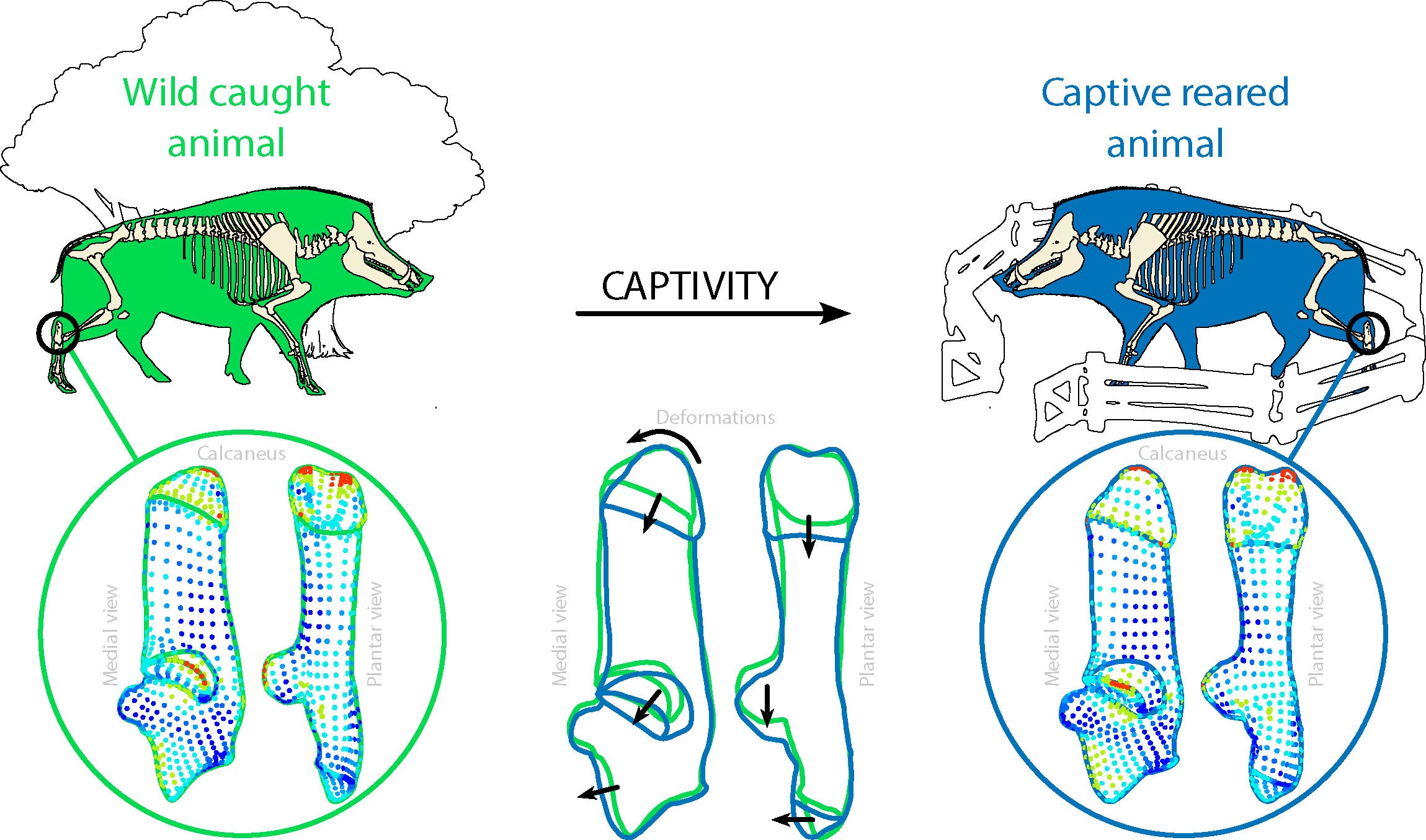
    Deformation of the calcaneus (tarsal bone) in wild boars reared in captivity compared to wild boars in their natural environment. The colored dots indicate the degree of deformation (minimum in dark blue, maximum in red). The deformations are mainly related to an elongation of the muscle insertion area in the highest part of the bone. Credit: Hugo Harbers / AAPSE / CNRS-MNHN

    Until now, archaeozoologists have been unable to reconstruct the earliest stages of domestication: the process of placing wild animals in captivity remained beyond their methodological reach.[1]

    Using the wild boar as an experimental model, a multidisciplinary team made up of scientists from the CNRS and the French National Museum of Natural History[2] have shown that a life spent in captivity has an identifiable effect on the shape of the calcaneus, a tarsal bone that plays a propulsive role in locomotion.

    Being relatively compact, this bone is well preserved in archaeological contexts, which makes it possible to obtain information about the earliest placing of wild animals in captivity. This modification is caused by changes in the animal’s lifestyle, since the bone is reshaped as a result of its movement, the terrain, and muscle stress. The scientists observed that the shape of the calcaneus was mainly modified in the area of muscle insertions: contrary to what might be expected, captive wild boars displayed greater muscle force than wild boars in their natural environment.

    It appears that a captive lifestyle turned them from “long-distance runners” into “bodybuilders.” As well as providing archaeologists with a new methodology, these findings show the speed with which morphological changes can occur when an animal is taken out of its natural environment by humans, and could prove useful in programs reintroducing captive-bred animals into the wild. These results are published in the journal Royal Society Open Science dated March 4, 2020.

    Reference: “The mark of captivity: plastic responses in the ankle bone of a wild ungulate (Sus scrofa)” by Hugo Harbers, Dimitri Neaux, Katia Ortiz, Barbara Blanc, Flavie Laurens, Isabelle Baly, Cécile Callou, Renate Schafberg, Ashleigh Haruda, François Lecompte, François Casabianca, Jacqueline Studer, Sabrina Renaud, Raphael Cornette, Yann Locatelli, Jean-Denis Vigne, Anthony Herrel and Thomas Cucchi, 4 March 2020, Royal Society Open Science.
    DOI: 10.1098/rsos.192039

    Notes

    1. Genetic modifications, as well as morphological traits common to domestic animals, such as reduced size, slenderness, etc, appear after many generations, as a result of behavioral or breeding selection for traits valuable to humans.
    2. This study primarily involved the following laboratories: Archéozoologie, archéobotanique : sociétés, pratiques et environnements (CNRS/MNHN), Réserve zoologique de la Haute Touche (MNHN), Adaptative mechanisms and evolution (CNRS/MNHN), Institut de systématique, évolution, biodiversité (CNRS/MNHN/Sorbonne Université/EPHE).

    Never miss a breakthrough: Join the SciTechDaily newsletter.
    Follow us on Google and Google News.

    Agriculture Archaeology CNRS Paleontology
    Share. Facebook Twitter Pinterest LinkedIn Email Reddit

    Related Articles

    First Tales of the Earliest Domesticated Goats Revealed by 10,000-Year-Old DNA

    Jebel Sahaba: Analysis of Bones Reveals a Succession of Violence Rather Than a Prehistoric War

    Paleontologists Identify a New Species of Ancient Whale

    Paleontologists Provide New Perspective on Triassic Period, Emergence of Dinosaurs

    Paleontologists Identify a New Species of Prehistoric Reptile, Colobops Noviportensis

    Paleontologists Discover Never-Before-Seen Ancient Fish Species

    Archaeologists Discover Oldest Known Funereal Fish Hooks

    Neolithic Pottery Reveals Cheese-Making from 7,500 Years Ago

    27-Foot Long Crocodylus Thorbjarnarsoni Roamed Kenya

    1 Comment

    1. Ronald L Grube on March 4, 2020 1:38 pm

      We know what it does to insects, what does and has do to humans. I have been exposed sence I was a child in the 50s. I’m not to good any more.

      Reply
    Leave A Reply Cancel Reply

    • Facebook
    • Twitter
    • Pinterest
    • YouTube

    Don't Miss a Discovery

    Subscribe for the Latest in Science & Tech!

    Trending News

    The Universe Is Expanding Too Fast and Scientists Can’t Explain Why

    “Like Liquid Metal”: Scientists Create Strange Shape-Shifting Material

    Early Warning Signals of Esophageal Cancer May Be Hiding in Plain Sight

    Common Blood Pressure Drug Shows Surprising Power Against Deadly Antibiotic-Resistant Superbug

    Scientists Uncover Dangerous Connection Between Serotonin and Heart Valve Disease

    Scientists Discover a “Protector” Protein That Could Help Reverse Hair Loss

    Bone-Strengthening Discovery Could Reverse Osteoporosis

    Scientists Uncover Hidden Trigger Behind Stem Cell Aging

    Follow SciTechDaily
    • Facebook
    • Twitter
    • YouTube
    • Pinterest
    • Newsletter
    • RSS
    SciTech News
    • Biology News
    • Chemistry News
    • Earth News
    • Health News
    • Physics News
    • Science News
    • Space News
    • Technology News
    Recent Posts
    • Scientists Overcome Major Quantum Bottleneck, Potentially Transforming Teleportation and Computing
    • Quantum Physics’ Strangest Problem May Hold the Key to Time Itself
    • Scientists Create “Liquid Gears” That Spin Without Touching
    • The Simple Habit That Could Help Prevent Cancer
    • Forgotten Medicinal Plant Shows Promise in Fighting Dangerous Superbugs
    Copyright © 1998 - 2026 SciTechDaily. All Rights Reserved.
    • Science News
    • About
    • Contact
    • Editorial Board
    • Privacy Policy
    • Terms of Use

    Type above and press Enter to search. Press Esc to cancel.