
‘Lost Crops’ Could Have Fed As Many as Maize
Make some room in the garden, you storied three sisters: the winter squash, climbing beans and the vegetable we know as corn. Grown together, newly examined “lost crops” could have produced enough seed to feed as many indigenous people as traditionally grown maize, according to new research from Washington University in St. Louis.
But there are no written or oral histories to describe them. The domesticated forms of the lost crops are thought to be extinct.
Writing in the Journal of Ethnobiology, Natalie Mueller, assistant professor of archaeology in Arts & Sciences, describes how she painstakingly grew and calculated yield estimates for two annual plants that were cultivated in eastern North America for thousands of years — and then abandoned.
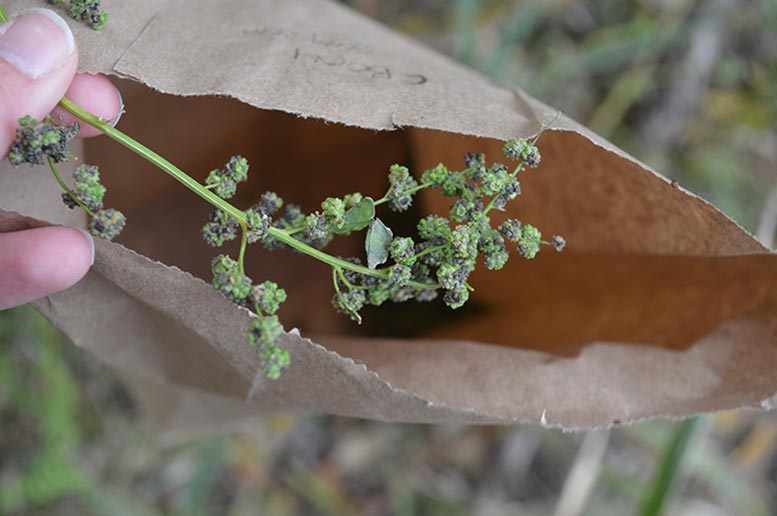
Growing goosefoot (Chenopodium sp.) and erect knotweed (Polygonum erectum) together is more productive than growing either one alone, Mueller discovered. Planted in tandem, along with the other known lost crops, they could have fed thousands.
Archaeologists found the first evidence of the lost crops in rock shelters in Kentucky and Arkansas in the 1930s. Seed caches and dried leaves were their only clues. Over the past 25 years, pioneering research by Gayle Fritz, professor emerita of archaeology at Washington University, helped to establish the fact that a previously unknown crop complex had supported local societies for millennia before maize — a.k.a. corn — was adopted as a staple crop.
But how, exactly, to grow them?
The lost crops include a small but diverse group of native grasses, seed plants, squashes and sunflowers — of which only the squashes and sunflowers are still cultivated. For the rest, there is plenty of evidence that the lost crops were purposefully tended — not just harvested from free-living stands in the wild — but there are no instructions left.
“There are many Native American practitioners of ethnobotanical knowledge: farmers and people who know about medicinal plants, and people who know about wild foods. Their knowledge is really important,” Mueller said. “But as far as we know, there aren’t any people who hold knowledge about the lost crops and how they were grown.
“It’s possible that there are communities or individuals who have knowledge about these plants, and it just isn’t published or known by the academic community,” she said. “But the way that I look at it, we can’t talk to the people who grew these crops.
“So our group of people who are working with the living plants is trying to participate in the same kind of ecosystem that they participated in — and trying to reconstruct their experience that way.”
That means no greenhouse, no pesticides, and no special fertilizers.
“You have not just the plants but also everything else that comes along with them, like the bugs that are pollinating them and the pests that are eating them. The diseases that affect them. The animals that they attract, and the seed dispersers,” Mueller said. “There are all of these different kinds of ecological elements to the system, and we can interact with all of them.”
Her new paper reported on two experiments designed to investigate germination requirements and yields for the lost crops.
Mueller discovered that a polyculture of goosefoot and erect knotweed is more productive than either grown separately as a monoculture. Grown together, the two plants have higher yields than global averages for closely related domesticated crops (think: quinoa and buckwheat), and they are within the range of those for traditionally grown maize.
“The main reason that I’m really interested in yield is because there’s a debate within archeology about why these plants were abandoned,” Mueller said. “We haven’t had a lot of evidence about it one way or the other. But a lot of people have just kind of assumed that maize would be a lot more productive because we grow maize now, and it’s known to be one of the most productive crops in the world per unit area.”
Mueller wanted to quantify yield in this experiment so that she could directly compare yield for these plants to maize for the first time.
But it didn’t work out perfectly. She was only able to obtain yield estimates for two of the five lost crops that she tried to grow — but not for the plants known as maygrass, little barley and sumpweed.
Reporting on the partial batch was still important to her.
“My colleagues and I, we’re motivated from the standpoint of wanting to see more diverse agricultural systems, wanting to see the knowledge and management of indigenous people recognized and curiosity about what the ecosystems of North America were like before we had this industrial agricultural system,” Mueller said.
Reference: “Experimental Cultivation of Eastern North America’s Lost Crops: Insights into Agricultural Practice and Yield Potential” by Natalie G. Mueller, Andrea White and Peter Szilagyi, 20 December 2019, Journal of Ethnobiology.
DOI: 10.2993/0278-0771-39.4.549
Never miss a breakthrough: Join the SciTechDaily newsletter.
Follow us on Google and Google News.