

Silphium was an extinct Libyan plant renowned for contraception, medicine, and trade. Its disappearance remains a historical mystery, and scientists continue searching for surviving descendants.
Roman leader Julius Caesar is said to have kept a stock of it in the treasury. Ancient writer Pliny the Elder says Rome’s Emperor Nero owned the last stalk of it.
And some have suggested rampant extramarital sex in elite Roman circles led to demand outstripping supply, and it dying out altogether.
What is it?
Silphium: an extinct plant that once grew wild in modern-day Libya.
Used for contraception and abortion, medicine, food seasoning, perfume, and as a livestock improver, its special properties made this herb one of the most precious commodities in Graeco-Roman antiquity.
Then, one day, it went extinct.
What Did Silphium Really Look Like?
Silphium is often described these days as an aphrodisiac, despite no ancient source confirming this.
Some of the earliest depictions of silphium are of the plant’s heart-shaped seedpod, which may be the source of this association.
Depictions on coins and figurines have led modern botanists to wonder if silphium was related to modern wild giant fennels (from the genus Ferula). (It’s not related to plants of the genus Silphium, such as compass-plant and rosinweed, in North America).
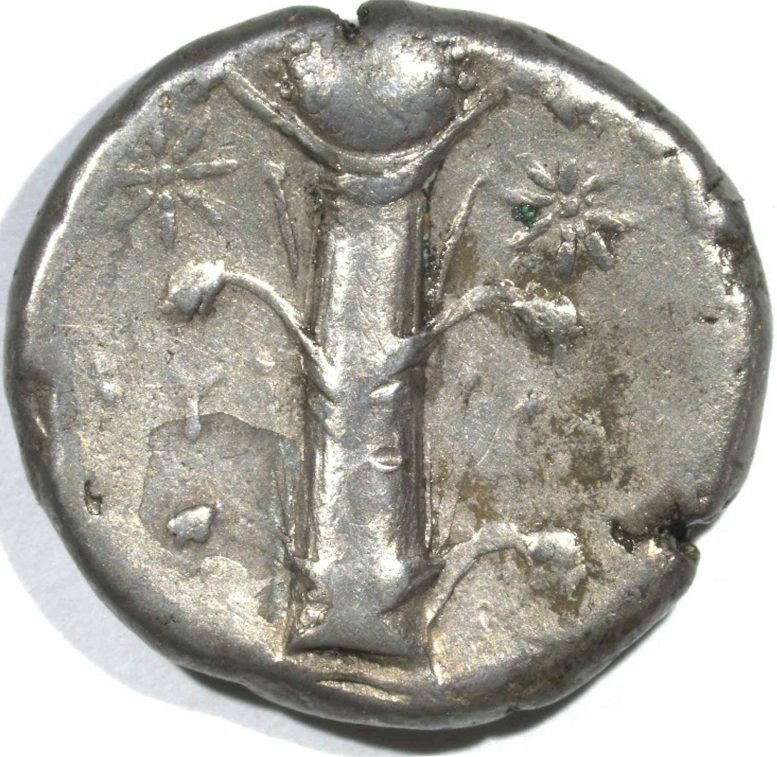
Depictions of silphium next to gazelles (another product of Libya) suggest typical ancient silphium stalks were around 30 cm in height.
Resin was extracted from the plant’s stems and roots and preserved in flour, which allowed it to make the journey from Libya to further shores.
How Silphium Fueled Ancient Economies
The Romans called this resin “laser” or “laserpicium.” The best laserpicium was extracted from the root, but an inferior type could also come from the stem.
And before the Romans, the Greeks also used silphium; it was so central to some regional economies that it was a frequently depicted motif on coins.
The Greeks seemingly did not harvest silphium themselves; they were given it as tribute by Libyan tribes who lived with it and knew how to harvest and prepare it.
The Greeks of those regions capitalized on and exploited this indigenous knowledge, creating and fulfilling a market for this product. This pattern of extracting and profiting from the local knowledge of indigenous peoples is still a feature of the modern globalized economy.
Silphium in Ancient Medicine and Contraception
Silphium is frequently mentioned in ancient medical treatises and was often administered through food. The modern distinction between food and medicine was not as pronounced in antiquity as it is today; curatives were frequently added to simple dishes such as lentil porridge.
In Ancient Graeco-Roman medicine, silphium was considered a “windy” food that could clear the body of obstructions causing ill health. “Windy” foods were also thought to prevent conception and ensure miscarriage (depending on when they were administered).
Soranus of Ephesus’s four-volume text on gynecology, written around the 1st-2nd century CE, suggests various strong-tasting herbs and spices (including silphium) could be mixed with wine or simple foods for oral contraception. Soranus notes oral contraceptives frequently caused upset stomachs.
Preventive suppository suggestions by Soranus include smearing the cervix with substances such as old olive oil, honey, resin, balsam, white lead, myrtle oil, moistened alum, galbanum resin (a silphium relative used in perfume), and a lock of fine wool. These were not drugs but had properties that could lessen the chance of conception by being antibiotic or spermicidal or providing a physical barrier.
Women’s Knowledge and Uncertain Effectiveness
Looking to the male-authored literature for evidence of women’s medicine is, of course, flawed. It is highly likely knowledge on pregnancy, contraceptives, and abortifacients was transferred between women, much of which did not make it into surviving ancient medical texts.
We have no proof of the efficacy of silphium as a contraceptive or abortive agent, as we don’t have any to test.
Silphium resisted human cultivation, and as such, there was a finite supply. The financial value of silphium (and state control over it) seemed to be a bone of contention among local populations, and by the Roman period, there were reports of vandalism and local farmers bringing livestock to graze on it.
Climatic changes and the desertification of the north coast of Africa may have led to the plant’s extinction. While the Romans believed silphium was extinct in the 1st century CE, it may have continued in local use and consumption until the 5th century CE.
There have been multiple attempts to identify remnant pockets of silphium in the modern world, but scholars cannot agree on a single surviving plant. Silphium may have been a hybrid plant that reproduced asexually (making it hard to cultivate and vulnerable).
The Search for Silphium’s Modern Descendants
In 2021, a new species of giant fennel (Ferula drudeana) was identified around former Greek settlements in Anatolia (modern-day Turkey).
It looks much like the ancient depictions of silphium; it may be that seeds from Libya reached Turkey and survived to the present.
However, until we find evidence of the seeds of ancient silphium in securely dated archaeological deposits, we will not be able to test this hypothesis.
Many species of giant fennel occur across the Mediterranean and surrounding regions, but due to many outlets falsely reporting its aphrodisiac qualities (particularly for treating erectile dysfunction), there are growing conservation concerns about modern over-harvesting.
Adapted from an article originally published in The Conversation.
Never miss a breakthrough: Join the SciTechDaily newsletter.
Follow us on Google and Google News.
1 Comment
The ancient plant Silphium, thought to be extinct for over 2,000 years, has been rediscovered in Turkey by researcher Mahmut Miski, who believes he has found its modern analog, Ferula Drudeana