
Tutankhamun’s 1925 examination left behind evidence that official accounts largely omitted. A closer look at the records reveals a troubling gap between scientific history and what actually happened.
November 2025 marks 100 years since archaeologists first examined Tutankhamun’s mummified remains. What followed wasn’t scientific triumph—it was destruction. Using hot knives and brute force, Howard Carter’s team decapitated the pharaoh, severed his limbs, and dismembered his torso. Then they covered it up.
Tutankhamun’s tomb was first discovered in the Valley of the Kings by a team of mostly Egyptian excavators led by Howard Carter in November 1922. However, it took several years for the excavators to clear and catalog the tomb’s antechamber—the first part of what would become a decade-long excavation.
This meticulous work, as well as delays caused by friction between Carter and the Egyptian government, meant that it wasn’t until 1925 that Tutankhamun’s remains were uncovered. This milestone whipped up another wave of what has been termed “Tutmania” after the tomb’s initial discovery generated a wave of popular fascination for Egyptian archaeology.
When Resin Trapped the Pharaoh
When Carter’s team eventually opened Tutankhamun’s innermost coffin, they found the pharaoh’s body fused to the casket by a hardened, black, pitch-like substance. This resin was poured over the wrappings during burial to protect the body from decay.
Carter described the corpse as “firmly stuck” and noted that “no amount of legitimate force” could free it. In a desperate attempt to soften the resin and remove the body, the coffin was exposed to the heat of the sun. When this failed, the team resorted to hot knives, severing Tutankhamun’s head and funerary mask from his body in the process.
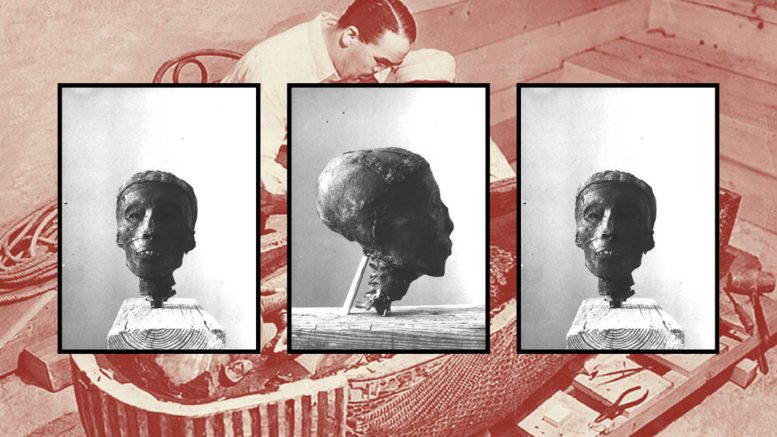
The autopsy that followed was devastating. Tutankhamun was left “decapitated, his arms separated at the shoulders, elbows, and hands; his legs at the hips, knees, and ankles; and his torso cut from the pelvis at the iliac crest.” His remains were later glued together to simulate an intact body—a macabre reconstruction that concealed the violence of the process.
The Evidence Carter Left Out
Egyptologist Joyce Tyldesley has pointed out that this destruction is conspicuously absent from Carter’s public account of the autopsy. It is also absent from his private excavation records, which are available at the University of Oxford’s Griffith Institute and online.
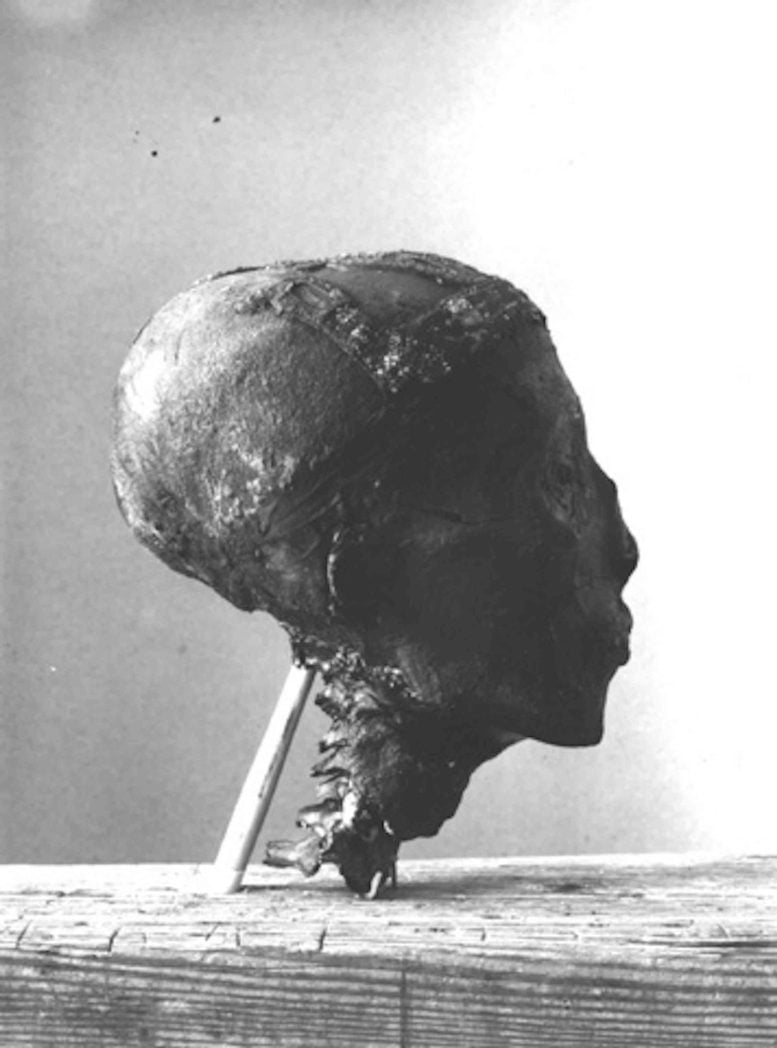
Tyldesley suggests that Carter’s silence may reflect either a deliberate cover-up or a respectful attempt to preserve the dignity of the deceased king. His omissions, however, were documented in photos by the archaeological photographer Harry Burton. These shots offer a stark visual record of the dismemberment.
In some of Burton’s images, Tutankhamun’s skull is visibly impaled to keep it upright for photography. These images sit in grim contrast to the one Carter chose for the second volume of his work detailing the excavations, The Tomb of Tut-Ankh-Amen, published in 1927. In this sanitized image, the pharaoh’s head is wrapped in fabric, concealing the severed spinal column, presenting a more palatable view for public consumption.
Archaeology’s Darker Legacy
As we reflect on the centenary of this examination, it is worth reconsidering the legacy of Carter’s excavation, not just as a landmark in Egyptology, but as a moment of ethical reckoning. The mutilation of Tutankhamun’s body, obscured in official narratives, invites us to challenge narratives of archaeological triumph and to look back on the past with a more critical view.
“Today has been a great day in the history of archaeology,” Carter wrote in his excavation diary on November 11, 1925, when the medical examination of Tutankhamun’s remains began. But the archival evidence suggests something far more morally complicated, even grisly, lying behind the seductive glint of gold.
Adapted from an article originally published in The Conversation.
Never miss a breakthrough: Join the SciTechDaily newsletter.
Follow us on Google and Google News.
3 Comments
What a surprise. No wonder the curse followed them to their graves.
Is any of this ethical?? When a person plans for their death they have a process/location in mind and trust that their wishes will be honored. Whether they want a cremation or burial or whatever, the person expects that to be their final resting place. And so do all their loved ones. In King Tut’s case, I’m guessing thousands of people’s wishes/plans/expectations were involved in his mummification and entombment. What right does anyone have to disturb that by excavating or preserving the body or doing an autopsy or putting body parts on display in a museum? If I knew that that is what would happen to my remains after I die, I’d be horrified. Absolutely horrified and enraged.
Imagine if your own severed desiccated head, looking really nothing like you, ended up on display being photographed and studied so that archeologists can make a name for themselves. When all you wanted was to rest in peace in your chosen location.
Didn’t matter to him as he was long dead.