
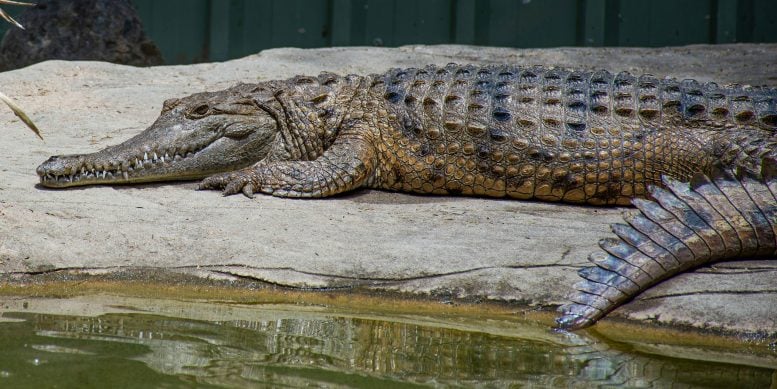
New research uncovers a lost world of strange crocodile relatives that once thrived across Australasia alongside early humans.
The sight of a saltwater crocodile basking on a mudbank is one of the most iconic and intimidating images of northern Australia. Yet the crocodiles that inhabit the region today are just the survivors of a much richer and stranger lost world.
Until recently, Australasia was home not just to the familiar crocodiles found in tropical waterways, but also to a unique cast of crocs unlike any living species.
Our recent review of evidence from the past 129,000 years reveals a dramatic story of extinctions, human encounters, and survival against the odds.
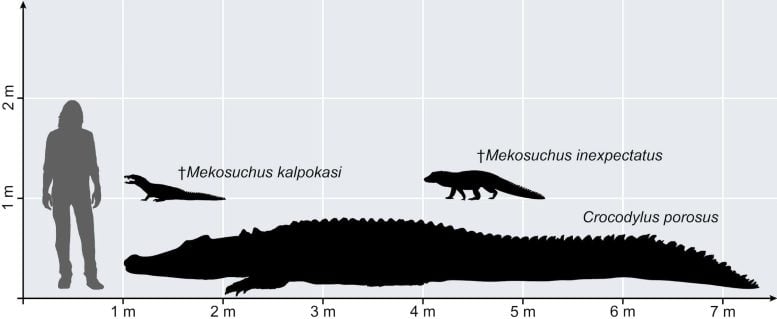
Modern crocodiles are members of the genus Crocodyls, but an entirely different group of crocodylians, known as mekosuchines, once dominated the region.
Mekosuchines: The Ancient Crocodile Rulers
For more than 50 million years, mekosuchines were the apex predators of Australasia. Some even survived to meet humans.
These remarkable animals came in an astonishing variety of shapes and sizes, inhabiting many different environments.
Some were giant semi-aquatic ambush predators, much like the saltwater crocodiles that still patrol northern rivers today. Others were much smaller “dwarf” species that inhabited islands such as New Caledonia. Most terrifyingly, some species possessed blade-like serrated teeth and probably hunted their prey on land.
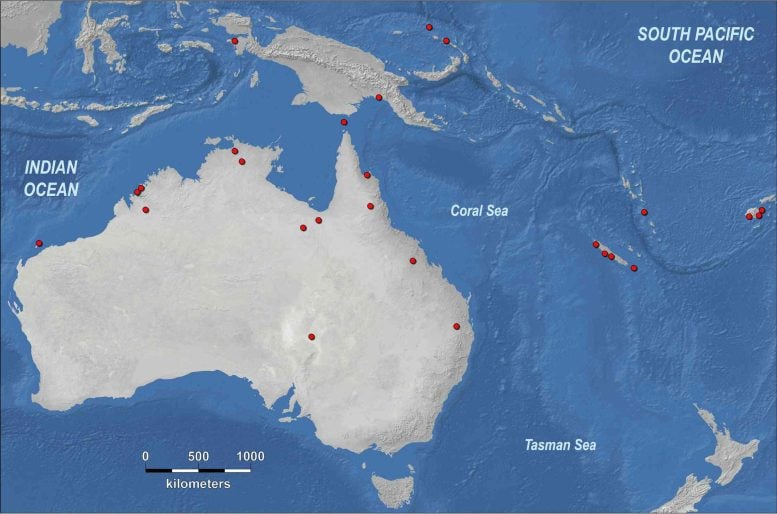
We pieced together a record of crocodylians over the past 129,000 years from scattered and highly fragmentary remains recovered from more than 20 archaeological and palaeontological sites.
Fossils, Rock Art, and Human Coexistence
Most are located in Australia, though some are found in New Guinea, and a handful more across the southwest Pacific. At archaeological sites on the Australian mainland, as well as in the Torres Strait and New Guinea, researchers have uncovered the broken bones and teeth of modern crocodile species, showing that these formidable reptiles have shared landscapes with people for thousands of years.
Ancient rock art, some dating back around 20,000 years, reveals that Indigenous Australians were closely observing and depicting these animals for millennia. The distribution of archaeological remains and rock art closely mirrors the modern ranges of crocodiles today. This points to a long and relatively stable coexistence between humans and these powerful predators.
Archaeological evidence shows that humans did occasionally eat crocodiles, and sometimes even crafted pendants from their teeth. Yet such discoveries are quite rare. When ancient archaeological sites do yield crocodile bones, there are usually only a handful of them.
The evidence suggests crocodiles were hunted only rarely. This is not surprising.
Adult saltwater crocodiles are enormous, immensely powerful, and highly lethal to humans. For ancient communities, engaging with these apex predators would have been a hazardous undertaking, and something mostly avoided.
The Mystery of Australia’s Extinct Crocs
But modern crocodiles weren’t alone in these ancient landscapes. Fossils show they shared them with the mekosuchines.
On mainland Australia, mekosuchines are currently only known from fossils. Most remains date from more than 40,000 years ago. We currently have no evidence of these extinct crocs from archaeological sites or in ancient rock art.
We don’t know if humans and mekosuchines ever directly interacted in Australia. Their disappearance occurred around the same time as the extinction of other Australian megafauna, potentially after a long period of coexistence with humans. The exact cause of their demise in Australia remains a mystery.
However, the story is different on the islands of New Caledonia, Vanuatu and Fiji. There, some mekosuchine species managed to survive into much more recent times. And humans almost certainly encountered them directly.
Island Dwarf Crocodiles and Human Arrival
The extinct crocs of New Caledonia and Vanuatu were small, reaching less than two metres in length as adults. They also likely lived more on land than today’s semi-aquatic crocodiles. Their small statures and terrestrial lives would have made them far more accessible for human hunters.
Tragically, the known record of these island mekosuchines ends within a few centuries of human settlement. In several cases, their remains were found in association with human artefacts and middens.
In one example from Vanuatu, a mekosuchine limb bone appears to bear the gnaw marks of a rat, an invasive species introduced to the island by humans. While definitive proof is elusive, it seems likely that direct or indirect human involvement may be the reason for the disappearance of these “dwarf” island crocodylians.
Crocodile Extinctions and Conservation Lessons
We are now living through the Anthropocene, an age when humans are profoundly influencing the planet and extinctions are accelerating, as is particularly evident in Australia.
The prehistoric past is not just a record of vanished worlds, but a warning for the future. Understanding how apex predators like crocodiles responded to past climatic changes, environmental upheaval, and human impacts provides important clues for their conservation in the future.
To truly unravel these questions will take the combined work of paleontologists, archaeologists, ecologists, and conservationists. Just as crucial will be deep engagement with Indigenous knowledges and land managers, whose long histories of observing and living alongside these animals offer clues for protecting the world’s remaining crocodiles, and the threatened ecosystems they inhabit.
Reference: “The late Quaternary crocodylian record from Australasia” by Jorgo Ristevski, Julien Louys, Sue O’Connor, Adam M Yates, Molly Husdell, Gilbert J Price, Sean Ulm, Ian J McNiven, Steven W Salisbury and Nicole Boivin, 9 May 2026, Zoological Journal of the Linnean Society.
DOI: 10.1093/zoolinnean/zlag065
Adapted from an article originally published in The Conversation.
Never miss a breakthrough: Join the SciTechDaily newsletter.
Follow us on Google and Google News.